Beauty of Joseon vs Round Lab Sunscreen: Filters, Finish, Fit
Pull up the ingredient list for Beauty of Joseon's Relief Sun: Rice + Probiotics next to Round Lab's Birch Juice Moisturizing Sun Cream and twelve of the first thirteen ingredients run in the same order — Round Lab just lists Tinosorb M one slot earlier, ahead of niacinamide instead of after it. Same four UV filters, same base, same SPF50+ PA++++ on the label. Beauty of Joseon vs Round Lab sunscreen comparisons keep landing in the same two-way tie on forums for exactly that reason — the bottles look like they should perform identically, and mostly they don't.
Written for: dry-to-normal skin in a dry climate chasing a dewy finish, and oily or acne-prone skin in a humid one that wants sunscreen to disappear — standing in front of two nearly identical white bottles on an Olive Young shelf, or with both tabs open on Target.com, trying to work out whether the price gap buys anything real.

The Filters Are Nearly a Carbon Copy
Both formulas open with water, dibutyl adipate, propanediol, then the same four-filter stack: Diethylamino Hydroxybenzoyl Hexyl Benzoate (Uvinul A Plus), Ethylhexyl Triazone, Methylene Bis-Benzotriazolyl Tetramethylbutylphenol (Tinosorb M), and Diethylhexyl Butamido Triazone — in that exact sequence, per incidecoder's listing for Beauty of Joseon and for Round Lab. Neither brand states who manufactures its sunscreen, so whether that's one shared factory recipe or just the same off-the-shelf filter combo every mid-size Korean sunscreen brand buys is an open question, not something I can confirm from a label. What the label does tell you: you are not paying for a meaningfully different UV filter system between these two.
Where the Formulas Actually Split
Past that shared base, they diverge fast. Beauty of Joseon carries 30% rice extract, niacinamide, and a probiotic ferment complex — Lactobacillus/Pumpkin Ferment, Bacillus/Soybean Ferment, Monascus/Rice Ferment. Round Lab leans into birch sap at a labeled 1,425 ppm, sodium hyaluronate plus hyaluronic acid, dipotassium glycyrrhizate (licorice root), allantoin, and purslane and sweet wormwood extracts. On paper that reads as glow-and-brighten versus calm-and-hydrate. In practice, it's closer to the reverse of what the ingredient list suggests.
Yahoo Life writer Jennifer Romolini tested the Beauty of Joseon formula and described it absorbing "within literal seconds, leaving behind a slightly-dewy, but not at all greasy glow" — her full review is here. Aesthetic doctor Rachel Ho ran the Round Lab side and found it "dries fairly quickly to leave a weightless feel" with no white cast, but — despite the "moisturizing" in the name — wrote plainly that it "does not feel moisturising at all," flagging it as better suited to oily or acne-prone skin and recommending dry-skin users layer it over a proper moisturizer first. That's the opposite of what a birch-sap-and-hyaluronic-acid ingredient list would lead you to assume, and it's exactly the kind of gap between formulation and finish an INCI list alone won't tell you.
Neither brand discloses what percentage of that niacinamide or hyaluronic acid actually made it into the bottle. An INCI list tells you rank order, not concentration — "contains niacinamide" is a marketing checkbox as much as a formulation promise unless a brand states the number, and neither one does here.
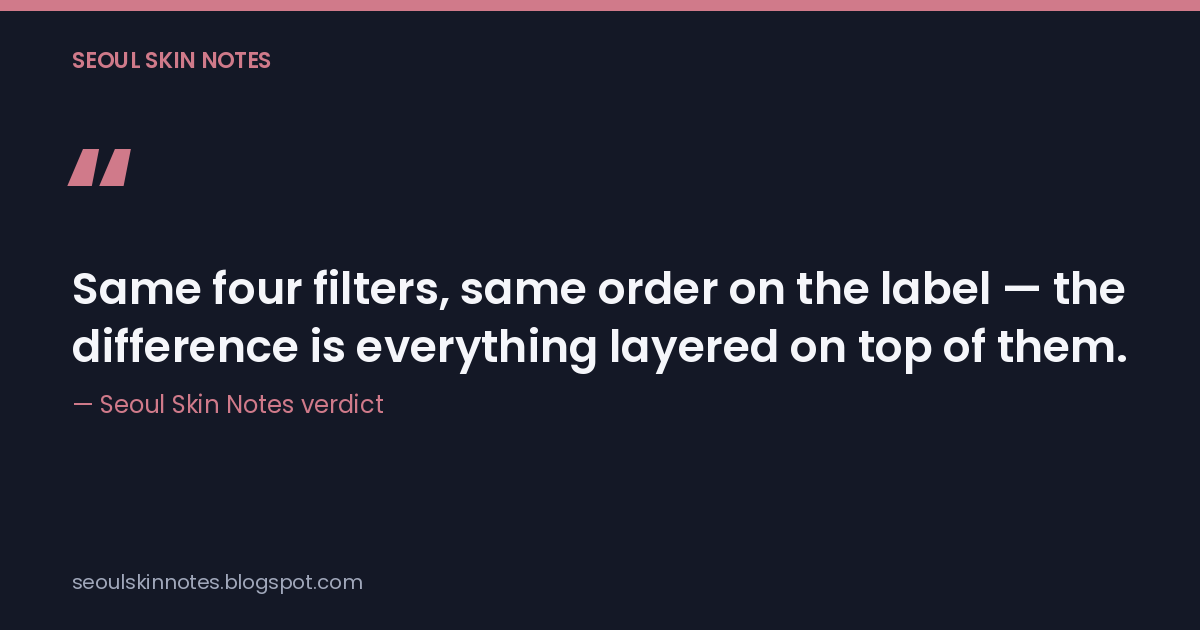
So: dry or combination skin chasing a dewy look has more reason to reach for Beauty of Joseon. Oily or acne-prone skin that wants a sunscreen to disappear, not to hydrate, has more reason to reach for Round Lab — and to add a separate moisturizer underneath if the season turns dry. If your routine already runs a barrier-focused moisturizer, Round Lab's drier finish stops being a downside and becomes the point: the moisturizer does the hydrating job underneath, so the sunscreen on top doesn't have to. Neither product is wrong about what it's for. They're just not interchangeable the way the shared filter list makes them look.
The US Versions Aren't the Same Sunscreen
The ingredient-list comparison above assumes you're buying the formula it's based on, and for one of these two brands, that assumption doesn't always hold. Round Lab's own US site sells a separate line called Birch Moisturizing Sunscreen UV Lock, and its Drug Facts panel on DailyMed lists Avobenzone 2.7%, Homosalate 13.5%, and Octisalate 4.5% as the active ingredients — the older FDA-monograph filter set, not Tinosorb M or Uvinul A Plus. Round Lab's official product page prices it at $24.99 (regularly $28) and labels it SPF45+, PA++++. Target carries the same UV Lock product for $24.99, though Target's own listing can't quite agree with itself — the title says SPF 45, the specifications box says SPF: 50. That's not a typo I'm making; it's what the page shows.
Beauty of Joseon's official US store, by contrast, still lists Relief Sun: Rice + Probiotics at the same SPF50+ PA++++ and the same Tinosorb-based formula sold in Korea, priced at $18. Buy Beauty of Joseon from its own site and you're getting the formula this whole comparison is about. Buy Round Lab from its own site or from Target, and you're getting a different sunscreen with a different, older filter system than the SPF50+ PA++++ version stocked by Korean-import retailers like StyleKorean. If you specifically want the Tinosorb-based Round Lab formula compared above, an import seller — not Round Lab's own US storefront — is where to find it.
There's a fast way to check before you buy: look for a PA rating on the box. The FDA's own sunscreen monograph doesn't include a PA category at all — it's a Korean and Japanese UVA-protection standard, not something US-regulated products carry. A box marked "PA++++" anywhere is the Tinosorb-based, Korea-market formula. A box that lists only "Broad Spectrum SPF 45" or "SPF 50" with no PA rating in sight is the FDA-monograph reformulation, whichever brand's name is on the front.
What a Bottle Actually Costs You
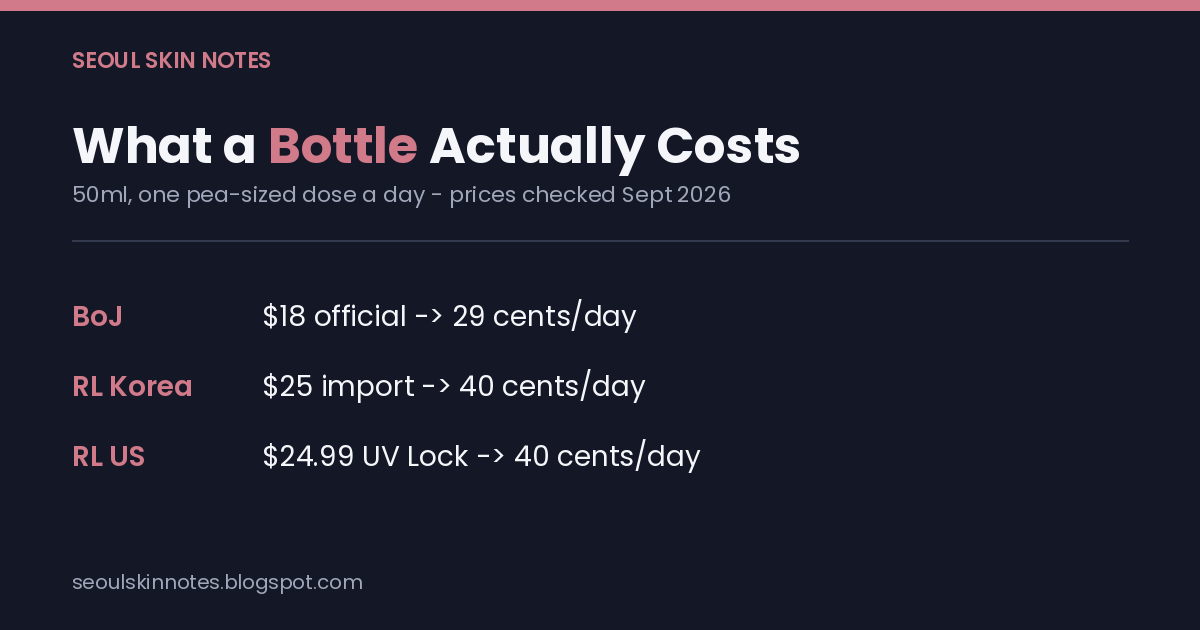
A pea-sized, roughly 0.8g dose for the face gets you about 62 applications out of a 50ml bottle — call it two months at once-a-day use, less if you're reapplying midday. Beauty of Joseon's Relief Sun runs $18 at its official US store, or $15.30 at import retailer Jolse as of this week, which works out to roughly 29 cents a day at full price. Round Lab's Korean-formula import runs $28 at StyleKorean as of this week — about 45 cents a day — while the US-market UV Lock version runs $24.99 on Round Lab's own site or at Target, closer to 40 cents a day. The Beauty of Joseon gap isn't huge in absolute terms, but over a year of daily use it's the difference between about $105 and roughly $150-165 depending on which Round Lab version you're buying, and you're not getting a different filter system for that extra money — you're getting more rice extract and probiotics instead of birch sap and licorice root.
I'd buy the Beauty of Joseon again for anything dry-to-normal wanting a dewy finish under makeup — the price and the independent review both back that up. I'd call Round Lab's Korean-formula version a fine pick, not a must-buy, unless oily or acne-prone skin specifically wants that drier finish; skip Round Lab's US UV Lock version if the whole reason you wanted this brand was the Tinosorb-based formula, since it isn't that. This is a two-product shortlist I picked because they're the two that keep coming up together — not a ranking of every Korean sunscreen worth $20.
Bought either one recently and gotten a different formula, a different price, or different packaging than what I've described here? Prices and reformulations move fast enough in this category that I'd genuinely like to know before the next update to this post.
This is a running news series, not a one-off post — new stories go up twice a day, roughly 7am and 7pm Korea time.
More Korea coverage from our network: Hallyu Now · Korea Travel Planner · K-Sports Global · Korean Table


Comments
Post a Comment