Skincare Ingredients Not to Mix: Vitamin C, Niacinamide, Retinol
Only one of the three most-feared ingredient pairings in skincare deserves the warning label everyone gives it. The other one has a real research trail behind the caution — it's just not the caution most people think it is.

The Myth That Won't Die: Vitamin C and Niacinamide
Somewhere along the way, "don't mix vitamin C and niacinamide" became one of those rules everyone repeats without a source. Healthline's medically reviewed guide traces it back to a specific, dated problem: dermatologist Dr. Meena Singh explains the concern comes from "outdated research using pure forms of niacinamide with ascorbic acid" that were "combined at a very high temperature and shown to form nicotinic acid, which can lead to skin irritation." Your bathroom shelf does not run at that temperature. At room temperature, in a modern stabilized formula, that reaction doesn't happen.
You can layer them. That same guide still says patch-test anything new and introduce it gradually, which is just sound practice for any active, not a special rule for this pair.
If you're picking two K-beauty serums to try this specific combination with, COSRX's The Niacinamide 15 Serum runs $25 for 20 mL as of September 2026, and lists niacinamide at 15% right in the ingredient panel, second item after water and a glycol. That's an honest concentration claim, not just a name on the label. For vitamin C, Beauty of Joseon's Light On Serum: Centella + Vita C is $17 for 30 mL on the brand's own US site as of the same month, and its ingredient list puts 3-O-Ethyl Ascorbic Acid right after water. No exact percentage is stated for it on the label, but the choice of derivative matters more than the number here. Plain L-ascorbic acid needs a low pH to stay stable and active, which is the one case where sequencing with other actives gets genuinely fussier. A derivative form like this one skips that problem, which is a big part of why K-beauty vitamin C serums lean on derivatives so often instead of the raw acid.

Does Vitamin C Cancel Out Retinol?
No, and this is the other myth worth killing off. Paula's Choice's own ingredient guide states plainly that "there is no problem with pairing vitamin C and retinol." It goes further: vitamin C's antioxidant action can help protect retinol from oxidizing, so the two hold up better together in the same routine than either does alone.
Where the caveat lands is timing, not chemistry. Dr. Dennis Gross's own guide recommends the simple split most dermatologists land on: vitamin C in the morning, under sunscreen, where its antioxidant job matters most; retinol at night, since it increases sun sensitivity and works best left alone to do its job overnight. You can layer both in the same routine if you want, but the AM/PM split isn't a workaround for some chemical conflict — it's just each ingredient doing its best work at the time of day it's suited for.
Retinol Plus Exfoliating Acids Is the One That Needs a Real Rule
Here's the pairing where the internet has the chemistry backwards. Per that same Paula's Choice guide, "there is no research that demonstrates that AHA / BHA exfoliants deactivate or lessen the effectiveness of retinol when used in the same routine." The two ingredients don't neutralize each other on contact the way people assume.
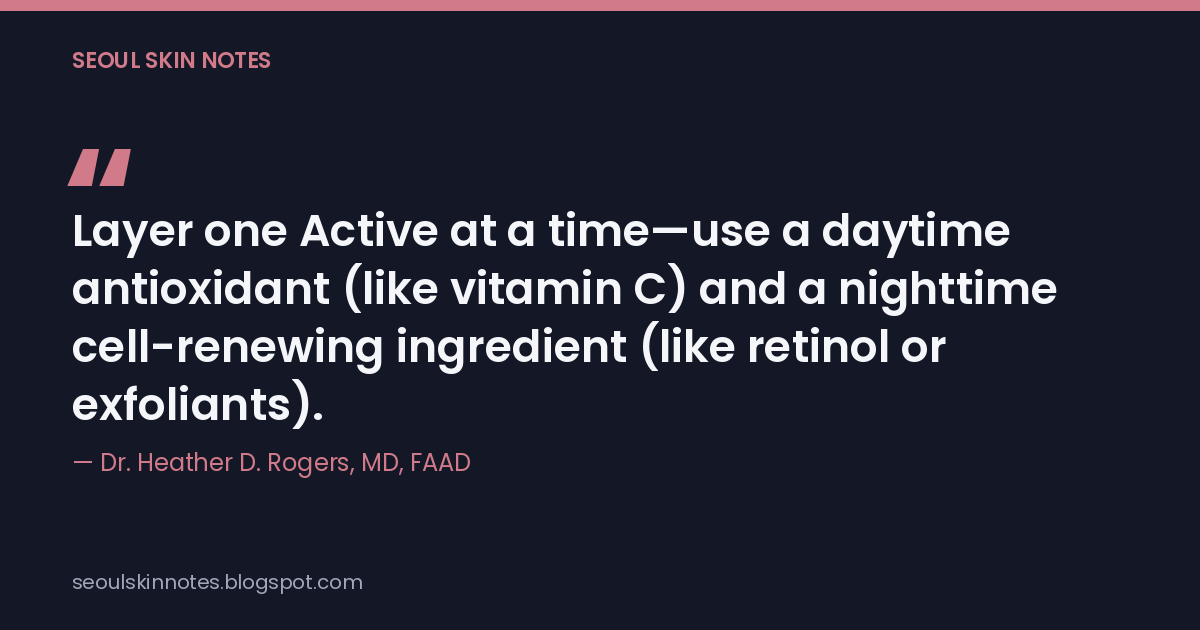
Your skin is the real problem, not the chemistry. Retinol and an AHA or BHA are both actives that increase cell turnover and thin the outer layer that normally buffers irritation. Stack two of them the same night and you raise your odds of redness, stinging, and flaking well before either one has finished its job. Dr. Heather D. Rogers, MD, FAAD, a double board-certified dermatologist, puts the general rule bluntly: "Layer one Active at a time — use a daytime antioxidant (like vitamin C) and a nighttime cell-renewing ingredient (like retinol or exfoliants)." Her recommended ceiling is two actives total, one for morning and one for night, and anything beyond that "do so slowly and observe your skin's reaction."
That means retinol and an AHA/BHA exfoliant belong on alternating nights, not the same one. Not because they cancel each other out. Because your barrier is the thing genuinely at risk if you don't. If you've been layering both nightly and wondering why your skin's been flaky and tight for two weeks, that's very likely the reason, not a bad batch of product.
The Bottom Line on Layering These Three
So the shortlist: vitamin C and niacinamide, fine, any time of day. Vitamin C and retinol, fine, ideally AM/PM split but not dangerous stacked. Retinol and an exfoliating acid, keep those on separate nights. That's the one rule here backed by a real skin-barrier mechanism rather than outdated chemistry.
If your routine already has a vitamin C serum and a niacinamide serum sitting side by side, stop rationing them across separate days out of habit. That habit isn't protecting anything. Save the rationing for retinol nights versus acid nights instead — that's the one place skipping a night genuinely protects your skin, rather than just following a rule nobody checked.
This is a running news series, not a one-off post — new stories go up twice a day, roughly 7am and 7pm Korea time.
More Korea coverage from our network: Hallyu Now · Korea Travel Planner · K-Sports Global · Korean Table


Comments
Post a Comment