Ten Snail Mucin Trials, None on a Korean Product
A 2025 systematic review went looking for every human trial of snail-derived skincare published in English and came back with ten. I read its table row by row on September 20, 2026 (KST). Every intervention in that table that names a species names the same one, Cryptomphalus aspersa, and the two trials I read most closely both tested products made by the same Spanish manufacturer.
If you have seen "clinically proven" printed near a snail mucin bottle and wondered which clinic, how many people and for how long, those three questions have answers. They are just smaller answers than the phrase implies.
Fabi 2013 treated half of each face
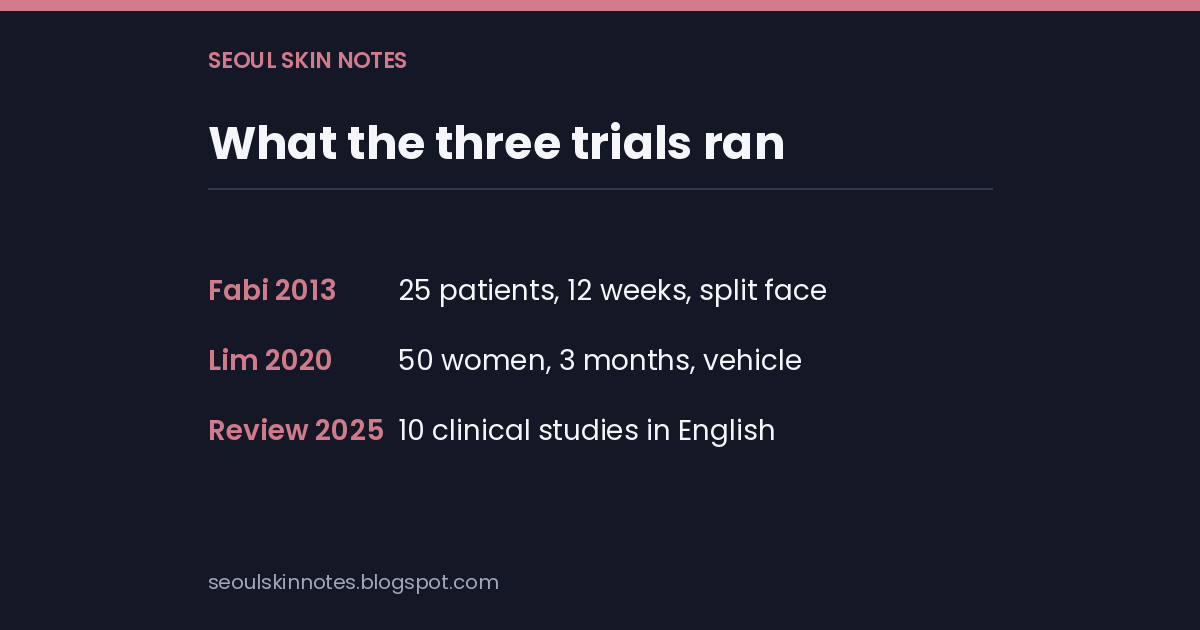
Fabi and colleagues, Journal of Drugs in Dermatology, April 2013 describe "a 2-center, double-blind, randomized, 14-week study in which 25 patients with moderate to severe facial photodamage were treated." The treatment was an emulsion at 8% SCA and a liquid serum at 40% SCA on one side of the face, placebo on the other, for twelve weeks. Silicone impressions of the periocular wrinkles were taken at baseline and at twelve weeks.
The result the abstract leads with reads "Periocular rhytides on the active ingredient side showed significant improvement after 12 weeks (P=.03)."
The sentence at the very end of the same abstract is less convenient for a product page. Subjects "noted a significant degree of improvement in fines lines at the 8-week time point on the SCA-treated side (P≤.05) but did not report a significant difference in the quality of their skin." After twelve weeks of a 40% serum, the subjects' own rating of their overall skin quality did not separate from placebo.
SCA is not a generic abbreviation in that paper. The introduction names the product as "Tensage; Biopelle, Inc, Ferndale, MI, manufactured by Industrial Farmaceutica Cantabria, SA," and adds that "Through a patented process, snails are stimulated and their secretions are collected." I read the abstract and the opening of the introduction on the journal's site. I did not get the rest of the article open, so I cannot tell you what its funding or disclosure section says.
Lim 2020 has a Cantabria employee on the author list
The second trial is Lim and colleagues, Journal of Clinical and Aesthetic Dermatology, 2020: "A three-month, single-center, double-blinded, randomized, vehicle-controlled trial." Fifty women aged 45 to 65 with signs of photoaging, thirty on the active regimen and twenty on vehicle. The products are Endocare Tensage Serum plus an Endocare concentrate carrying a second snail extract, IFC-CAF, made from snail eggs rather than secretion.
Transepidermal water loss fell further than vehicle at day 90 (p=0.026). Firmness improved at day 30 (p=0.012) and day 90 (p=0.005), elasticity at day 90 (p=0.024), roughness at day 90 (p=0.002). On the investigator's global assessment after one month, the split was "79.3% vs. 36.8%; p=0.005."
Wrinkles are where it gets awkward for the marketing department. Both arms improved, periocular at p=0.021 and perioral at p=0.033, and the review's summary of the trial records it "without significant differences between the groups." The vehicle did that too, and the review notes that both regimens carried hydrating ingredients while only the Endocare arm had the snail extracts.
Above the abstract, before any of those numbers, the funding line reads "This work was supported by grants from Cantabria Labs." One co-author, Dr. Vitale, "is an employee of Cantabria Labs," and Dr. Goh "is an advisory board member for Cantabria Labs." Cantabria is the company behind Endocare and the manufacturer named in the Fabi paper. None of that makes a cutometer reading wrong. It does mean Cantabria paid for the measurement of a Cantabria product, and I would want that sentence sitting next to the p-values whenever someone repeats them.
Ten studies, one gastropod
The count comes from Aflatooni, Boby, Natarelli and Albers, "Snails and Skin: A Systematic Review on the Effects of Snail-based Products on Skin Health," Journal of Integrative Dermatology, 2025: "In total, 10 clinical studies were included in the review, one of which was detailed in a conference abstract." Its own conflicts of interest and funding lines both read "None."
Read the intervention column from top to bottom and the variety collapses. Endocare Tensage Serum with an IFC-CAF concentrate. Endocare Concentrate SCA 40% ampoules with vitamins C and E. An eye and face cream built on a C. aspersa egg extract. A serum combining snail secretion filtrate at 40% with two plant extracts at 4% and 0.3%, tested on acne. Three SCA-containing formulations, one each for oily skin, dry skin and the eye area. Fabi's 8% emulsion and 40% serum. SCA 40% applied after fractional nonablative laser. An SCA cream called Radiocare used against radiation dermatitis in seventeen cancer patients. An 8% and 40% pair over three months in fifteen women. Snail cream at 2%, 5% and 10% in twenty women.
For the growth-factor-like activity of the two branded extracts, SCA and IFC-CAF, the review gives a figure, "7 clinical trials including 287 total patients."
The authors are not shy about any of this. Of the uncontrolled photoaging study they write that "the lack of a control group presents as a limitation in drawing clear conclusions on the efficacy of SCA in reducing photoaging." Of the acne serum they write that "it is difficult to attribute the efficacy of anti-microbial activity and reduction in inflammatory acne lesions solely to the snail filtrate ingredient." Across the whole set they say it twice, once in the discussion, "Other limitations in the studies include the lack of large sample sizes needed to support the benefits of snail-derived ingredients in regular long-term use," and again in the conclusion, where "many of the studies were limited by small sample sizes and a lack of long-term follow up to assess lasting effects."
The bottle on the Korean shelf is not in the table
COSRX's Korean store lists the 100 mL Advanced Snail 96 Mucin Power Essence at ₩23,000. That was the price when I opened the page today. The spec block below it prints the full ingredient list in Korean, 달팽이점액여과물 first and 정제수, purified water, last, and it names the manufacturer as ㈜한국기능성화장품연구센터 with COSRX as the responsible seller.
It also prints a row that English-language coverage rarely mentions, 기능성 화장품 여부, whether the product is a functional cosmetic. The answer is 해당 없음. Not applicable.
Functional cosmetics in Korea is a closed regulatory list. It is not a compliment. ChemLinked's summary of the regulation sets out eleven categories, and two of them are precisely what these trials measured, cosmetics that "provide elasticity to the skin and help alleviate or improve wrinkles" and cosmetics that "help restore the function of the skin barrier." A company making those claims has to clear an MFDS evaluation, and by that summary "Only products that receive an evaluation result notice from the MFDS can be legally distributed in South Korea." COSRX sells this essence outside that list. A Korean shopper passes the row saying so on the way to the buy button; an English-language shopper usually never sees it.
There is a second, duller reason no Korean product appears in that review, and it sits in the methods: "Articles were excluded if they were written in a non-English language." A Korean brand could have run an 인체적용시험, a human application test, published it in Korean, and been invisible to this search by design. So I went looking in Korean for one. Most of what came back was testing houses advertising their services and ingredient dictionaries, but not all of it. In 2010 the Journal of Korean Medicine Ophthalmology & Otolaryngology & Dermatology ran a four-week trial on twenty atopic dermatitis patients comparing a 15 percent snail secretion filtrate solution against a 15 percent hyaluronic acid solution, with the SCORAD index as the primary endpoint. It is written in Korean, so the review's language rule would have dropped it. It is also sixteen years old, and it is not about anybody's essence.
So where does that leave you, holding a bottle that cost ₩23,000 and wondering whether to buy it again. Ten trials exist. They are small, most of them ran on the same patented SCA filtrate, several had no control group at all, and not one of them tested the formula in your hand. Snail secretion filtrate at the top of an ingredient list is a real ingredient in real quantity — I checked where that 96 sits on the label on September 4, and compared it with PDRN on September 12. What does not exist is published human data on that specific product.
If you have seen a Korean brand print the actual n and the actual p-values from its own 인체적용시험, rather than a sentence saying one was completed, send me the link. I have not found one.
This is a running series, not a one-off post — a new post goes up every day, at around 1am Korea time.
About · Contact · Privacy Policy
Read next: PDRN vs Snail Mucin: What Each Ingredient Does · Centella Asiatica Results From Five Human Trials · Snail Mucin, Alcohol and Indonesia's October 18 Halal Deadline


Comments
Post a Comment