Korean Water Cream Test: 10 Creams at 30 Minutes vs 4 Hours
Korea's Consumer Agency tested ten popular water creams (수분크림, "moisture cream") sold in Korea, eight of them from Korean brands, for how much water they left in the skin, and the answer depended on when it looked. Thirty minutes after application, all ten rated "excellent" or better. Four hours after application, five were still in the top tier, three had dropped to the middle, and two sat at the bottom. One of the bottom two was the cheapest cream in the panel per millilitre.
The report is 비교공감 제2020-1호, published 16 January 2020 on the government's Consumer24 portal. It is more than six years old, and I'll come back to what that means. A Korean-language search for the agency's water cream tests turned up this one report, and it has per-product numbers that English-language roundups of "best Korean moisturizers" don't carry.
If you're buying a gel or water cream for the dry months and wondering whether the light, quick-absorbing texture holds up past lunchtime, this test is about exactly that question.
How the agency measured it
The agency picked the ten brands from a May 2019 survey of 1,000 women aged 20 to 59 who had bought a water cream in the past year. It kept only products whose labelling or advertising stressed "수분" (moisture), and dropped anything sold for one skin type, one season or one age group.
Moisture was measured on skin, but not facial skin. The creams went on the inner forearm, "팔꿈치부터 손목까지 부분" (the part from the elbow to the wrist), of 30 women in their 20s to 50s, and the skin's water content was read before application, at 30 minutes and at 4 hours. The method follows MFDS's 2018 guideline for substantiating cosmetic claims.

The ratings are relative, in three steps: ★★★ "상대적으로 매우 우수" (relatively very good), ★★ "상대적으로 우수" (relatively good), and ★ "양호" (fair). So a single star doesn't mean a cream failed to moisturise. It means it came last among these ten. I didn't find the raw moisture readings in the report or its two PDF attachments, only the stars.
A separate panel of 50 women in their 30s and 40s put each cream on their faces and scored five sensations on a 1-to-5 scale. Every product also passed the safety checks (7 heavy metals, 15 preservatives, pH) and the fill-volume and labelling checks.
The results, with price per 10 mL
Prices are what the agency paid in July 2019, in Korean won.
| Brand and product | 30 min | 4 hours | Price per 10 mL |
|---|---|---|---|
| Innisfree Artichoke Layering Intense Cream (150 mL) | ★★ | ★ | ₩1,467 |
| Missha Super Aqua Ultra Hyalron Cream (70 mL) | ★★★ | ★★★ | ₩4,000 |
| Mamonde Floral Hydro Cream | ★★★ | ★★ | ₩4,400 |
| The Face Shop The Therapy Royal Made Moisture Blending Cream | ★★★ | ★★★ | ₩7,000 |
| Kiehl's Ultra Facial Cream | ★★★ | ★★★ | ₩8,000 |
| belif The True Cream Aqua Bomb | ★★★ | ★★ | ₩8,400 |
| IOPE Hyaluronic Cream | ★★★ | ★★★ | ₩8,400 |
| Dr.Jart+ Vital Hydra Solution Biome Moisture Cream | ★★ | ★ | ₩9,000 |
| CNP Dual-Balance Water Lock Moist Cream | ★★★ | ★★ | ₩9,000 |
| Biotherm Aquasource Cream | ★★★ | ★★★ | ₩10,800 |
The spread from cheapest to dearest is 7.4 times. Price and the 4-hour result don't line up in either direction. The bottom tier holds the cheapest cream and one of the two tied for second-most expensive, and the top tier runs from ₩4,000 to ₩10,800.
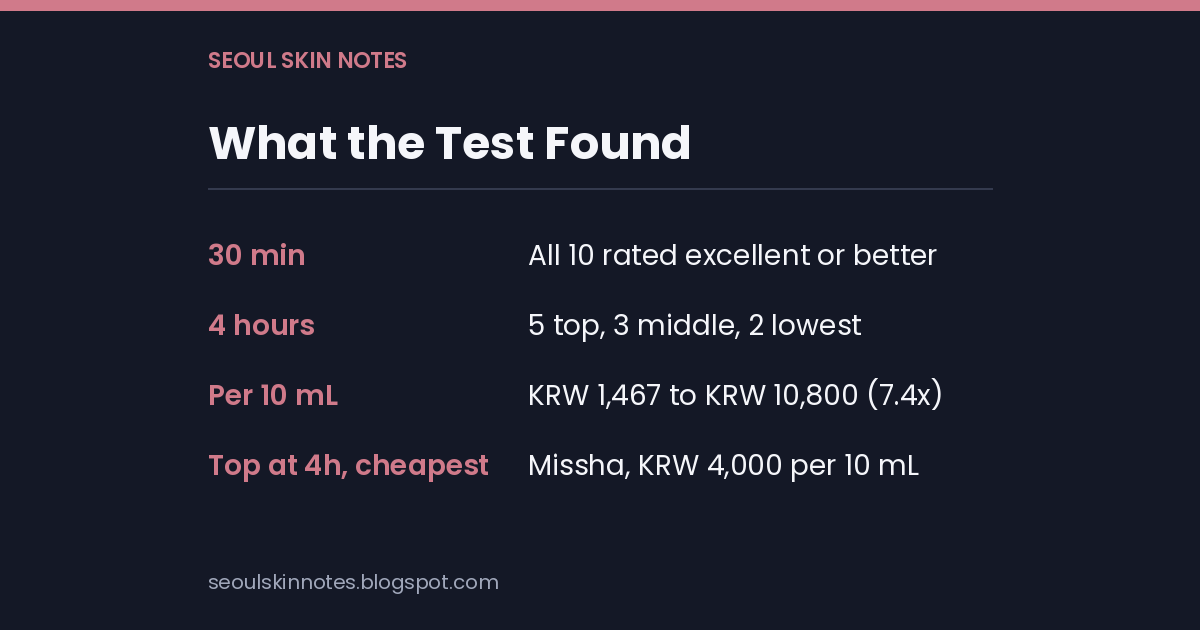
The agency singled out Missha for value, because it was top tier at both time points and had the second-cheapest price. For readers outside Korea, the useful comparison is with the two non-Korean creams in the panel. Kiehl's Ultra Facial Cream (made in the US) and Biotherm Aquasource (France) both reached the top tier at 4 hours, and Missha matched them at half of Kiehl's price per 10 mL and well under half of Biotherm's.
Felt moist and measured moist were different lists
The per-product sensory scores sit in a separate comparison tab of the Consumer24 page, below the star ratings.
On "수분감" (how moist it feels), the panel average was 3.77. Kiehl's scored 3.54, below that average, and still measured in the top tier at 4 hours. Mamonde scored 4.10, one of the highest, and measured in the middle tier. Biotherm had the highest felt-moisture score, 4.12, and also the top measured result, so the two lists do overlap sometimes. They just aren't the same list.
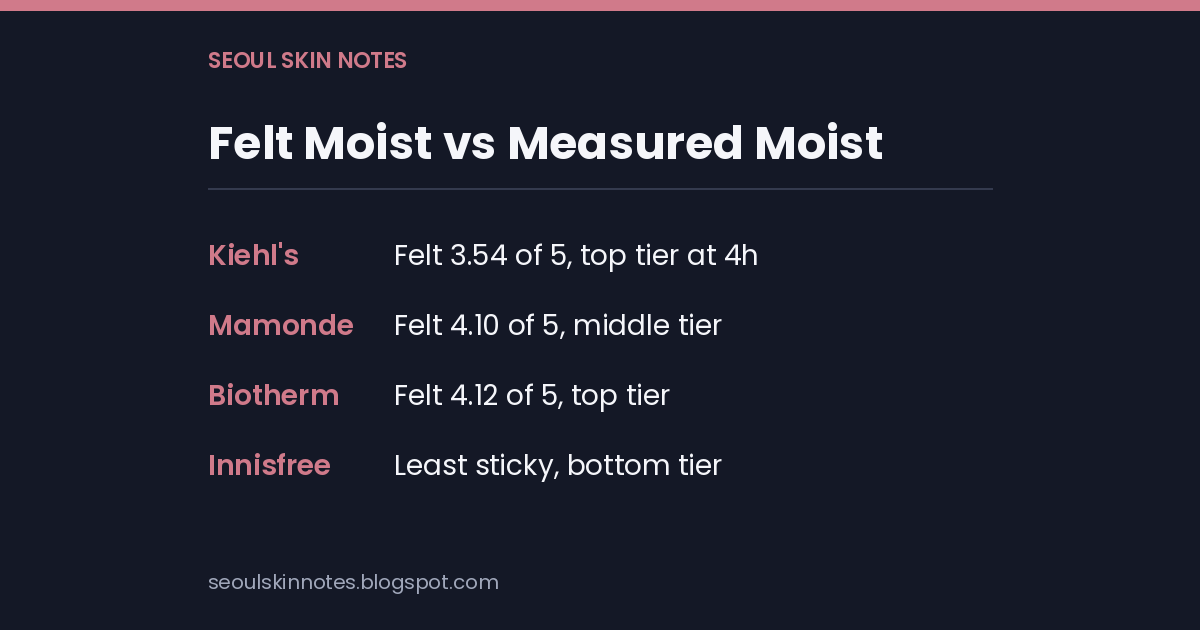
Lightness is where the pattern gets suggestive. Innisfree had the lowest stickiness score in the panel (1.96, against an average of 2.75) and the lowest residue score (1.84, against 2.53), and it was in the bottom tier at 4 hours. CNP was the next lightest on both (2.24 and 1.86) and landed in the middle tier. Kiehl's, though, was also low on stickiness at 2.30 and made the top tier. With ten products and three rating steps, I can't tell whether "light finish, shorter hold" is a real tendency or two products happening to line up.
Four of the ten had the word "젤" (gel) on the packaging: The Face Shop, Biotherm, belif and CNP. Two of them reached the top tier at 4 hours and two the middle. On this panel, "gel" on the label didn't sort anything.
Dr.Jart+ is the one result with no mixed signal. It had the lowest felt-moisture score, 3.18, and the bottom tier at 4 hours.
Is the Missha cream still the value pick in 2026?
On the 2019 numbers, yes. On today's shelf, I don't know, and here is why.
The ratings apply only to the exact products tested, and the report says so ("본 시험결과는 해당 제품에 한함"). Mamonde told the agency it planned to discontinue its cream in early 2020, so at least one product on the list was on its way out when the report was published. I haven't checked whether the other nine are still sold with the same formula, so treat the stars as a record of those 2019 batches.
A 30-minute reading told the agency very little, because every cream passed it. If a brand or reviewer shows you a before-and-after hydration number, look for the time point. Four hours is where these ten separated.
The same agency programme also measured the pH of ten Korean foam cleansers, which I wrote up here.
If you've used one of these ten, which way did yours go by mid-afternoon?
This is a running series, not a one-off post — a new post goes up every day, at around 1am Korea time.
About · Contact · Privacy Policy
Read next: Korean Foam Cleanser pH: 10 Measured, Only 3 Below 7.5 · Serum Vials That Look Like Eye Drops: 4 Flagged in Korea · Peeling Gel Clumps vs Dead Skin: A Korean Report and a Glove Test


Comments
Post a Comment