Peeling Gel Clumps vs Dead Skin: A Korean Report and a Glove Test
If you have used a Korean peeling gel, you know the moment. You rub it over your nose for a while and small rolled-up crumbs start to fall, and it is hard not to think that all of it came off your face. According to the Korean sources I read for this post, those crumbs are clumps of the peeling gel itself, with some dead skin caught up in them.
That point is not new in Korea. It was spelled out in May 2025 by Health Chosun, with a professor and two dermatologists quoted by name, plus unnamed spokespeople from two cosmetics companies.
What the Korean article says the crumbs are
Health Chosun sorts exfoliators into two kinds, and the gels that make crumbs are the physical kind, which work by rubbing. Chemical ones use acid to loosen dead skin. Shin Gyu-ok, a professor in Eulji University's beauty art department, said the clumps pick up loosely attached dead skin, sebum, dust and other residue on the way out. Her explanation of the clumps themselves, in my translation: "Polymer ingredients in physical peeling gels, such as cellulose, carbomer and polyvinyl alcohol, tangle with each other and form clumps when you rub them."
The article then puts it in its own words: the clumps are not dead skin but "an aggregate of the physical peeling gel" (물리적 필링젤의 응집체). An unnamed Amorepacific spokesperson gave the same account, saying the gels contain ingredients that readily pick up dead skin and residue, so dead skin on the skin's surface clumps together with the gel as it aggregates, and that the clumps "come off easily with water."
Does that make the gel useless? Neither quote says so. Both say dead skin is in the clump, and neither says how much of the clump it is.
Why the nose makes more crumbs than the cheeks
Health Chosun's piece points early on to the T-zone, where the crumbs pile up fastest and where it is easy to conclude that you simply have more dead skin there. It then gives its own reasons. The T-zone does collect more dead skin and dirt, it is oilier, so clumps form more easily, and it has more curves than the cheek, so it is likely to be rubbed harder. Professor Shin's version was that hand friction, water and oil all affect how the product turns from gel into a semi-solid.
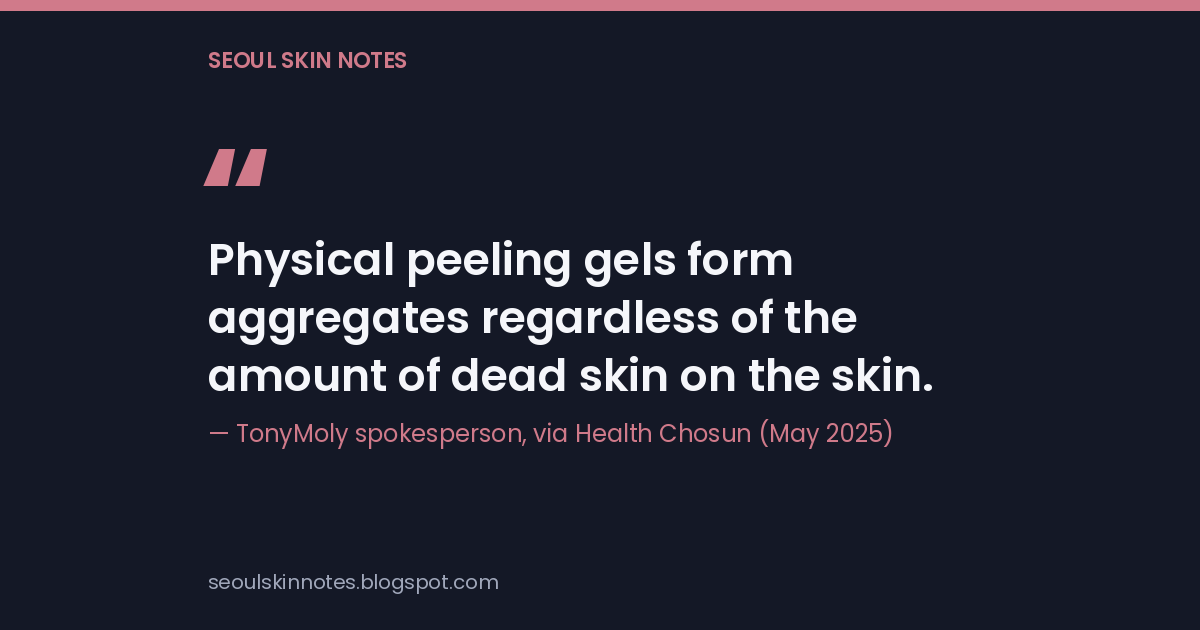
The strongest statement came from TonyMoly. Its unnamed spokesperson allowed that very rough or flaky skin creates more friction, which can make it look as if more clumps are forming. Its main point to Health Chosun, though, was that because of the nature of the formula, physical peeling gels form aggregates "regardless of the amount of dead skin on the skin," and that the amount does not change much with skin condition.
Two explanations of the same crumbs
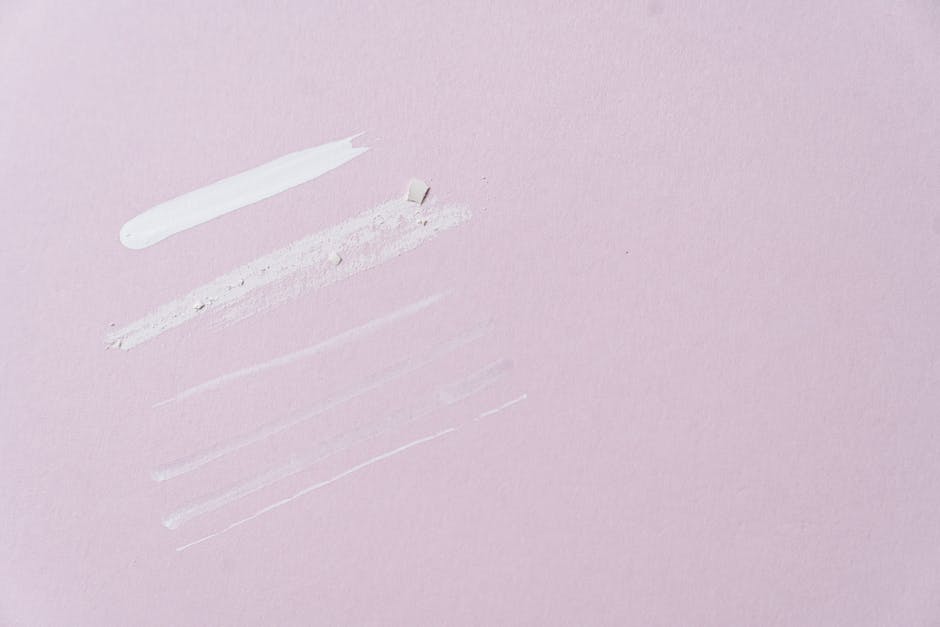
The Korean article names cellulose, carbomer and polyvinyl alcohol. A Japanese source puts it a little differently. In an August 2015 post, the cosmetic-chemistry blogger Kazunosuke rubbed a peeling gel in circles on a rubber glove, where there is no dead skin at all, and crumbs kept coming out. He identified the crumbs as carbomer, a gelling agent, clumping together, and put the smooth feel afterwards down to steartrimonium chloride, a cationic surfactant, sticking to the skin. The gel he tested listed water, glycerin, steartrimonium chloride, ethanol and carbomer first.
So which description fits a Korean bestseller? I checked the Dr.G Brightening Peeling Gel. Its Olive Young product page did not give me the full ingredient list, so I used the list on INKEEDecoder (formerly INCIDecoder), which was uploaded in 2017 and may be older than the current tube.
On that list, Cellulose is the second ingredient, straight after water. Acrylates/C10-30 Alkyl Acrylate Crosspolymer, a relative of carbomer, sits near the end. Nothing on the list ends in "-trimonium chloride." In my reading, that list fits the Korean article's cellulose-and-carbomer description better than the Japanese one.
Whether the tube on sale today still uses that list, I could not confirm, and there's a reason to doubt it: the Olive Young Global page for the 60 g tube highlights hyaluronic acid, panthenol, centella and ceramide, and none of those four is on the 2017 list.
How often the Korean sources suggest using one
Health Chosun's concern is the barrier, since the outer layer of dead cells keeps moisture in and stripping too much can bring redness, stinging and dryness. Professor Shin said to rub gently and to follow with a moisturizer or a soothing product. Her suggested frequency was once a week for normal skin and once or twice a week for oily skin.
According to Health Chosun, dermatologists recommend the chemical type over the physical one. Seo Dong-hye, director of Areumdaunnara Dermatology, said chemical peeling gels "can be designed so that only a scientifically set amount of dead skin is removed," and that people whose skin is not very oily, or who react to some products, are better off with them. Health Chosun adds two caveats. Chemical types may not feel as dramatic straight away. For very sensitive skin, it recommends skipping peeling gels altogether.
On a label, the physical type lists cellulose, carbomer or polyvinyl alcohol. The chemical type lists AHAs such as glycolic, lactic or mandelic acid, which Health Chosun suggests using in the evening because of possible pigmentation with sun exposure; BHAs such as salicylic acid or betaine salicylate; or PHAs such as lactobionic acid or gluconolactone.
Is exfoliating the face worth it at all? Professor Kim Beom-joon of Chung-Ang University Hospital's dermatology department, quoted from an earlier Health Chosun interview, said using a peeling product on clear skin with no breakouts "may not mean much," but it is effective for acne-prone skin with many sebaceous glands.
If your skin feels smoother after a peeling gel, that part is real. The pile of crumbs is a poor measure of it, though, and I would judge a gel by how the skin feels the next morning.
Has anyone here tried one on the back of a glove or on a clean plate? I would like to know which gel it was and whether it still crumbled.
This is a running series, not a one-off post — a new post goes up every day, at around 1am Korea time.
About · Contact · Privacy Policy
Read next: Mugwort in K-Beauty: What's Been Measured, Not Marketed · Your BHA Toner Isn't a Legal Acne Product in Korea · Korea's Retinol Shortcut, and the Retinal Trials


Comments
Post a Comment