Korea's Retinol Shortcut, and the Retinal Trials
A retinal (retinaldehyde) serum usually costs more than a retinol one on the same shelf, and the reason given online is almost always the same fact: retinal needs one less conversion step to become retinoic acid in skin, so it should act faster. That part of the chemistry checks out. What most of that marketing skips is that Korea's own cosmetics regulator built an actual shortcut for one of these two ingredients, and it isn't retinal.
The four ingredients that skip the paperwork
Korea's Ministry of Food and Drug Safety (MFDS) runs two routes to a legal "주름개선" (wrinkle-improvement) claim on a cosmetic. Use one of a short list of named ingredients at a set concentration, and a brand skips submitting its own efficacy and safety data, because MFDS already reviewed that exact concentration for everyone who uses it. Four ingredients qualify.
I opened the actual document, Annex 4 to the Regulation on the Review of Functional Cosmetics, current as of when I read it on September 24, 2026 (KST). Under the wrinkle-improvement heading it names four raw materials, and stops there. Retinol at 2,500 IU/g. Retinyl palmitate at 10,000 IU/g. Adenosine at 0.04%. Polyethoxylated retinamide at 0.05 to 0.2%.
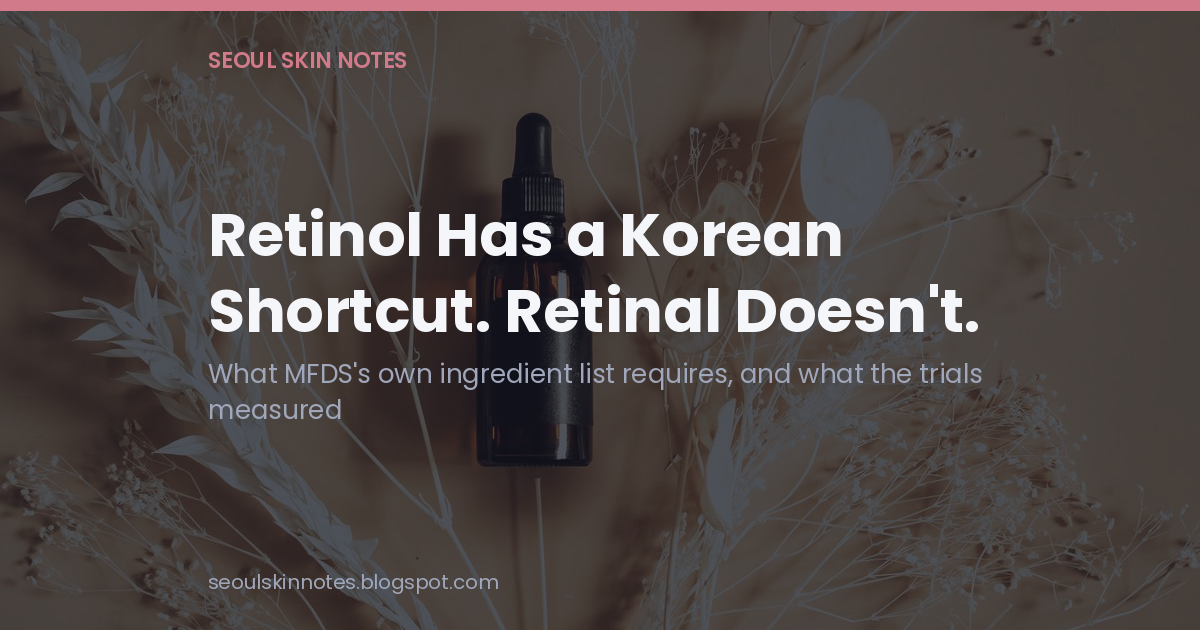
Retinal isn't on it. Neither is plain retinoic acid, which Korea sells only as a prescription drug, tretinoin cream, listed in MFDS's own drug database rather than as a cosmetic ingredient at any strength. Retinal's absence from Annex 4 doesn't ban it from a cosmetic. It just means a brand selling a retinal serum and wanting the official wrinkle-improvement label has to skip the shortcut. Article 4 of the same regulation lays out what that costs instead: toxicity and irritation testing, plus a brand's own efficacy data, reviewed product by product, one filing at a time.
What the trials actually measured
Rules aside, what has each ingredient actually shown on skin? I went back to a 2006 clinical review of retinoid trials that rounds up the primary studies by name, and pulled the retinaldehyde and retinol ones apart. Retinaldehyde's clinical record is older than the marketing around it feels. A randomized, vehicle-controlled trial from 1998 to 1999 (n = 125) put 0.05% retinaldehyde directly against 0.05% retinoic acid. Optical profilometry found the two "equally effective in reducing wrinkles and skin roughness." Retinoic acid caused more local irritation, which hurt how well people stuck with using it. A smaller 1999 trial (n = 40) tested 0.05% retinaldehyde against plain vehicle and measured a real jump in epidermal thickness and skin elasticity (p < 0.01). Patients tolerated it well.
Retinol's own record isn't thinner, just older in a different way. The first controlled trial of any retinol formulation ran in 1998 and found a real improvement in fine wrinkles after 12 weeks. A 2000 study applied 1% retinol daily to 53 people aged 80 and older for just seven days. It measured lower activity of two skin-degrading enzymes, MMP and collagenase, alongside more collagen production, straight from the tissue samples. Retinol is the weaker molecule on paper. It converts twice before becoming retinoic acid, where retinal converts once, and a commonly cited figure puts retinol at roughly 20 times less potent than tretinoin by weight.
The one trial that put both on the same face
I could find exactly one study testing retinal and retinol directly against each other in the same people, and it's Korean. A 2021 split-face trial from a Yonsei University dermatology team, published in the Journal of Cosmetic Dermatology, enrolled 23 Korean volunteers. An encapsulated 0.05%/0.1% retinaldehyde cream went on one randomly assigned side of each face, 0.05%/0.1% retinol on the other. Eight weeks later, both sides had improved on wrinkle depth, hydration, elasticity, and facial contour, measured by 3D imaging. The retinaldehyde side outperformed the retinol side on those measures. Dermal density came out the same on both sides. Nobody in the study had an adverse reaction to either cream.
Twenty-three people is a small trial. It's still the only one that puts a number on the size of the gap, and the gap runs in retinal's favor.
Checking your own bottle
If a Korean retinol product is sitting in front of you, look for the actual 기능성화장품 (functional cosmetic) mark on the box. That's confirmation it cleared one of the two routes above, not just a company's word for it. A 2021 Kyunghyang Shinmun piece on this exact confusion found something worth checking first, and it's the reason the filing matters more than the front label: some products print "retinol" across the box but actually earned their functional approval through a different listed ingredient entirely. The piece doesn't name which one, and neither the product name nor the front-label wording tells you.
I searched Korean brand names alongside "레티날 임상시험" and the English term "retinal clinical trial" for a Korean brand's own published retinal data, and retinol numbers came up far more often. The clear exception is the trial above: Dr.Different, the Korean dermocosmetic brand behind that split-face study, ran its own retinal-vs-retinol comparison with the same Yonsei team and got it into an SCI-indexed journal instead of leaning on Annex 4. Retinal is real chemistry with a real, if smaller, body of trials behind it, sitting inside a regulatory system that currently makes retinol the easier ingredient to prove — which is exactly why most brands skip doing what Dr.Different did.
This is a running series, not a one-off post — a new post goes up every day, at around 1am Korea time.
About · Contact · Privacy Policy
Read next: How Korea Defines a Niacinamide Whitening Serum (2-5%) · Why Korean Sunscreen Isn't FDA-Approved in 2026 · "Dermatologist Tested" vs "Doctor Recommended" on Korean Labels
You might also like: How to Read the Date on Korean Food Packages After the 2023 Law Change (Korean Table)


Comments
Post a Comment