"Dermatologist Tested" vs "Doctor Recommended" on Korean Labels
A Korean cosmetics box is allowed to print 피부과 테스트 완료, dermatologist tested. It is not allowed to print that a doctor recommends the product. Those two phrases live in two different documents, and the second one is a flat ban that the Ministry of Food and Drug Safety enforces by having sales listings blocked.
If you read Korean packaging and have wondered whether "dermatologist tested" means more there than it does on a drugstore bottle in the US or the UK, the answer sits in two annexes you can open yourself. Everything below is the text as it stood when I read it on September 18, 2026 (KST).
The one line in Annex 5
The ban is item 2-다 of Annex 5 to the Enforcement Rule of the Cosmetics Act, 화장품법 시행규칙 [별표 5], marked as last amended December 12, 2019. In my translation, the operative sentence says a doctor, dentist, oriental medicine doctor, pharmacist, medical institution or other party must not be presented, or hinted at, as designating, certifying, recommending, instructing, researching, developing or using the product. I pulled that text out of the two-page PDF the National Law Information Center serves for the annex.
There is a carve-out inside the same item, and it is narrower than it first looks. Human application test results matching the definitions in subparagraphs 1 through 3 of Article 2 of the Act may be cited, within that scope, once they have been publicly recognised through presentation to a relevant academic society. The annex then attaches conditions to that citation. It has to convey the original meaning of the paper accurately, and it has to state the researcher's name, the name of the document, and the date of publication. Bodies that certify halal, natural or organic cosmetics and are designated by the MFDS Commissioner sit outside the list too.

The line the January 2025 edition added
The working list of banned wording is not in the Act at all. It is Annex 1 of the MFDS guidance document 화장품 표시·광고 관리 지침, published as a civil-applicant guide. Which edition you get depends on where you download it. The ministry's own board post is filed under 안내서-0086-05, registered May 7, 2024, and its attachment is the 2024 edition, sixteen pages. The January 21, 2025 edition, 안내서-0086-06, seventeen pages, is mirrored by the Jung-gu district health centre in Seoul. I opened both.
Under the heading for Article 13(1)4 of the Act, on printed page 13 of the 2025 edition, the table lists six worked examples of banned phrasing. Their row is headed 특정인 또는 기관의 지정, 공인 관련, designation or certification by a named person or body, and five of the six name one. A cosmetic certified by some atopy association, one born of a medical institution's cutting-edge technology, one co-developed by a doctor from some university, one developed by a doctor, one recommended as safe by some hospital. The sixth is a run of shelf terms that come out in English as hospital-use, hospital-exclusive, dermatology-clinic-exclusive, for-clinic-procedure-use, pharmacy-use and pharmacy-exclusive, printed in the table as 병원용, 병원전용, 피부과전용, 피부과시술용, 약국용, 약국전용.
I also pulled the November 23, 2023 edition of the same guide from the Korea Cosmetic Association and compared the tables. The five named-party examples were already there in 2023. The shelf-terms line was not. It is not in the May 7, 2024 edition on the ministry's board either, where the same table stops after OO 병원에서 추천하는 안전한 화장품, the hospital-recommendation example. So the line arrived with the January 21, 2025 revision.
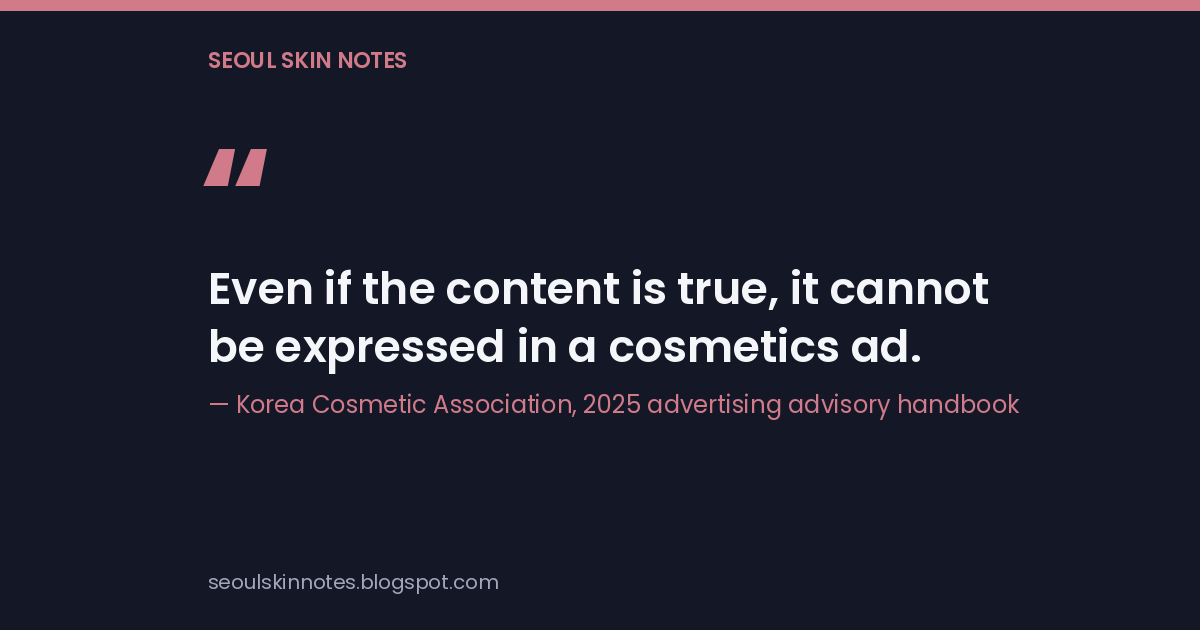
The association's 2025 advertising advisory handbook walks through the same examples and answers the obvious follow-up. If the company's chief executive genuinely is a doctor, can the ad say so? No: 해당 내용이 사실이더라도 화장품의 광고에서는 표현 할 수 없다, even if the content is true, it cannot be expressed in a cosmetics ad. Where a hospital or pharmacy is simply a place the product is sold, the fact of distribution can be stated, as long as it stops short of implying a doctor's recommendation. The ban runs to pictures as well, and the handbook names four of them: photos of doctors, photos of hospitals, medical instruments, cross motifs.
One term survives all of this. 더마, derma, is usable according to the same handbook, while 메디슨 (medicine), 드럭 (drug), 코스메슈티컬 (cosmeceutical) and 치유, healing, are not. The handbook gives its reason in the same line. Derma is glossed there as 피부를 의미하는, meaning skin, while the other four are treated as drug-efficacy wording. The permission is not unconditional either. The handbook tells companies to watch that the surrounding copy does not end up reading as a medicine claim.
"Dermatologist tested" sits in the other annex
Annex 2 of that same guide, from printed page 15, is a different kind of list. These are not banned words. They are wording the ministry treats as a substantiation target, meaning the company has to be able to produce evidence on request. Under the heading for efficacy, effect and quality, one row reads 시험·검사와 관련된 표현, wording related to testing and inspection, and its evidence column asks for human application test data or in-vitro test data. The two examples printed in that row are 피부과 테스트 완료 and "efficacy X proven by testing body Y".
The rows around it apply the same bar to the numbers you see in K-beauty copy: 30% improvement in hydration, 20% improvement in skin texture, skin tone improvement after two weeks, and comparative claims of the "lasts five times longer than product X" shape. The obligation behind the table is Article 14 of the Cosmetics Act. The government's plain-language Easy Law page for this provision quotes paragraph 1 as requiring a business operator to be able to substantiate the factual matters in its own labelling and advertising. The same page gives the company 15 days from the ministry's request to hand that file over, and says the ministry can order the wording stopped if nothing arrives.
That bar is not the same as approval. In a December 12, 2024 interpretation published by the National Law Information Center, the MFDS cosmetics review division, 화장품심사과, was asked whether a skin irritation test result lets a company advertise a product as low-irritant. The division did not approve the phrase. It answered that the substantiation data has to show a 저자극 test result under test methods and evaluation criteria that take the safety assessment guidelines of the ICDRG and the PCPC into account.
The guide is a guide, by the way. Its own front matter states that the document does not carry external legal force, 대외적으로 법적 효력을 가지는 것이 아니므로.

What 237 blocked listings looked like
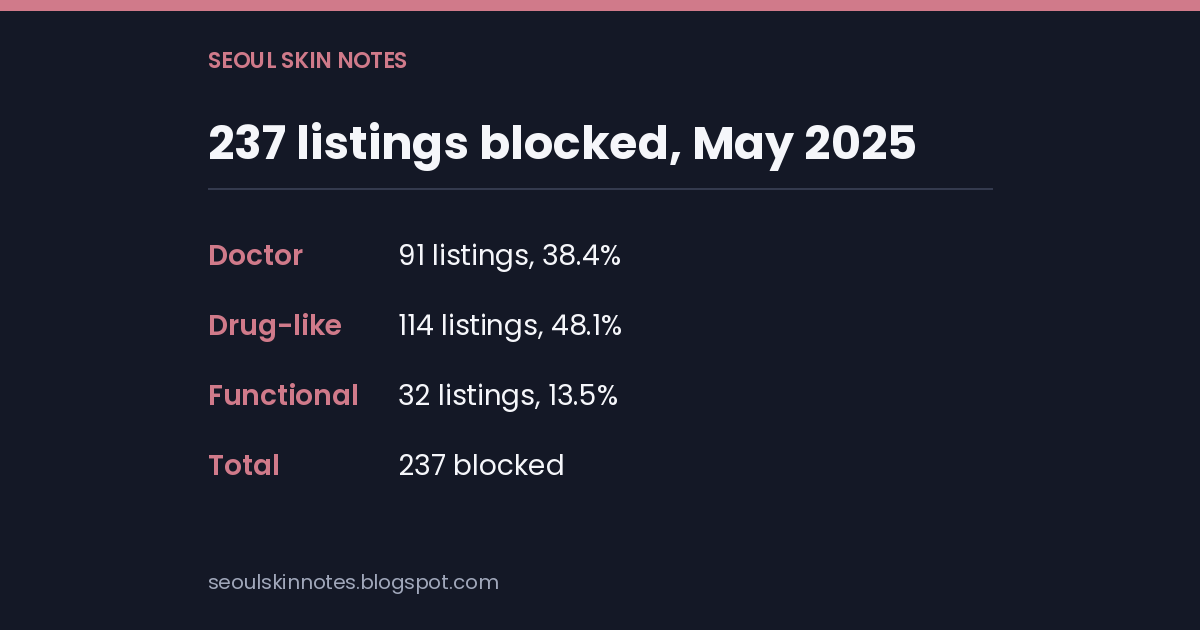
On May 23, 2025, Hankook Ilbo reported that the MFDS and the Korea Cosmetic Association had checked online cosmetics sales posts, found 237 in violation of the Cosmetics Act, and asked the Korea Communications Standards Commission to block access to them. CNC News put the split in percentages the following day: 91 listings, 38.4%, for doctor or hospital recommendation wording; 114 listings, 48.1%, for drug-style efficacy claims such as inflammation reduction and skin regeneration; 32 listings, 13.5%, for passing ordinary cosmetics off as functional ones. Newsthevoice Healthcare, back on May 23, breaks the total into a first round of 186 and 51 more found by tracing the responsible distributors behind those listings, with 35 of those distributors facing site inspections.
The MFDS press release itself is the one thing here I could not open. A site-limited search of mfds.go.kr did not turn it up, and the one ministry guide page I tried alongside it came back with a temporary-unavailable notice, so the split above comes from news coverage. Whether the ministry's own text breaks the 237 down the same way, I do not know.
Checking a claim yourself
Two links do most of the work. Annex 5 downloads as a two-page PDF straight from law.go.kr at the link above, and the guidance PDF with both phrasing tables is the Jung-gu mirror linked above, the January 2025 edition. If a Korean phrase from your bottle turns up in the Annex 1 table, no Korean seller is supposed to be printing it. Open the guide and search the text for that phrase. In that edition Annex 1 starts on printed page 9 and Annex 2 on page 15. In the 2024 edition still attached to the ministry's board post they sit on pages 8 and 14, and the shelf-terms line is not there.

Worth knowing what this does not reach. The rules bind Korean labelling and Korean advertising by manufacturers, responsible distributors and sellers. A US or UK retail page for the same product falls under that country's rules, so a brand's English copy abroad can carry wording its Korean listing cannot. I wanted to put the US position beside this properly, and the FDA's own page on cosmetic labelling claims returned 401 to me on both attempts, so I am not going to characterise it from memory.
If you have a Korean product page in front of you right now that names a doctor, or says 병원전용, tell me which one. I want to know whether the wording is on the seller's Korean listing or only on the English version.
This is a running series, not a one-off post — a new post goes up every day, at around 1am Korea time.
About · Contact · Privacy Policy
Read next: How Korea Defines a Niacinamide Whitening Serum (2-5%) · Why Korean Sunscreen Isn't FDA-Approved in 2026 · How Korean Sunscreen SPF Is Tested: 10 Subjects, 2 mg/cm2
You might also like: How to Read the Date on Korean Food Packages After the 2023 Law Change (Korean Table)


Comments
Post a Comment