Why Korean Sunscreen Isn't FDA-Approved in 2026
Why isn't Korean sunscreen FDA-approved? Because almost nothing on a US sunscreen shelf is FDA-approved either. In the United States a sunscreen is a drug, and most of them reach the shelf under an over-the-counter monograph that lets a product be sold with no approved application at all, provided every active ingredient in it appears on a list the FDA maintains. Korean formulas run into that list.
If you keep a Korean sunscreen in your bathroom, live in the US, and have read three different explanations of this online, this one is built out of the orders themselves. The list moved twice in 2026, and I opened both of those orders on September 21 (KST) instead of somebody's summary of them.
A drug in one country, a cosmetic in the other
Korea files sunscreen under 기능성화장품, functional cosmetics. The category is defined in the Cosmetics Act, and the relevant line covers a cosmetic "자외선을 차단 또는 산란시켜 자외선으로부터 피부를 보호하는 기능을 가진 화장품", a cosmetic that blocks or scatters UV to protect the skin. The filters themselves come from a separate positive list in MFDS's cosmetic safety standards notice, and each one on that list carries a percentage ceiling beside it. Under Article 4 of the same Act, a company selling a sunscreen then submits safety and efficacy material to the Ministry of Food and Drug Safety item by item, either for review (심사) or as a report (보고).
The US built the same thing out of drug law. The CARES Act was signed on 27 March 2020, and sunscreens have sat in Over-the-Counter Monograph M020 since. The FDA's own questions-and-answers page says the deemed final order that Act created "considers sunscreens containing 16 sunscreen active ingredients to be GRASE, consistent with the 1999 stayed (not in effect) sunscreen monograph." Sixteen, carried over from 1999.
A Korean brand cannot register a sunscreen filter in the US the way it registers one at home. The American version of that paperwork is a drug proceeding, and before this June the monograph list had not gained an ingredient since the late 1990s.

What changed on 10 June 2026
One filter got through. DSM Nutritional Products LLC filed a monograph order request on 23 September 2024 asking for bemotrizinol at concentrations up to 6 percent, the FDA proposed it on 12 December 2025, took comments until 26 January 2026, and issued Final Administrative Order OTC000039 on 10 June 2026. The copy the portal serves now is stamped "Issued June 10, 2026, corrected August 10, 2026"; I read that one against the original June file, and the passages quoted below are the same in both. The agency's press release the day before calls it "the first new active ingredient added to the over-the-counter (OTC) sunscreen monograph since the late 1990s" and considers it GRASE "for use in sunscreens by adults and children 6 months of age and older."
Bemotrizinol's INCI name is Bis-Ethylhexyloxyphenol Methoxyphenyl Triazine, which you may know as Tinosorb S. If you have been reading ingredient databases for years, you have read the opposite of this. INCIDecoder's entry still says of it, "it's not FDA-approved so you will not find it in sunscreens coming from the US (not because it's not good, but because US regulations make it impossible for newer sunscreen agents to get approved)."
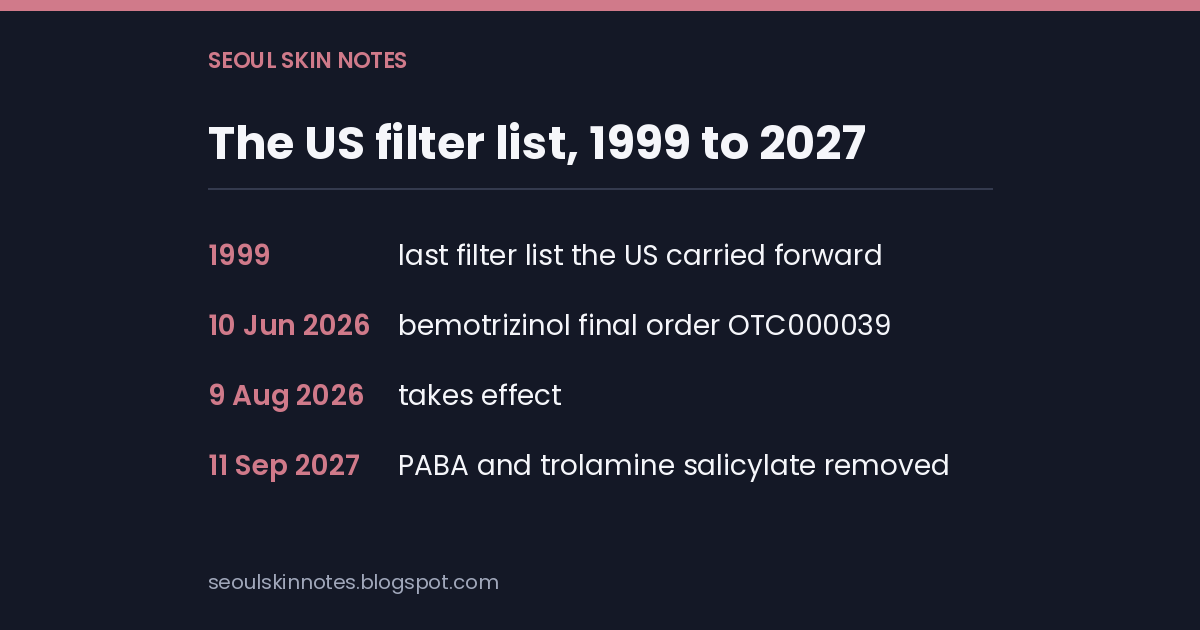
The order carries two things the press release skipped over. It took effect on 9 August 2026, so no US sunscreen could carry bemotrizinol under the monograph before that day. Section V then hands DSM a window. The order has the effect of "authorizing solely DSM Nutritional Products LLC (or the licensees, assignees, or successors in interest of DSM with respect to the subject of this final order)" to market products incorporating the change, and that exclusivity "shall last for a period of 18 months following the effective date of this final order and beginning on the date DSM may lawfully market drugs pursuant to this order."
Can your Korean sunscreen be sold here now, then? Only under DSM's licence, and only if the rest of the formula clears as well. The order names none of the licensees. What the coverage does name is the supply side. STAT reports that bemotrizinol "will initially be sold in the U.S. by the Dutch manufacturer DSM Nutritional Products under the brand name Parsol Shield, which is expected to launch later in the year." Searching in English for the brands that have taken a licence, I found that supply name and no list of brands behind it.
The list shrank in the same season. On 11 September 2026 the FDA issued Final Administrative Order OTC000008 – 1, removing aminobenzoic acid (PABA) and trolamine salicylate, on the grounds that "Topical use of PABA is associated with significant rates of allergic and photoallergic skin reactions, some of which are likely to be severe." That removal takes effect on 11 September 2027.
Turn your own bottle over
You can check this part yourself in about thirty seconds.
Take Round Lab's Birch Juice Moisturizing Sun Cream. INCIDecoder lists four UV filters in it. Diethylamino Hydroxybenzoyl Hexyl Benzoate, Ethylhexyl Triazone, Methylene Bis-Benzotriazolyl Tetramethylbutylphenol, Diethylhexyl Butamido Triazone. None of the four sits on the American list, and the June order added none of them. Beauty of Joseon's Matte Sun Stick does contain bemotrizinol, alongside Diethylamino Hydroxybenzoyl Hexyl Benzoate and Ethylhexyl Triazone, so one of its three organic filters is now on the US list and two are still not.
Brands reformulate rather than export. The US edition of Skin1004's sun serum swaps in avobenzone, homosalate, octisalate and octocrylene, so the two tubes share a name and no filters at all. I went through that swap filter by filter two weeks ago.
You do not have to take my reading of any of this on trust. The FDA keeps every sunscreen order on its OTC Monographs@FDA portal. Search the administrative orders there and each row gives an order ID, a published date and a link through to the signed PDF; the effective date is inside the PDF rather than on the list. Both 2026 orders came from there. Korea's side sits on MFDS's amended-notice board, which you can search by title. That is where I went looking for the notice that has not appeared, and I would not mind a second pair of eyes on it.

Korea's list moves too, and this year it stalled
MFDS ran its own filter proceeding over the same period. Notice 제2025-63호, published on the ministry's site on 2 September 2025, added "심사가 완료된 '트리스-바이페닐 트라이아진'", Tris-Biphenyl Triazine with its review completed, to the restricted-ingredient annex. The same notice dropped a lawsone and dihydroxyacetone mixture out of the UV filter category, and for benzophenone-3 and five other ingredients it either lowered the concentration ceiling or set a usage limit where none had been fixed.
A second filter was proposed. On 12 January 2026 the ministry put out a draft adding Phenylene Bis-Diphenyltriazine, which Cosmorning reported would bring the Korean count to 32, with comments open to 6 February. I went looking for the finalised version on MFDS's own amended-notice board. Searching it by title, the most recent 화장품 안전기준 등에 관한 규정 amendment it holds is still 제2025-63호. Reading the same board forward from Notice 제2026-1호 of 13 January 2026 to 제2026-66호 of 15 September 2026, the only cosmetics notices listed are about allergen labelling and production reporting. That board skips some notice numbers, so what I can tell you is that the amendment does not show up on it.
One thing I could not do is open the annex table itself. The National Law Information Center serves the annex through a script my tools cannot run, and the page loads empty for me, so the current Korean ceiling for bemotrizinol is a number I do not have for you. The link is there if your browser does better than my tools.
Hold the counts next to each other anyway. Sixteen actives carried into US law from 1999, one added this June, two leaving next September. Thirty-one or thirty-two in Korea, depending on whether that January draft has landed.
None of this tells you which sunscreen protects your skin better, and the American list is not a quality ranking. Korea measures protection its own way, on ten subjects at 2 mg/cm², and I went through that test method on the 16th.
Read the filter names off the back of whatever Korean sunscreen you own and tell me which ones you find. I want to know how many bottles already sitting in bathrooms carry the one ingredient that changed status in June.
This is a running series, not a one-off post — a new post goes up every day, at around 1am Korea time.
About · Contact · Privacy Policy
Read next: How Korean Sunscreen SPF Is Tested: 10 Subjects, 2 mg/cm2 · Skin1004 Sunscreen Korean vs American Version: What Changed · How Korea Defines a Niacinamide Whitening Serum (2-5%)
You might also like: How to Read the Date on Korean Food Packages After the 2023 Law Change (Korean Table)


Comments
Post a Comment