Serum Vials That Look Like Eye Drops: 4 Flagged in Korea
Korean single-dose serum vials that look like eye drops were the subject of two warnings on August 4, 2026. Korea's Ministry of Food and Drug Safety (MFDS) and the Korea Consumer Agency (KCA) flagged four PDRN ampoules whose containers are hard to tell apart from single-use artificial tears, and three of the four brands said they would stop making them.
The sources here are the MFDS press note, a Korean PDF with eight instruction cards attached, and the Korean news reports of the KCA figures.
What the Korea Consumer Agency counted
The KCA went through its injury reporting system, CISS, for cases where people put something other than eye drops into their eyes by mistake. Between January 2021 and June 2026 there were 21 such cases, according to Kyunghyang Shinmun's report on the KCA findings. Four of them, or 19%, involved serums or other cosmetics.
One of those four cases was reported this February. A moisturizing serum was put into an eye as artificial tears and the eye was injured. The KCA said that product's container looked like a clear plastic single-use artificial tear vial.
Twenty-one cases over five and a half years is a small number. It is also only what was reported to one system, and the other 17 cases were not broken down in any of the reports I read.
The four products
The KCA then looked at serums and ampoules sold on Naver, Coupang, Gmarket and 11st. It found four products whose containers were difficult to distinguish from artificial tears. These are the names as the KCA listed them, in my translation:
- Anua "PDRN Hyaluronic Acid Capsule 100 Serum"
- Rire (리르) "PDRN Glutathione 2X Ampoule"
- JayJun Cosmetic "PDRN Porcelain Ampoule"
- medicube "PDRN Pink One Day Whitening Serum"
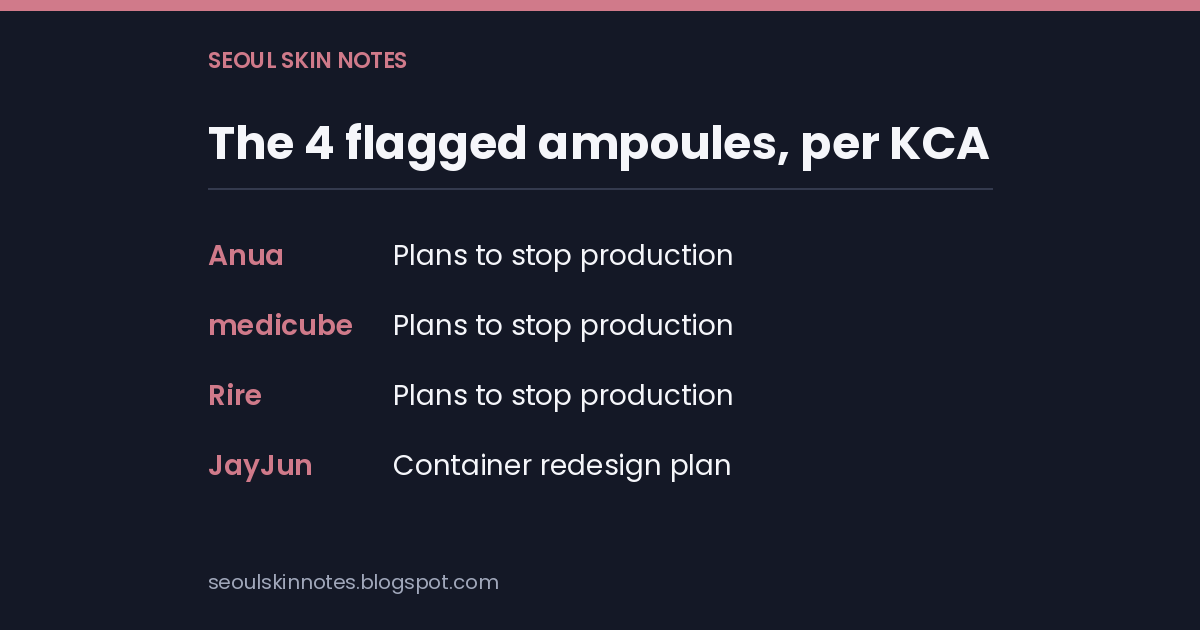
All four are PDRN products. The companies behind Anua (The Founders), Rire (IW Company) and medicube (APR) told the KCA they plan to stop producing them, and JayJun Cosmetic submitted a plan to redesign the container (Asia Economy). The MFDS note says the two agencies recommended that all four companies correct the container and packaging, and that the MFDS plans to push a Cosmetics Act amendment banning cosmetic containers or packaging that imitate the form of a medicine in a way that could harm public health.
The photos in the MFDS attachment show what the problem looks like. Each photo shows small single-dose plastic vials shaped like single-use artificial tears. The Anua vials hold a mint-green liquid, the medicube ones pink, the Rire ones yellow.
The boxes were not the problem. According to the KCA, the packaging and the online product pages carried lines such as "a cosmetic, not a medicine" and "do not use in the eyes." On the individual one-dose vial, that wording was hard to see.
Is the medicube one still on sale outside Korea?
I checked on September 28 (KST). The US medicube store still lists the PDRN Pink One Day Serum at $19.00. Its own description says: "Each dose is individually packaged in a convenient, single-use vial inspired by eye drops."
The page also includes the warning "Avoid direct contact with eyes and do not apply as an eye serum." Its FAQ says that if any product remains, you can reseal the vial and use the rest within one day.
The six Korean reports I read cover APR's plan to stop production. None of them mention stock already sold or listed overseas.
Anua's US site has a PDRN Hyaluronic Acid Capsule 100 One Day Serum page at $25. The page text I read does not say whether it comes in the same vials the MFDS photographed, so I cannot tell you if it is the flagged format. The MFDS photo of the Anua product shows vials.

How to tell a vial apart, per the MFDS
The MFDS attached eight card-news images to its note. The fourth card reads "사용 전 3초, 표시부터 확인하세요" (take three seconds before use and check the label). An artificial tear carries the word 의약품 (medicine). A cosmetic carries 화장품책임판매업자, the "responsible seller" line. The card ends with 헷갈리면? 눈에 넣지 마세요, meaning if you are unsure, do not put it in your eye.
This check works if you read Korean or can match those characters. On a vial bought overseas, the only text may be the brand name and "PDRN," so two other instructions matter more for most readers:
- Keep medicines and cosmetics in separate places, each in its own box. The third MFDS card says stick-type ampoules and serums are hard to tell from real artificial tears when they sit side by side
- Do not use them in the dark, which both the KCA and the fifth MFDS card advise
The KCA official quoted by Kyunghyang said consumers should check what is printed on the container before use and refrain from using these products in dark places (어두운 장소에서는 사용을 자제). The fifth MFDS card says the same (어두운 곳에서는 사용을 자제하세요) and adds that containers are easy to mix up before bed or at dawn, so turn on a light and check the product first.
If a serum gets into your eye
The MFDS instruction is to rinse right away with saline or clean water, and to see an ophthalmologist quickly if the foreign-body feeling or pain continues after rinsing. Kyunghyang reported that surfactants and preservatives in serums and ampoules can cause burning, toxic conjunctivitis and damage to the corneal epithelium. It adds that the outcome of a chemical eye injury depends on the substance's pH and concentration, how long it touched the eye, and how long it took to rinse.
I wanted to read the KCA's own release as well, but kca.go.kr did not load for me on September 28 (several connection errors), so the KCA numbers here come from the Korean news reports. If you have a box of these vials, where do you keep them?
For what PDRN is and what the serums claim, my earlier PDRN explainer covers it.
This is a running series, not a one-off post — a new post goes up every day, at around 1am Korea time.
About · Contact · Privacy Policy
Read next: Medicube PDRN Recall: Which Creams the Sudan Red Test Flagged · COSRX vs Anua: Which BHA Toner Names Its Acid % · PDRN vs Snail Mucin: What Each Ingredient Does


Comments
Post a Comment