Medicube PDRN Recall: Which Creams the Sudan Red Test Flagged
Same batch numbers. Two different labs, two different verdicts on whether a banned dye was sitting inside a jar of Medicube's PDRN Pink Collagen Capsule Cream. Most recap headlines about this recall skip past that detail, though it matters if you own one of these jars.
What Singapore's Regulator Tested For
Hong Kong Customs fired the first shot on July 24, saying its Government Laboratory had detected Sudan Red in a sample of the cream and telling the public to stop using it. Medicube pushed back within days, saying its own accredited Korean lab returned a "Not Detected" result on the same product. Singapore's Health Sciences Authority opened its own investigation from there, directing three companies selling the cream locally to pause sales on July 31 while it ran its own tests.
The specific compound HSA tested for is Sudan IV, an industrial dye banned in cosmetics sold in Singapore under the ASEAN Cosmetic Directive because of its carcinogenic and allergenic risk. It's not a skincare ingredient in any legitimate sense. It's a coloring agent used for things like waxes, solvents, and shoe polish, and it has no business anywhere near a face cream.
HSA's testing found Sudan IV in exactly two batches, both sold through one company, Venus Beauty Pte. Ltd. Samples from the other two companies selling the identical product, including APR's own official Singapore distributor, came back clean. On August 26, HSA ordered the recall of only the Venus Beauty batches (numbers 2E122I.2E117I and 2E191G.2E193G), while sales of the officially-distributed cream resumed once every batch destined for retail started getting tested before it hit shelves.
Where the Batch-Number Mystery Comes In
On September 6, The Korea Herald reported that APR ran its own independent lab tests in Korea on samples carrying those exact same batch numbers HSA had flagged, 2E122I.2E117I and 2E191G.2E193G.
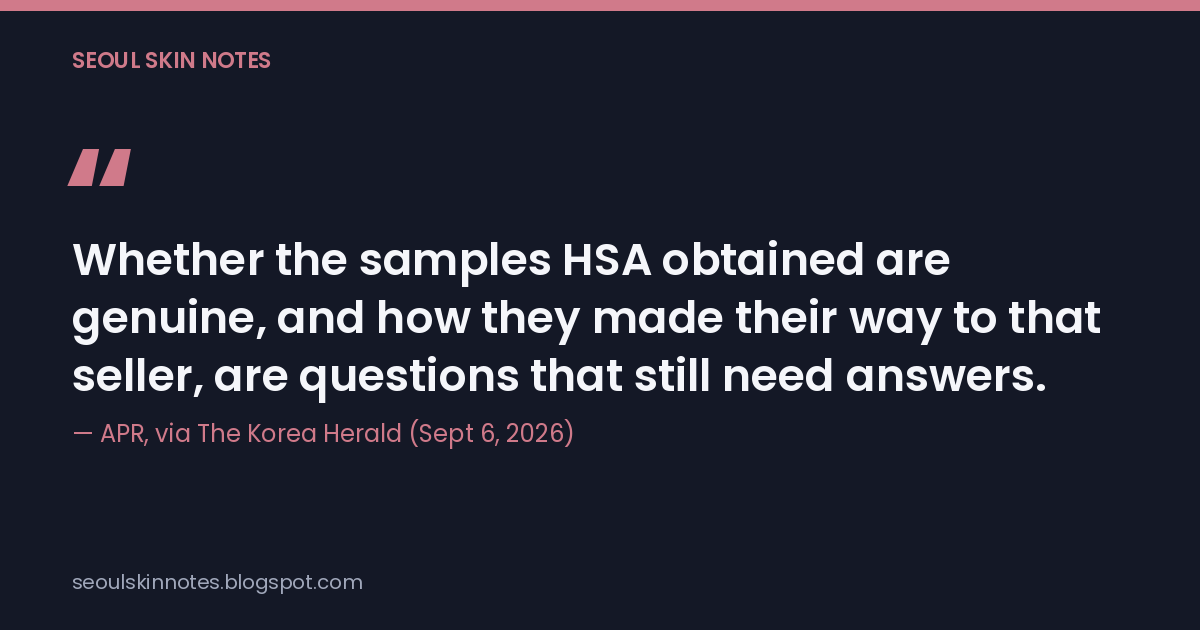
No Sudan IV, APR's tests found. An APR representative put it plainly:
APR says it has no export records showing any product ever reached Venus Beauty through an authorized channel, which raises the real question underneath this whole story: if two labs tested product carrying identical batch codes and got opposite results, was Venus Beauty selling authentic Medicube stock, or something that only claimed those batch numbers? Nobody's published a clean answer to that yet. I'd treat the batch-number match as suspicious rather than reassuring — counterfeiters copying real lot codes onto fake or diverted product is a known problem across K-beauty resale channels.
What's Listed in the Formula

Sudan IV was never supposed to be in this cream's formula at all. Pulling the INCI list, Niacinamide sits at position 3, right after water and glycerin — high enough on the list that it's realistically in the 4-5% range brands typically use for the pore and tone benefits Medicube advertises. Sodium DNA, the actual PDRN (polydeoxyribonucleotide) ingredient the product is named for, lands much further down at position 23, alongside Adenosine at 21 and Salmon Egg Extract near the bottom of the list. That positioning matters if you're buying this specifically for PDRN. Sodium DNA is present, but it isn't the dominant ingredient by volume the marketing copy might suggest.
None of that formula has anything to do with the recall. A banned dye showing up in two flagged batches is a contamination or counterfeiting question, not a formulation one — the cream Medicube designed doesn't call for red dye of any kind.
So Should You Toss Your Jar?
If you bought yours from an authorized retailer (Medicube's own US site or Ulta) and you're not in Singapore, none of the tested-positive batches were ever confirmed to have circulated through those channels. This recall, as of this posting, is specifically about two batch codes sold through one unauthorized Singapore reseller. That's a real reason for caution about where you buy.
It is a good prompt to check where your tube came from, though. HSA's own advice here holds well beyond Singapore — buy from "reputable retailers with an established presence" rather than marketplace sellers or gray-market importers. As of September 6, 2026, the same 55g jar runs $34.00 direct from Medicube's US site and $22.00 at Ulta, a big enough gap that it's tempting to chase a cheaper listing on a third-party marketplace instead. This is exactly the wrong moment to chase that gap. An unverified reseller selling below authorized pricing is the same shape of risk that put Venus Beauty's batches under investigation in the first place.
Skip the panic; keep the skepticism about where cheap listings come from. If your batch number matches 2E122I.2E117I or 2E191G.2E193G and you bought it anywhere other than an authorized retailer, that's worth a second look — everyone else can keep using what's already open.
This is a running news series, not a one-off post — new stories go up twice a day, roughly 7am and 7pm Korea time.
More Korea coverage from our network: Hallyu Now · Korea Travel Planner · K-Sports Global · Korean Table


Comments
Post a Comment