"Dermatologist Recommended" Is Illegal on Korean Cosmetics Labels
A lot of shoppers outside Korea assume "dermatologist tested" and "피부과 테스트 완료" are the same kind of soft marketing claim, just in two languages. They aren't. Korean law bans a cosmetics ad from saying a doctor endorses, recommends, or even uses the product, full stop, and the enforcement behind that rule has real numbers attached.
What the law says
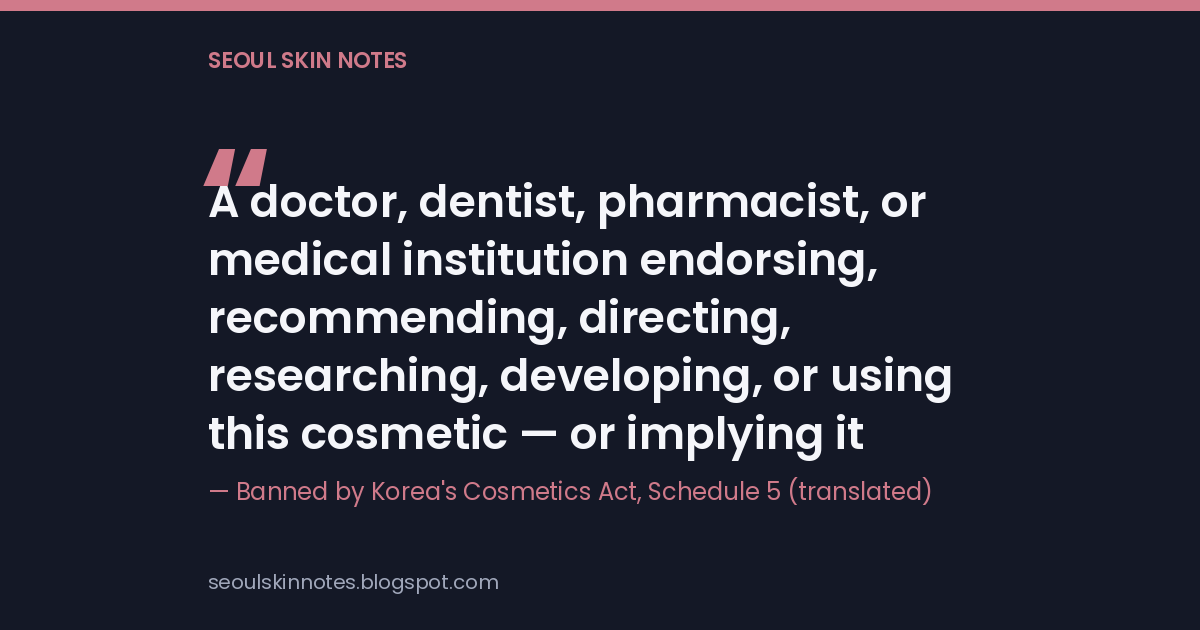
Korea's Cosmetics Act, Article 13, bans any label or ad that could be mistaken for a medicine, or that "deceives consumers or is likely to cause consumers to be misled" about anything factual. Schedule 5 of the enforcement rule, published with the rest of the statute by the Korea Cosmetics Industry Association, spells out one of those categories by name: a doctor, dentist, herbal-medicine doctor, pharmacist, medical institution, or anyone else in the medical field is not allowed to be shown or implied as endorsing, certifying, recommending, directing, researching, developing, or using a cosmetic in its marketing.
There's a narrow carve-out. If a brand has an actual human clinical trial result that met the legal definition of one and got presented at an academic conference, it can cite the published literature within that specific scope. That's a real study getting quoted, not a doctor's photo on a bottle.
"Low-irritation" isn't a vibe either
I went looking for how far this extends past the obvious "doctor recommends" line, because "hypoallergenic" and "저자극" show up on a lot of Korean skincare packaging aimed at sensitive-skin shoppers. A government interpretation published through Korea's National Law Information Center answers a company's own question on this directly: can a brand advertise a product as "저자극 제품" just because its own clinical trial facility ran a skin-irritation test and called the result low-irritation?
The answer isn't a flat no, but it isn't a shrug either. The substantiating data for a low-irritation claim has to come from a test method and evaluation standard that draws on the International Contact Dermatitis Research Group and the U.S. Personal Care Products Council's safety-assessment guidelines, a specific bar, not whatever in-house test the brand happened to run. A regulation explainer from Cosmorning adds the supervision requirement: a human-use test behind that kind of claim has to be run under the direction of a specialist physician or hospital, or someone with five or more years of experience at a university or cosmetics research institute. Loose lab results with no outside oversight don't clear it.

The enforcement isn't theoretical
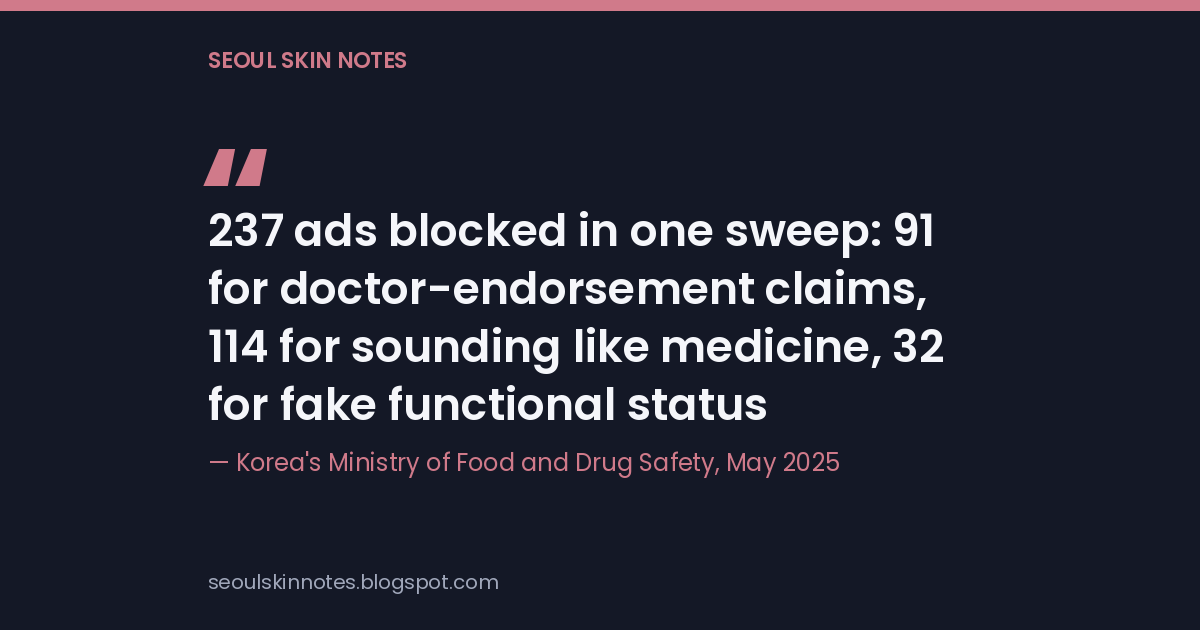
This isn't a dusty statute nobody checks. In May 2025, Korea's Ministry of Food and Drug Safety ran a sweep of online cosmetics ads and blocked 237 of them in a single action. Of those, 91 used phrases like "doctor recommended" or "hospital exclusive" in a way that could mislead a buyer, 38.4% of the total. A bigger share, 114 (48.1%), crossed into sounding like medicine outright, with words like "reduces inflammation" or "regenerates skin." The remaining 32 (13.5%) advertised an ordinary cosmetic with the kind of "wrinkle improvement" language reserved for cosmetics that passed Korea's separate functional-cosmetic review, claiming a status the product doesn't actually hold. The ministry didn't stop at the ad itself. After the first 186 cases, it traced the companies actually selling those products and caught 51 more, for the 237 total, and ran on-site inspections at 35 of them.
That one sweep sits inside a bigger, rising pattern. Data a lawmaker's office pulled from the ministry, published by Medifonews in October 2025, puts total cosmetics false-advertising cases at 12,617 between 2021 and September 2025: 1,913 in 2021, climbing to 2,453, then 3,090, then 2,680 in 2024, a 40.1% jump over those three years, with 2,481 more already logged by that September. Of that 12,617, roughly 70% (8,727 cases) were the medicine-sounding type specifically, phrases like "skin regeneration" or "reduces inflammation" dressed up as a cosmetic claim.
What a foreign shopper can check
None of this means every Korean skincare brand you'll ever see plays it straight. It means the specific phrase "doctor recommended" or "hospital exclusive" on a Korean-market product isn't a credibility signal the way it might read to you, since it's explicitly the kind of language regulators there spend enforcement effort chasing down. A legitimate Korean brand selling domestically has a real legal reason to avoid that exact phrasing. So if you're buying through an importer or a global storefront and you see that framing translated onto the English packaging anyway, what changed between the domestic label and the export one?
I tried to pull up the FDA's own page on cosmetics labeling claims today to see how directly the U.S. compares, and it wouldn't load for me, so I can't hand you that side-by-side the way I'd like to. What I can hand you is the primary source on the Korean side: the Korea Cosmetics Industry Association's page above carries the actual statute text, and the National Law Information Center's interpretation is the one I quoted above on low-irritation claims. Both are public and searchable if you want to check a specific claim against the law yourself rather than take my summary of it.
If you've read Korean packaging that leaned on a doctor or a hospital by name, or the softer "피부과 테스트 완료," I'd be curious which brand it was. That's exactly the category this sweep was built to catch.
This is a running series, not a one-off post — a new post goes up every day, at around 1am Korea time.
About · Contact · Privacy Policy
Read next: Snail Mucin, Alcohol and Indonesia's October 18 Halal Deadline · How Korea Defines a Niacinamide Whitening Serum (2-5%) · Why Korean Sunscreen Isn't FDA-Approved in 2026


Comments
Post a Comment