How Korea Defines a Niacinamide Whitening Serum (2-5%)
Stand two Korean niacinamide serums side by side, one printed "2%" and one printed "15%," and it's easy to assume the bigger number is just a stronger version of the same thing.
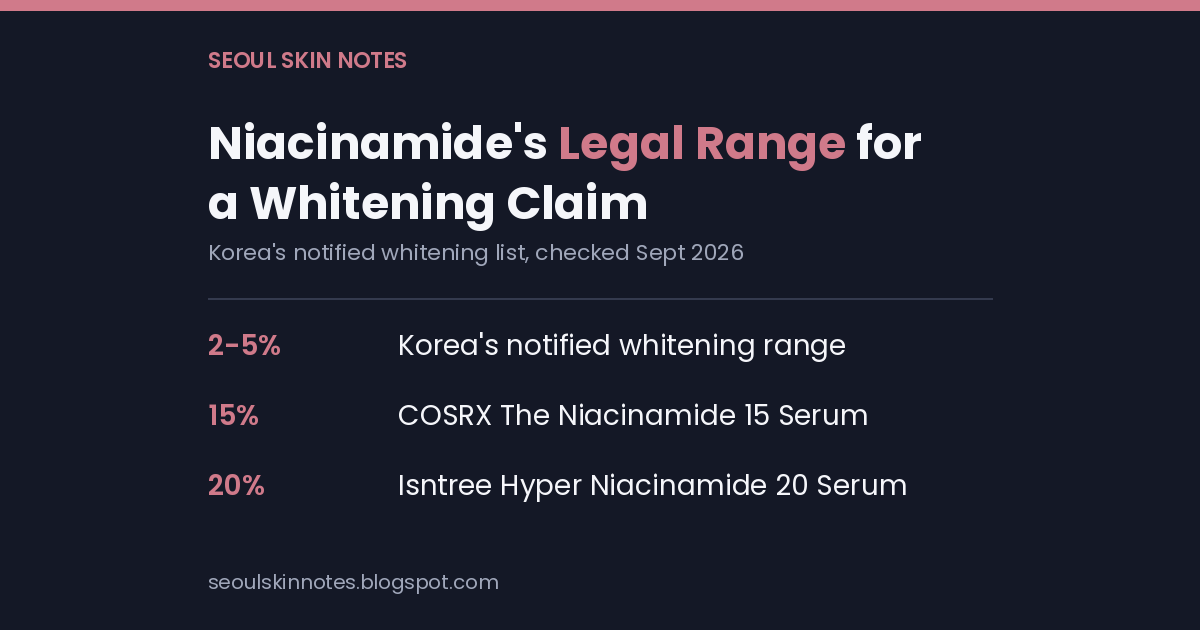
Korea's own cosmetics regulator has a number for this, and it isn't 15. 「기능성화장품 심사에 관한 규정」 별표4, the schedule attached to the Ministry of Food and Drug Safety's (MFDS) functional-cosmetics review notice, lists nine ingredients a brand can use to claim "helps with skin whitening," 피부의 미백에 도움을 준다, without submitting a single clinical study. Niacinamide's entry on that list reads, in full: 나이아신아마이드 2~5%. Two to five percent. No more.
What's on the Notified List
The whitening section of 별표4 names nine ingredients total, each with its own ceiling. Reading down the list makes niacinamide's range look almost generous by comparison:
| Ingredient | Concentration (as filed) |
|---|---|
| Mulberry extract (닥나무추출물) | 2% |
| Arbutin | 2–5% |
| Ethyl ascorbyl ether | 1–2% |
| Oil-soluble licorice extract | 0.05% |
| Ascorbyl glucoside | 2% |
| Magnesium ascorbyl phosphate | 3% |
| Niacinamide | 2–5% |
| Alpha-bisabolol | 0.5% |
| Ascorbyl tetraisopalmitate | 2% |
That table is copied straight from the PDF I downloaded off the National Law Information Center (국가법령정보센터) on September 22, 2026. It's a different attached schedule (별표4, not the SPF testing method in 별표3) off the same underlying MFDS notice the SPF testing post on this blog already covered. MFDS most recently amended the underlying regulation as 고시 제2025-88호, effective December 16, 2025, the revision that added solid-form (고형제) products to the eligible product types.
A companion table right below it, on the same page of the PDF, sets the same kind of ceiling for wrinkle claims: retinol tops out at 2,500 IU/g, adenosine at 0.04%. Hit either table's number and a brand can skip the clinical file that would otherwise back up a whitening or wrinkle claim, on niacinamide or on the other eight.
Why Exceeding the Number Isn't Illegal
Going over 5% isn't against the law. It just changes the paperwork. According to 찾기쉬운 생활법령정보, the Ministry of Government Legislation's official plain-language portal, a product only qualifies for the no-data-required track when "효능·효과가 나타나게 하는 성분의 종류·함량, 효능·효과, 용법·용량, 기준 및 시험방법이…고시한 품목과 같은," meaning the active ingredient, its concentration, the claimed effect, the dosing, and the test method all match what's already on file. A brand can still sell more than 5% niacinamide and still call it a whitening product. It just has to file its own efficacy and safety data for that specific concentration first, the same regulatory system used for a niacinamide-plus-dexpanthenol combo notified for hair loss shampoo in a different section of this rulebook.
The Concentration Gap on the Shelf
Here's where the notified ceiling and the actual shelf stop matching. COSRX's own Korean product page for The Niacinamide 15 Serum lists its full ingredient panel with the number built in: 나이아신아마이드(15%). Fifteen percent, three times past the top of the notified range, and the brand puts that number in the product's own name rather than hiding it. It's also on the ₩23,000 listing on Amorepacific Mall, which I checked on the same day. Isntree goes further. Its Hyper Niacinamide 20 Serum runs niacinamide at 20%, a full order of magnitude over the notified ceiling, with niacinamide sitting second in the ingredient list, right after water.
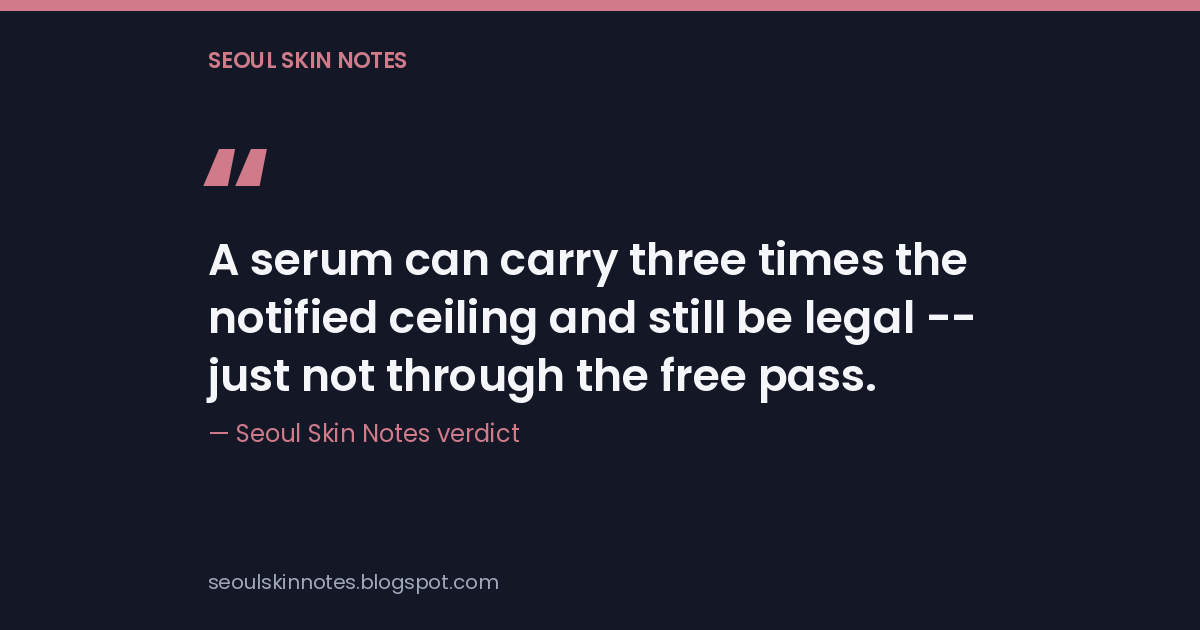
Neither product is doing anything wrong. Fifteen or twenty percent niacinamide is a real, sellable, apparently popular formula, and nothing in Korean law caps how much of it a bottle can hold. The 2–5% number was never a ceiling on the ingredient itself. It's a ceiling on which concentration gets the free pass, full stop, and nothing about that number moves just because a higher one sells well.
A Number the Label Won't Tell You
Whether COSRX or Isntree ever filed for individual review on these two products isn't something I'm going to guess at, because a reader can check it directly instead of taking my word for it. MFDS runs a public lookup at nedrug.mfds.go.kr, listed as "기능성화장품제품정보(심사)" for the individual-review track. Search fields are product name, company, ingredient, or review date, and on the day I opened it, the review-track database listed 20,702 filed items total. A second tool at the same site, CCBDC01, covers the no-review report track with the same fields: company name, ingredient, filing date. I haven't run either COSRX's or Isntree's product name through these myself. I only confirmed the two search tools work and what fields they return.
Type a product's Korean name into either box, and you'll get back a review number and a date, a report number and a date, or nothing. Have you looked up the number on your own serum yet?
This is a running series, not a one-off post — a new post goes up every day, at around 1am Korea time.
About · Contact · Privacy Policy
Read next: "Dermatologist Tested" vs "Doctor Recommended" on Korean Labels · Why Korean Sunscreen Isn't FDA-Approved in 2026 · How Korean Sunscreen SPF Is Tested: 10 Subjects, 2 mg/cm2
You might also like: How to Read the Date on Korean Food Packages After the 2023 Law Change (Korean Table)


Comments
Post a Comment