How Korean Sunscreen SPF Is Tested: 10 Subjects, 2 mg/cm2
Before a Korean sunscreen can print SPF 50+ on the box, it has to clear a test written into an MFDS notice called 기능성화장품 심사에 관한 규정, the Regulation on the Examination of Functional Cosmetics. The version in force is 식품의약품안전처고시 제2025-88호, effective December 16, 2025, and its page at the National Law Information Center lists it as 일부개정, a partial amendment. The testing method sits in 별표 3, 자외선 차단효과 측정방법 및 기준, fifteen pages of procedure: how many people, which part of the body, how much product, what lamp.
This is for anyone who has read a thread asking whether Korean SPF ratings can be trusted and wanted the underlying numbers rather than a summary of them. Everything below is quoted from the Korean text of Annex 3 as of September 16, 2026 (KST).
Ten people, one back, 2 mg/cm²
Clause 4 of Chapter 2 reads "피험자는 [부표1]의 피험자 선정기준에 따라 제품당 10명 이상을 선정한다," at least ten subjects per product, selected under the criteria in Sub-table 1. That sub-table narrows the pool to healthy men and women aged 18 to 60 with no skin disease, and to Fitzpatrick skin types I, II and III only. It excludes anyone who has had an adverse reaction to UV exposure or an allergic reaction to cosmetics, and anyone taking photosensitising drugs, with anti-inflammatories and antihypertensives given as the examples.
Clause 5 reads "시험은 피험자의 등에 한다." The test is done on the subject's back, on skin without damage, heavy hair growth or unusual pigmentation. Clause 10 gives the dose in one line: "도포량은 2.0mg/cm2 으로 한다."

The lamp is a xenon arc solar simulator with a continuous spectrum resembling sunlight and no particular peak, filtered to remove wavelengths at or below 290 nm. Product goes on with a rubber fingerstall, then sits fifteen minutes at room temperature to dry. Two reference samples calibrate the run, one with an SPF of 4.47 ± 1.28 for products expected below SPF 20, one at 15.5 ± 3.0 above that.
What gets measured is MED. Clause 3 defines it as "UVB를 사람의 피부에 조사한 후 16~24시간의 범위내에, 조사영역의 전 영역에 홍반을 나타낼 수 있는 최소한의 자외선 조사량," the smallest UVB dose that produces redness across the whole irradiated area, read between 16 and 24 hours later. The reading is not an instrument reading. Two or more trained people judge the erythema under a sufficiently bright light, and the same person who scored the untreated site scores the treated site on the same day.
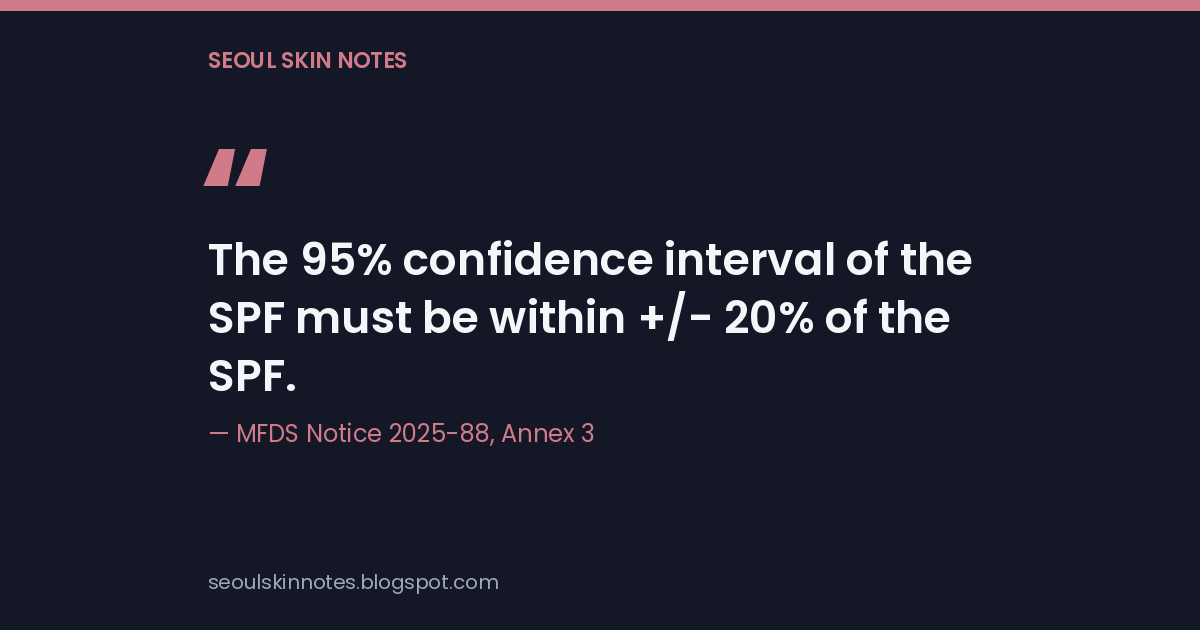
Each subject gives one SPF, MED on protected skin divided by MED on bare skin. Clause 13 then says the product's SPF is "그 산술평균값," the arithmetic mean of those, with a gate attached: "자외선차단지수의 95% 신뢰구간은 자외선차단지수(SPF)의 ± 20% 이내이어야 한다." If the interval is wider, the lab has to enlarge the panel or reset the conditions and run it again. Clause 14 throws away the decimals, so a computed 30.7 is labelled SPF30.
Where the plus signs come from
Chapter 4 covers UVA and repeats the same three numbers, at least ten subjects per product, the back, 2 mg/cm². The endpoint changes to MPPD, the smallest UVA dose that produces a faint darkening across the irradiated area, read between 2 and 24 hours later. PFA is MPPD on protected skin over MPPD on bare skin, averaged the same way, with a tighter interval: ±17% instead of ±20%.
PFA is rounded down to an integer, and from 2 upward it maps onto the grade you see on the box.
| PFA | Grade | Wording in the annex |
|---|---|---|
| 2 to under 4 | PA+ | 낮음 (low) |
| 4 to under 8 | PA++ | 보통 (moderate) |
| 8 to under 16 | PA+++ | 높음 (high) |
| 16 or more | PA++++ | 매우 높음 (very high) |
A PFA under 2 gets no grade at all. My earlier post on what PA++++ means next to SPF covers the label side; the boundaries above are where those cutoffs come from.
Korean sunscreen vs American sunscreen, on the test bench
The FDA's sunscreen monograph, 21 CFR 201.327, sets its panel floor at paragraph (i)(3)(i): "A test panel should include enough subjects to produce a minimum of 10 valid test results," with a maximum of three subjects rejected. Paragraph (i)(4)(iii): "Apply the sunscreen test product and the SPF standard at 2 milligrams per square centimeter (mg/cm 2) to their respective test sites." Test sites are "locations on each subject's back, between the beltline and the shoulder blades (scapulae)."
Ten valid results, 2 mg/cm², the back. I read the two texts next to each other and the experiment matches; the arithmetic at the end of it does not. Korea prints the arithmetic mean with the decimals dropped, and handles the spread through the separate ±20% rule. The FDA prints a lower bound, defined at paragraph (i)(6)(ii) as "the largest whole number less than SPF̄ − (t * SE)". One panel's raw data can therefore support two different label numbers depending on which rule the product is filed under. That is one more thing going on when a Korean formula and its reformulated US version carry different figures.

On UVA the two systems stop matching entirely. The FDA has no PA scale; a product is "broad spectrum" if it reaches "a mean critical wavelength of 370 nm or greater," a spectral absorbance measurement with no human panel at all.
Why people keep asking
Two incidents put the question in circulation. In December 2020 Dispatch reported retests of Purito's Centella Green Level SPF50+ sunscreen at SPF 28 from the Korean dermatological research institute 한국피부과학연구원, 19 from a Polish in-vitro lab and 19 from a German in-vivo test.
The second is still open. In July 2026 the YouTube channel 피부는 민동성 commissioned testing on ten Daiso sunscreens and said eight fell short of their SPF 50+ labels. Daiso's rebuttal, quoted by Asiae on July 14, 2026, went at the panel rather than the result: the data was "유효 피험자가 2~3명의 가임상 결과," a pilot with two or three valid subjects, submitted as an Excel file with no test lab, no test director, no report number and no lot number. That is clause 4 of Annex 3 being used as a defence. Daiso said it had offered to run the test again at a state-accredited lab under MFDS rules and been turned down, and that it would go ahead "상품 공급사와 함께 공인 기관을 통한 객관적 검증을 철저히 진행," an objective verification through an accredited body together with the supplier. Searching on September 16 I found no published result from one.
The draft that is not in force yet
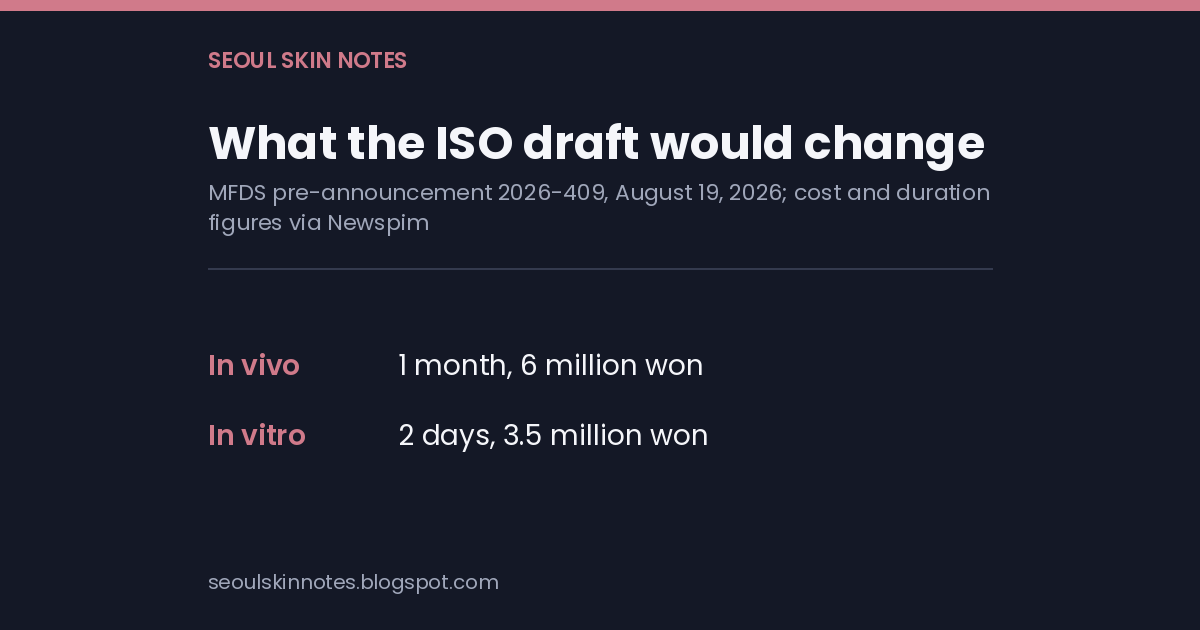
On August 19, 2026 MFDS pre-announced an amendment, 공고 제2026-409호, adding "국제표준화기구(ISO) 등에서 공인된 방법인 인체 외 시험자료," in vitro test data by ISO-recognised methods, as an acceptable basis for setting SPF and PA. CNC News names the two standards as ISO 23675 and ISO 24443. Newspim reports the practical difference as "인체 시험의 경우 한 달 동안 600만원이 소요됐으나 인체외 시험의 경우 이틀 동안 350만원이 소요된다," a month and 6 million won against two days and 3.5 million won, and a second clause that would allow SPF advertising "인체시험 또는 인체외시험으로 입증한 경우에만," only where one of the two tests backs it.
None of that is law yet. The notice states its comment deadline as "2026년 9월 18일(금)," two days from now, and a 행정예고 is a pre-announcement rather than an effective notice. The version in force at law.go.kr today is still 제2025-88호, and the MFDS notice for that December 2025 amendment puts the dosage-form exemptions and the hair-dye ingredient limits in Annex 4 among its changes. Annex 3 was left alone.
So if you pick up a Korean sunscreen today, the number on it came from ten backs and a xenon lamp. If the ISO methods go in next, some future boxes will carry a number from an in vitro test instead, and nothing in the draft I read asks the label to say which. Would you want it to?
This is a running news series, not a one-off post — new stories go up twice a day, roughly 7am and 7pm Korea time.
More Korea coverage from our network: Hallyu Now · Korea Travel Planner · K-Sports Global · Korean Table


Comments
Post a Comment