Skin1004 Sunscreen Korean vs American Version: What Changed
Short version first: the Skin1004 sunscreen Korean vs American question comes down to four UV filters, and the American tube is the cheaper one. Same name, same 50 ml tube, not one filter in common. The Hyalu-Cica Water-Fit Sun Serum you see on TikTok is the Korean SPF50+ PA++++ formula. The one Skin1004 sells on its own US site and on Amazon US is called "Water-Fit Sun Serum UV," and its drug-facts panel reads like a Neutrogena label.
Written for: 30-something combination skin in a humid US city, who has been paying third-party Amazon sellers for "the Korean one" and wants to know whether that markup buys anything.
Two ingredient lists, side by side
I pulled both lists on 7 September 2026, the Korean one from INCIDecoder's SPF50+ PA++++ listing and the US one from Skin1004's own UV product page, cross-checked against INCIDecoder's UV listing.
| Korean (SPF50+ PA++++) | US ("UV", SPF50 broad spectrum) | |
|---|---|---|
| UV filters | Diethylamino Hydroxybenzoyl Hexyl Benzoate (Uvinul A Plus), Ethylhexyl Triazone (Uvinul T 150), Methylene Bis-Benzotriazolyl Tetramethylbutylphenol (Tinosorb M), Diethylhexyl Butamido Triazone (Iscotrizinol) | Avobenzone 2.7%, Homosalate 13.6%, Octisalate 4.5%, Octocrylene 9% |
| Filter percentages disclosed | No (Korean cosmetic labelling doesn't require it) | Yes (US OTC drug labelling does) |
| Centella asiatica extract | Listed at 9,800 ppm, 15th in the list | Present, no ppm given, 20th in the list behind the thickeners |
| Niacinamide / adenosine | Both present | Neither |
| Panthenol, rice, oat, soybean extracts | None | All four added |
| Fragrance | None | None |
Four filters out, four filters in. Everything Korean sunscreen fans like about the texture of these formulas traces back to that left-hand column: Uvinul A Plus and Tinosorb M are the newer generation of filters, photostable on their own, and they let a chemist build SPF50+ without stacking a lot of oil-soluble UVB filter into the base. Homosalate at 13.6% plus octocrylene at 9% is the older way to get there.
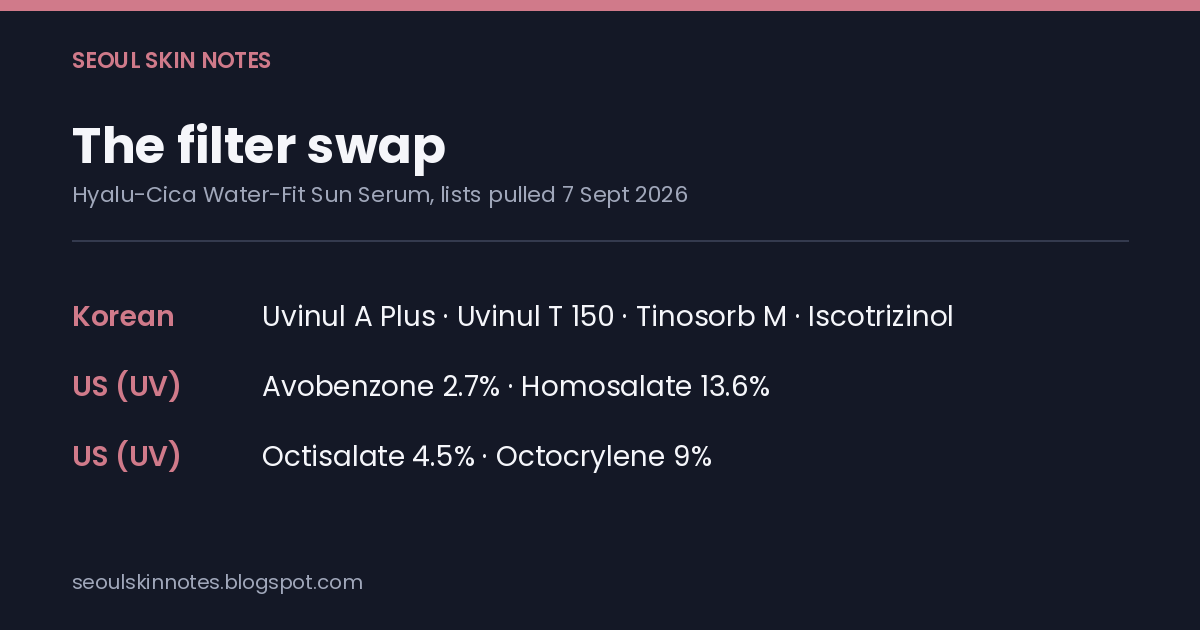
The right-hand column isn't a downgrade in protection. Avobenzone is a real UVA filter, and octocrylene is in there partly to keep it from breaking down in light. It does feel different on skin, though, and I'll get to that below.
Why the US tube had to change
Sunscreen is an over-the-counter drug in the United States, and a brand can only use filters on the FDA's monograph list. The Korean filters above are not on it. That list didn't get a single new entry from the late 1990s until 9 June 2026, when the FDA finalised bemotrizinol (Tinosorb S, up to 6%). Kavita Mariwalla, MD, president of the American Society for Dermatologic Surgery, told Dermatology Times the addition "allows US manufacturers to formulate in a cosmetically elegant way." Note the tense. Products using it are only now reportedly starting to appear, and Skin1004's UV tube predates all of that.
So Skin1004 took the route Beauty of Joseon took before it (Relief Sun isn't sold in the US and a separate US formula, Day Dew, sits in its place, per One Eye Beauty): keep the name, the tube, and the centella story, and rebuild the filter system from the approved list. It's a legitimate move. What I'd push back on is the marketing, which on the US page still leads with "no white cast" and "lightweight" as if nothing changed underneath.
One more regulatory wrinkle that cuts the other way. The EU capped homosalate in face products at 7.34% from July 2025. The US version runs 13.6%. So the American tube couldn't be sold in Paris, and the Korean tube can't be sold as a sunscreen in Los Angeles. Neither regulator is calling the other's product unsafe; they weigh different evidence and move at different speeds.
What the swap does on your face
I haven't tested either tube, so here is the most specific reviewer line I could find, with a time attached. Ledia at Kbeauty Notes, writing about the Korean version (page dated 7 September 2026), says it "looks very dewy, but sets very quickly into a satin finish" and that the faint cast you see while rubbing it in "disappears completely within a few minutes." She took it through a summer and planned to keep using it into autumn. She does not say she finished the tube, and I couldn't find anyone who has finished a tube of the US UV version and written about it. If that's you, the comments are open.

The dose matters more than the version. For a face you want roughly a quarter teaspoon, a bit over a gram, and a 50 ml tube used that way every morning is about seven weeks, not a season. At $19 that's around $2.70 a week, which is fine; at the $30-plus some third-party sellers ask for the Korean tube, it stops being fine.
Whether the US formula feels heavier is the honest unknown. Homosalate and octocrylene are oily liquids at those percentages, and the US inactive list adds cetyl alcohol and C20-22 alcohols that the Korean list doesn't have. If the UV tube sits greasier on you, I can't tell from the lists whether that's the filters or the fatty-alcohol base. Either is plausible. The Korean tube's extra niacinamide and adenosine are at undisclosed amounts and I wouldn't buy it for them.
Where to buy which, and what it should cost
A daily face SPF over $20 needs a reason. Neither tube has one, and on 7 September 2026 the prices looked like this.
United States: the UV version is $19 list, on sale at $17.10, on skin1004.com; Amazon US carries the same UV tube under the brand's own listing, and I'd check that price against the brand site before clicking. The Korean version on the brand's global site was $26 list, $20.80 on sale, and every size showed as sold out when I looked. Any US marketplace listing above that for the Korean tube is a reseller margin, and you're also trusting that seller's storage.
United Kingdom: Boots stocks the Korean SPF50+ PA++++ version, listed at £16 in the listing I could see on 7 September. Great Britain hasn't adopted the EU's 7.34% homosalate cap, per a CTPA notice, but that's moot here because the UK tube is the Korean formula anyway. Buy it in the shop; the customs form on a Korea-direct order eats the saving.
Australia: Chemist Warehouse stocks Skin1004 (brand page), but a product whose main job is UV protection is a therapeutic good in Australia that has to be on the ARTG, and Style Story, an Australian K-beauty retailer, says no Korean sunscreen brand was listed as of its last update, and that the TGA made a large local retailer pull non-compliant imported sunscreens in September 2025. Australians buying it from Olive Young Global or YesStyle are importing for personal use, and the SPF50+ on the label was tested to Korea's method, not AS/NZS 2604.
A few label words to read as marketing rather than claims. "Reef safe" on the Korean page is unregulated everywhere I looked. "No white cast" is unregulated too, and it depends on skin tone; the reviewer above still saw a cast for a few minutes. Neither page publishes a clinical test, so there's no sample size to quote, which at least means there's no inflated one.
Buy again, fine, skip
Buy again: the Korean SPF50+ PA++++ tube at £16 at Boots or under $21 from the brand's global site once it's back in stock. The newer filters earn the small premium, and the reviewer evidence on finish is consistent.
Fine: the US UV tube at $17 to $19. It's a properly labelled broad-spectrum SPF50 with avobenzone stabilised by octocrylene, and if you're reapplying at lunch anyway, that's the job.
Skip: the Korean tube from a reseller at $30 or more. You are paying $10 for four filter names and a niacinamide you can't measure, and for that money the redirect is a separate 10% niacinamide serum plus the $17 UV tube.
If you've used both tubes back to back, tell me which one your foundation slid around on by 3 pm. That's the comparison I couldn't find written down anywhere.
This is a running news series, not a one-off post — new stories go up twice a day, roughly 7am and 7pm Korea time.
More Korea coverage from our network: Hallyu Now · Korea Travel Planner · K-Sports Global · Korean Table


Comments
Post a Comment