Snail Mucin, Alcohol and Indonesia's October 18 Halal Deadline
From October 18, 2026, a cosmetic sold in Indonesia has to carry either a halal certificate or a non-halal marking, and that includes the Korean serum in your Shopee cart. Korea's Ministry of Food and Drug Safety (식약처) gave that date in an August 3 announcement about a delegation it had sent to Jakarta, and the Indonesian side has spent the summer publishing the fine print.
If you are in your twenties in Jakarta or Surabaya, oily skin in year-round humidity, and you buy Korean skincare through Shopee or a local distributor, this is what changes on the shelf next month. Readers in Malaysia and Singapore, your national rules are different, though the ingredient part below applies to you too.
Two dates, one deadline
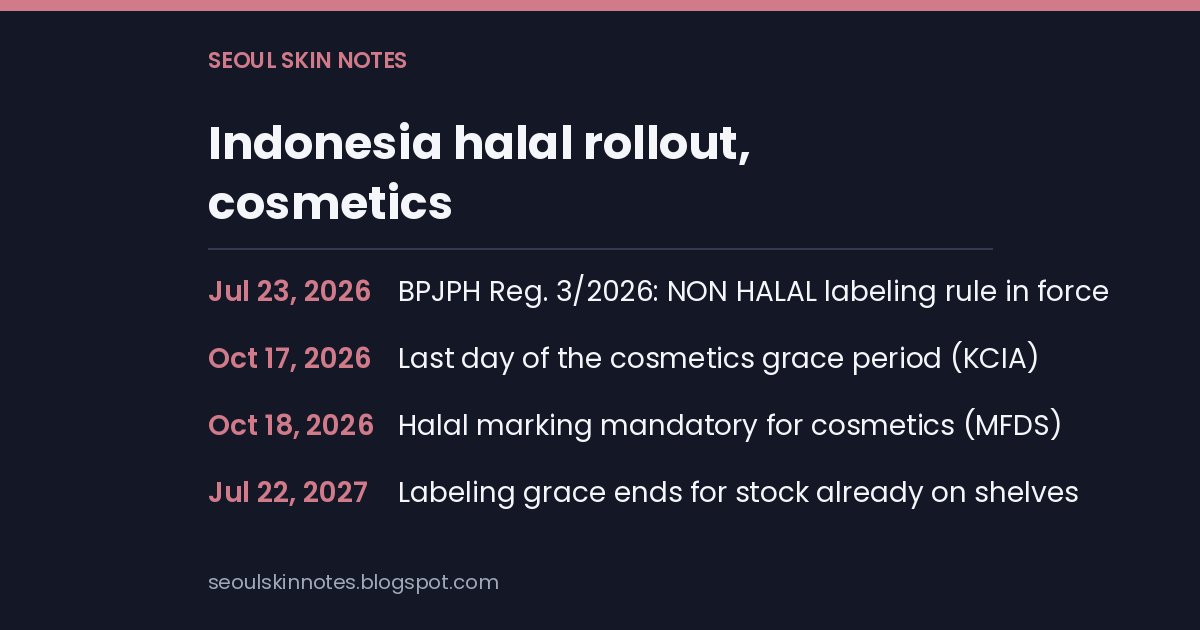
Korean coverage says October 18. English-language compliance guides say October 17. The Halal Foundation's news page opens with "Starting October 17, 2026, Indonesia will enforce mandatory halal certification for a wide array of products, including food and beverages, cosmetics, medicines..." The Korea Cosmetic Industry Association's market brief puts it the other way round, in Korean: cosmetics get a grace period "until October 17, 2026" (2026년 10월 17일까지 계도기간). The ministry's wording is "takes effect from October 18" (10월 18일부터 시행). Set the two side by side and the 17th is the last day of the grace period and the 18th is the first day the rule applies; the English guides appear to have taken the grace-period end date as the start date. One day either way, but if your distributor is counting shipments it is the 18th.
The legal basis is Indonesia's 2014 Halal Product Assurance Act, per the KCIA brief, which also gives the first wave: food and drink, from October 18, 2024. Cosmetics, medicines and some household goods are the second wave, and imports are covered (Financial News, Sept 10).
What a non-halal Korean toner will look like
I have not seen the label itself described in English K-beauty coverage. BPJPH, Indonesia's halal agency, issued Regulation No. 3 of 2026 on "the form and method of displaying non-halal information," in force since July 23, 2026. Korea's agri-food trade agency aT summarized it for exporters in a Sept 7 piece in Food Today. A product containing pork or a pork derivative prints "MENGANDUNG BABI" (contains pig) with a pig pictogram, red border, white background. Anything else that fails, whether a prohibited raw material or a non-halal process, prints "NON HALAL." For drinks, the summary adds a threshold: alcohol at 0.5 percent or more counts as non-halal. Uppercase, in a typeface called Rodfat, red #FC0202 on white #FFFFFF. The regulation covers food, drinks, medicines and cosmetics.
Products already in circulation before July 23 get up to twelve months, until July 22, 2027, before they need the marking, per the same aT summary.
So for about a year the Korean skincare aisle will be in three states. Certified, with the Indonesian halal logo. Marked with a red NON HALAL box. Or old stock cleared before the deadline, running down through mid-2027. On that third group, CNC News reported on August 3 that Indonesia's drug and food agency BPOM had promised to revise its rules to extend the grace period for goods legally imported before October 18; the ministry's own release described that extension as something BPOM would take to BPJPH for consultation (협의를 추진), with no new end date.
Snail mucin passes; alcohol is the line to read for
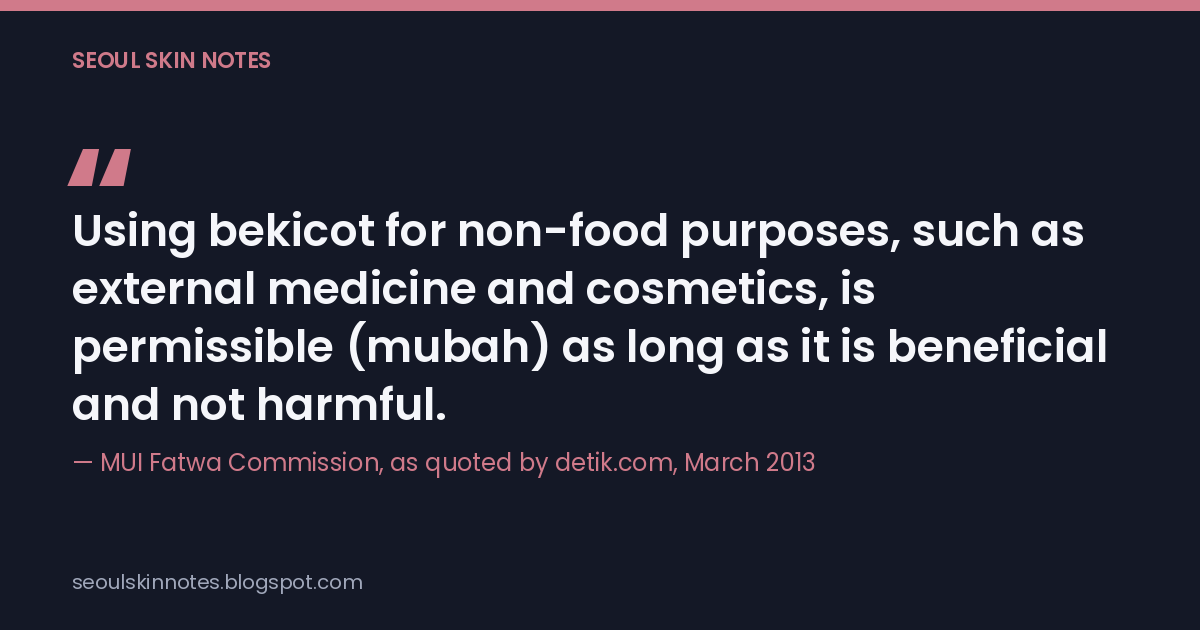
Whether snail secretion filtrate, the ingredient COSRX's Advanced Snail 96 Mucin Power Essence is named after, can be halal at all was answered by the Indonesian Ulema Council's fatwa commission. It ruled that the land snail (bekicot) is haram to eat, and in the same fatwa that "using bekicot for non-food purposes, such as external medicine and cosmetics, is permissible (mubah) as long as it is beneficial and not harmful" (my translation), as commission secretary Asrorun Niam explained it to detik.com on March 20, 2013. So the ingredient itself is not the blocker. Certification of a finished product is a separate question, since the whole supply chain has to pass, and I could not find a public list of which Korean snail products have cleared BPJPH.
Alcohol is where I would read the ingredient list. The 0.5 percent figure in the labeling regulation is written for drinks, per the aT summary, and I could not find a published alcohol threshold for cosmetics in any of the Korean coverage. Korean INCI lists name "Alcohol" or "Alcohol Denat." with no percentage, so a toner's label does not say how much is in it. The Indonesian distributor is the one who will find out when they file.
Pork derivatives are rarer in skincare than in food, but collagen, gelatin and some glycerin can be animal-sourced. The KCIA brief describes a halal cosmetic as one produced, processed and packaged under Islamic law (sharia), with pig-derived ingredients (돼지 유래 성분) as its one named example of what must be absent. BPJPH's deputy for registration and certification, Mamat Salamet Burhanudin, said in January that Indonesian cosmetics makers still import "approximately 85–90% of their raw materials," which is why the agency wants ingredient suppliers certified too (LPPOM MUI's write-up, Jan 20, 2026). The same guidelines, per that write-up, include rules on product names that "must not conflict with Islamic values or customary norms." Neither source says how a name like "Glass Skin" reads under that clause.
What Korea negotiated in July
The ministry sent a joint government-industry team to Jakarta on July 20–22 and came back with four items, per the Health Kyunghyang report on its announcement:
- The "halal supervisor" rule. A halal certification body in Korea previously had to employ a Muslim halal supervisor, which the ministry says did not fit a non-Muslim country. BPJPH agreed to change the rule so that a person who has completed BPJPH-recognized training and holds the qualification can do the job.
- A Korean factory that already holds halal certification will not need a fresh on-site audit when a different applicant files using that factory.
- The grace-period extension for goods cleared before October 18, above.
- Guidance on the existing rule for hand-carrying non-commercial samples for market research or study, 20 units per person, and the procedure that goes with it.
Suh Kyung-bae, chairman of the Korea Cosmetic Association, was on the trip and told CNC News that the government "stepping forward to speak for companies' customs and regulatory difficulties and drawing up concrete solutions was a real help to companies trying to enter Indonesia" (my translation). Behind it, the ministry has been building a database of roughly 4,000 halal-compatible ingredients checked against Indonesia's KMA No. 1360/2021 ingredient rules, announced on korea.kr on May 7.
Pre-shipment checks are the newer problem
What made Korean beauty trade press nervous this week comes before the ship leaves. Under BPJPH Regulation No. 4 of 2026, a certified product has to be physically inspected by an accredited body at the origin warehouse or production site before loading, with a Halal Product Assurance Report (LPPH) issued, Market Economy News reported on September 14. The paper quoted an Indonesia-based certification firm, GL Halal Certification Center, saying the strengthened pre-shipment verification system "can if anything become a competitive advantage for companies that prepared thoroughly" (my translation). Lead time and cost of that inspection are what brands are pricing in now.
Ga Gi-kyung, a principal researcher (수석연구원) at KTR (한국화학융합시험연구원), told a Sept 10 Korea International Trade Association seminar that "after the mandate, non-halal products must carry a Non-halal mark, and new rules such as pre-shipment conformity confirmation (LPPH) are being applied, so particular care is needed" (Money Today, my translation). About 150 exporter representatives were in the room. Indonesia has roughly 280 million Muslim consumers by Financial News's count, and the KCIA brief sized the halal cosmetics market at USD 5.6 billion in 2022 with a 2028 forecast of 9.2 billion.
For a shopper, nothing here needs doing before October 18. If a Korean product you rebuy shows up with a red NON HALAL box after October, its Indonesian distributor did not or could not certify it. For a toner the reason may be alcohol, for a cream the collagen or glycerin source, and the box will not say which. It is a disclosure, in the same way an INCI list is a disclosure. Whether a reader's own practice draws a line at alcohol on skin is a personal matter, and the MUI fatwa on snail shows the scholars themselves drawing an external-use line.
What I could not find anywhere is a published list of Korean brands or SKUs that already hold BPJPH certification for Indonesia. If a Shopee listing shows you the Indonesian halal logo on a Korean product, which one was it?
This is a running news series, not a one-off post — new stories go up twice a day, roughly 7am and 7pm Korea time.
More Korea coverage from our network: Hallyu Now · Korea Travel Planner · K-Sports Global · Korean Table


Comments
Post a Comment