COSRX vs Anua: Which BHA Toner Names Its Acid %
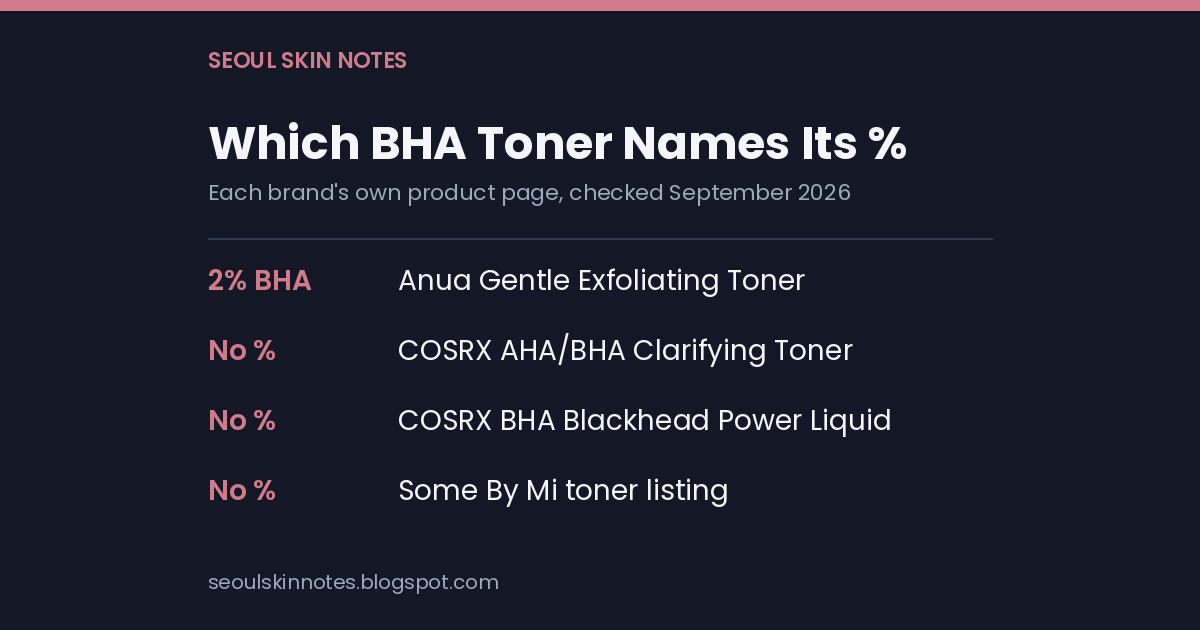
Anua's toner is called BHA 2% Gentle Exfoliating Toner, and its own product page states plainly, "a gentle exfoliating toner formulated with 2% BHA," priced at $20 for 150ml. COSRX's AHA/BHA Clarifying Treatment Toner sells at the same $20, the same 150ml, to a lot of the same shopping carts. Its own product page has no percentage anywhere. Neither does COSRX's other acid bestseller, the BHA Blackhead Power Liquid, at $25 for 100ml.
If you've compared two Korean acid toners side by side and picked one based on nothing but the name, this is about why that happens so easily.
What Anua's Page States
The raw listing data from anua.com, checked in September 2026, has the title field reading "BHA 2% Gentle Exfoliating Toner" and the description field reading, in full, "A gentle exfoliating toner formulated with 2% BHA, designed to exfoliate dead skin cells, help clogged pores, and improve skin clarity and balance." The 2% belongs to salicylic acid. On the ingredient database inkeedecoder, Salicylic Acid sits fourth in the full ingredient list, right after water, dipropylene glycol, and 1,2-hexanediol.
Two COSRX Products, Zero Percent Signs
COSRX's own descriptions, pulled the same way from cosrx.com, don't include a number once. The AHA/BHA toner's copy reads, "The formulation of AHA+BHA+Purifying Botanical ingredients help to improve skin texture, increase vitality, and control pores. Eliminate impurities, exfoliate, and hydrate all in one step." The Blackhead Power Liquid's copy reads, "BHA & Niacinamide exfoliating liquid for gentle exfoliation and oil control. Suggested for mid-level acid users." Neither title, on a $20 toner or a $25 liquid, includes a percentage.
It wasn't always that way for the liquid. A separate, older inkeedecoder listing, tagged "(Discontinued)," describes what looks like an earlier bottle of the same product as containing "4% natural BHA component." In that version, Betaine Salicylate sits third in a ten-ingredient list. The current listing drops the number entirely and moves Betaine Salicylate to fifth of eleven.
The two lists don't match ingredient-for-ingredient either. The current version adds a plain Betaine at third place, ahead of Betaine Salicylate, and lists Sodium Hydroxide where the older version had Arginine. Why did any of that change? Neither page explains.

Reading the List When the Front Label Won't Talk
Korea's own labeling rule makes ingredient-list position mean something, at least part of the time. 화장품법 시행규칙 별표4, amended 2025.2.7, item 3-나, requires ingredients used above 1% to be listed in descending order by how much is in the product. The clause itself reads, "화장품 제조에 사용된 함량이 많은 것부터 기재ㆍ표시한다." The next sentence carves out an exception: "다만, 1퍼센트 이하로 사용된 성분, 착향제 또는 착색제는 순서에 상관없이 기재ㆍ표시할 수 있다." Anything at or under 1% can go in any order a brand likes.
That's the frame for lining up all four products. On COSRX's toner, Glycolic Acid sits seventh of twelve ingredients and Betaine Salicylate ninth, both ranking behind Willow Bark Water at second place and Apple Fruit Water at third, the two ingredients that read the most like an acid toner's actual acids without being one. On Anua's toner, Salicylic Acid sits fourth. Some By Mi's AHA-BHA-PHA 30 Days Miracle Toner goes further: Salicylic Acid lands nineteenth and Lactobionic Acid twentieth, in a twenty-seven-ingredient list that puts niacinamide, tea tree leaf water, papaya extract, and even a swiftlet nest extract at twelfth place ahead of both.
None of that proves the acid content is small. Past the 1% line the rule stops requiring any order, so position nineteen could mean 0.9% or 0.09% — there's genuinely no way to tell from the list alone.
Some By Mi's own site doesn't add a number either. Its toner listing page describes the formula as containing "mild peeling acids such as AHA, BHA and PHA," without a percentage for any of the three. One ingredient-review site, whatsinmyjar.com, estimates the toner's acid content at 0.25 to 0.5 percent citric acid, 0.3 to 0.55 percent salicylic acid, and 0.3 to 0.5 percent lactobionic acid, without explaining the math behind those numbers. The brand itself hasn't confirmed any of the three.
Same Shelf, Same Price, Different Label
Line the four up and the split is clean. One product states its acid percentage on the label, and its ingredient position backs that up. Three don't state a number, with their acid ingredients ranging from mid-list to deep in a twenty-seven-item one. Korean cosmetics rules don't require any of the three to publish that number, because everything at or under 1% is exempt from the ordering rule in the first place.
A $20 toner with the strength printed on the front and a $20 toner without it aren't automatically different products underneath. But right now, one of them is telling you something the other one isn't, and "AHA/BHA" in a product name doesn't tell you which is which.
The next time a Korean acid toner's name skips the percentage, where does its actual acid sit on the ingredient list? Fourth, like Anua's? Or nineteenth, like Some By Mi's?
This is a running news series, not a one-off post — new stories go up twice a day, roughly 7am and 7pm Korea time.
More Korea coverage from our network: Hallyu Now · Korea Travel Planner · K-Sports Global · Korean Table


Comments
Post a Comment