Toner vs Essence vs Serum vs Ampoule: What Korean Brands Mean
Toner, essence, serum, ampoule. Go to COSRX's own website and look for the second item on that list. There isn't one. The category is called "Serums & Essences," one collection, no dividing line. Search SKIN1004's site the same way and the navigation runs "Toner & Mist" straight into "Ampoule & Serum," skipping essence entirely. Do the brands themselves even agree on where essence starts, or whether it's a category at all?
This one's for anyone standing in front of an Olive Young shelf or four open tabs, trying to work out whether the $22 "essence" and the $34 "serum" next to it are genuinely different things, or just different labels on similar bottles.

Essence Was Invented as a Marketing Category, Not a Formula
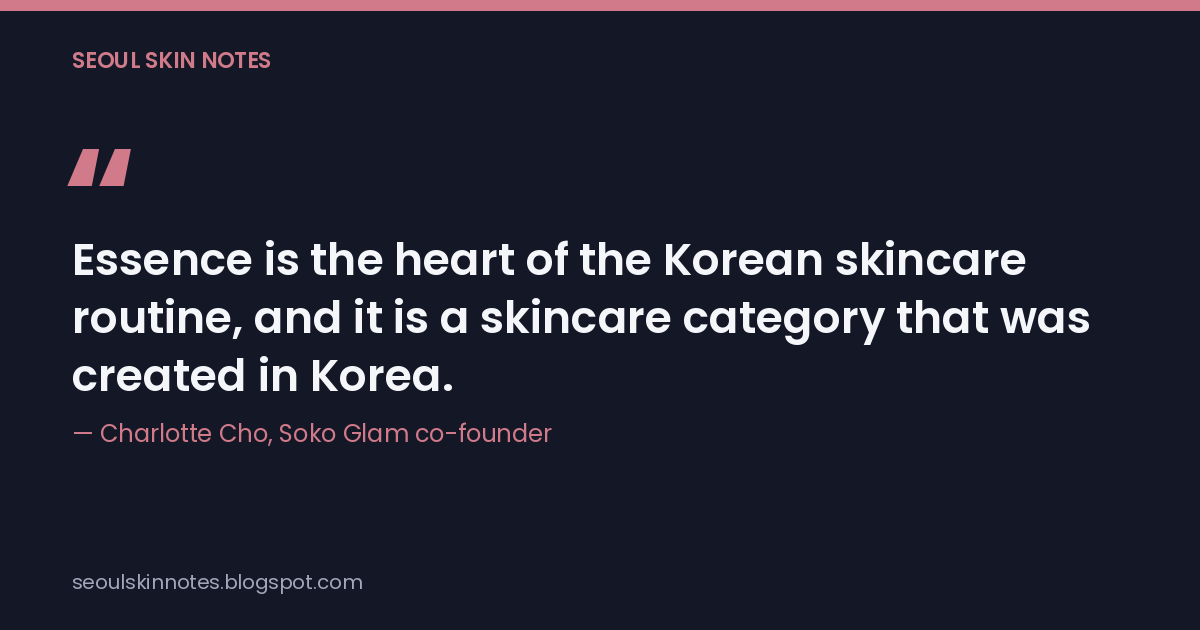
Essence didn't emerge from a chemistry difference the way, say, an ampoule's higher active load did. It emerged because Korean brands wanted a hydration-and-absorption step between toner and serum, and gave it a name. "Essence is the heart of the Korean skincare routine, and it is a skincare category that was created in Korea," Soko Glam co-founder Charlotte Cho told Into the Gloss back in 2015, choosing the word "created" deliberately.
That history explains why the definitions you find today wobble depending on who's writing them. Those are two different products being asked to share one shelf label. K-beauty educator Renee, writing for Dermstore, splits essence into two different things entirely: a "first-treatment essence" built around a high concentration of fermented ingredients, and a second type that's "more like a cross between a toner and a serum."
Where the Line Disappears
Serum and ampoule get a cleaner distinction, at least in theory. Renee describes an ampoule as "the supercharged version of serums", a short-term, higher-concentration treatment rather than an everyday step. That tracks with how most ampoules are sold. Smaller bottles, dropper caps, "use for 2-4 weeks" instructions.
Essence and serum are where the wheels come off. Look at COSRX's Advanced Snail 96 Mucin Power Essence, a watery, high-snail-mucin product the brand itself files under the same URL path as its serums, not a separate essence collection. Look at SKIN1004's Madagascar Centella line. The brand's own site organizes its skincare into "Toner & Mist," "Ampoule & Serum," "Moisturizer," and a few others.
Essence isn't one of them.
A product exactly like the ones other brands call "essence", thin, hydrating, sits between toner and serum in a routine, just gets folded into whichever neighboring category the brand picked.
The Percentage Numbers You'll See Floating Around Aren't Real
Search this exact question and you'll run into a specific, oddly confident set of numbers: essence sits at 3-8% active concentration, serum at 5-15%, ampoule at 15-30%. I went looking for where those figures actually come from. Nowhere. No brand publishes a concentration range by category, no regulatory body defines one, and the handful of small blog sites repeating those exact numbers don't cite a source either. Treat any number like that as a plausible-sounding invention until a specific product's own label confirms it. They're citing each other.
What you can check, product by product, is the one thing brands do disclose voluntarily: what a "97%" or "96%" claim on the front of a bottle actually refers to. Missha's own US site lists The First Essence 5X at $39 for 150ml with "97% Desert Cica Yeast Ferment" stated directly on the product page, a real, sourced number specific to that one product.
What Changes When You Move Up the Shelf
Strip out the category labels and what's left is texture and price. Toner runs thinnest and cheapest, built to replace the water your skin lost during cleansing rather than to treat anything. Essence and serum both sit in the middle, and which one a given bottle gets called seems to depend more on brand positioning than formula. A $22 "essence" and a $34 "serum" from two different brands can have near-identical viscosity and a comparable hero ingredient. Ampoule is the one label that reliably means something. Smaller bottle, dropper application, a concentration meant for weeks, not months, and priced accordingly.
If you're deciding what to buy, ignore the category word on the front of the bottle and read three things instead: the ingredient list's order (whatever's listed right after water is the one doing the most work), any percentage the brand states outright on its own site, and the bottle size relative to price. A thin, cheap bottle plays a toner's role under an essence's name often enough that the name shouldn't be the deciding factor.
Bought something labeled "essence" that turned out to perform more like a serum, or the other way around? I'd genuinely like to hear the specific product, since the mismatches are more common than the routine diagrams suggest.
This is a running news series, not a one-off post — new stories go up twice a day, roughly 7am and 7pm Korea time.
More Korea coverage from our network: Hallyu Now · Korea Travel Planner · K-Sports Global · Korean Table


Comments
Post a Comment