Korean Skincare for Black Skin: White Cast and Dark Spots
A cosmetic chemist recently had to go on the record, in Essence, explaining that Korean skincare doesn't bleach anyone's skin. Enough people were asking that someone had to answer it plainly.
Written for: anyone with Black or deep-brown skin circling the K-beauty aisle but stuck on two things — sunscreen reviews that never say how a formula sits on melanin-rich skin, and "brightening" copy that reads like it might mean something you don't want. Checked September 11, 2026.

Does "Brightening" Mean Lightening?
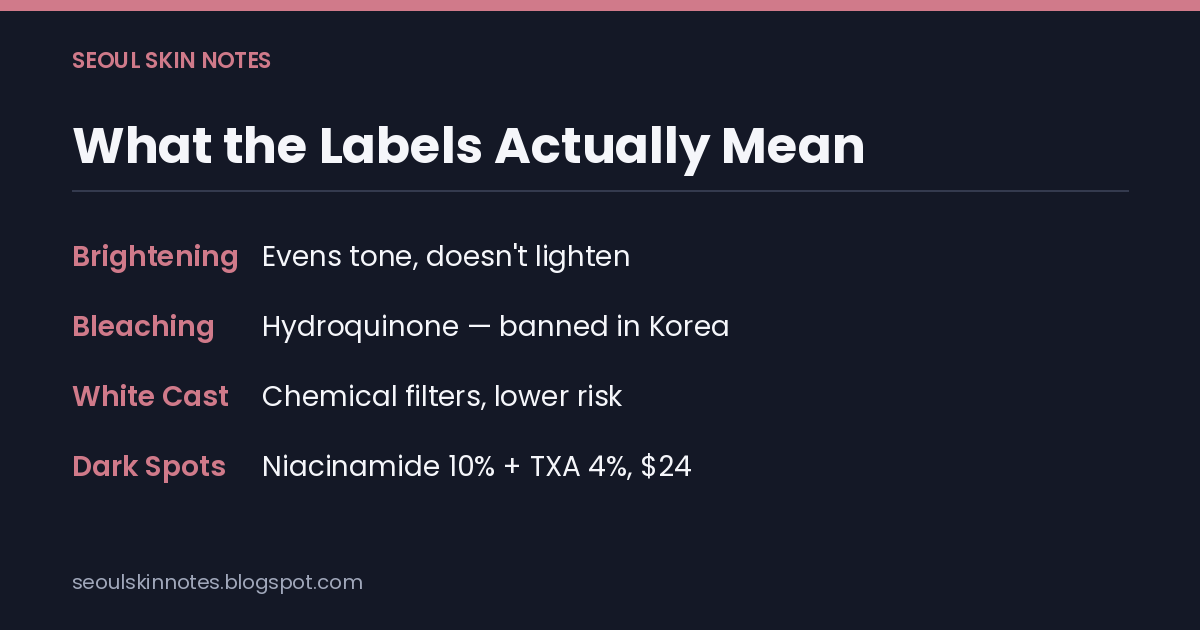
Short answer: no, not on its own. Mibaek (미백), the Korean word cosmetics use, translates loosely to "whitening," and English marketing copy softens that to "brightening" without explaining the gap. Under Korea's own cosmetic rules the term is narrower than either translation suggests: pulling melanin in an existing dark spot back down to your own baseline, not lightening skin that was never dark to begin with. The ingredient actually capable of bleaching skin tone-wide, hydroquinone, is a banned cosmetic ingredient in South Korea under Ministry of Food and Drug Safety rules, restricted the same way the EU restricts it, per ChemLinked's regulatory summary.
Cosmetic chemist Ron Robinson, founder of BeautyStat, put roughly the same point to Essence: Korean skincare can brighten and even out tone, but it takes an actual bleaching agent to change your skin color, not a serum with niacinamide in it. I'd add the part Robinson didn't need to. The formula being technically non-bleaching doesn't mean a brand's shade range or ad campaign reflects who's buying it. That's a separate, legitimate gripe from "does this cream lighten my skin," and you're allowed to hold both at once.
The White Cast Problem, Honestly
This is where the "zero white cast!" claims need a second look. Dr. Mara Weinstein Velez, a board-certified dermatologist and assistant professor at the University of Rochester Medical Center, told NBC Select that tinted mineral sunscreens blend better on darker skin than untinted ones. That's a tell by itself: if tinting is what fixes it, the untinted version was leaving something behind. Chemical filters, the kind most popular K-beauty sunscreens run on, generally have an easier time here because they absorb into skin instead of sitting on top of it.
Beauty of Joseon's Relief Sun runs on chemical filters only (its ingredient list has no zinc oxide or titanium dioxide at all), and it's marketed as leaving no white cast. Most reviews back that up. For the skin tones doing the reviewing. Aesthetic doctor Rachel Ho tested it herself and still caught a faint cast on her own skin, and said so plainly: on a deeper tone than hers, expect it to show more, not less. That's what an honest "no white cast" claim looks like: a real result on one specific skin tone, with a real caveat attached for the skin tones it wasn't tested on. Buy a sample size before committing to the full bottle if the brand sells one, and check it in daylight, not the bathroom mirror.

What Fades a Dark Spot
Post-inflammatory hyperpigmentation, the dark mark left behind by acne or irritation, shows up more often and sticks around longer on deeper skin. It's frequently the part patients mind more than the breakout that caused it. That's from a 2010 review in the Journal of Clinical and Aesthetic Dermatology, not exactly breaking news, but the caution in it hasn't gone stale: the same irritation that's supposed to treat PIH can also cause it. In one trial the authors cite, half of the Black patients using 0.1% tretinoin developed retinoid dermatitis, irritation bad enough to trigger the exact rebound pigmentation the treatment was meant to fix. Their fix isn't "skip retinoids." It's start lower, go slower than the bottle suggests, and switch to a cream over a gel if the gel stings.
Niacinamide gets recommended for this constantly, and it's a reasonable pick, but the same review is honest about a gap worth knowing: nobody has specifically studied how well it works on darker skin. The existing data leans on lighter-skinned and East Asian study groups. That's not a reason to skip it. It's a reason to expect a slower, less dramatic result than the marketing promises, and to judge it against what your own skin actually does rather than a testimonial from someone whose skin tone isn't yours.
Tranexamic acid is the newer addition to that stack, and it's the one ingredient here I can point to a specific, buyable product for. Anua's Niacinamide 10 + TXA 4 Serum runs $24 for a bottle combining 10% niacinamide, 4% tranexamic acid, and 2% arbutin. I can't promise it clears a dark mark in four weeks. Nobody credible promises that. But the concentrations are printed on the label, which already puts it ahead of most "brightening" serums that won't say a number at all.
Where That Leaves You
None of this is an argument to skip Korean skincare. It's an argument to read past the label and check who's doing the reviewing before you buy. A sunscreen that's cast-free on someone three shades lighter than you isn't a guarantee, it's a data point. Start with a sample size, patch test anything with an active before it goes on your whole face, and give a brightening serum longer than a week before deciding it's doing nothing.
Has a K-beauty sunscreen surprised you either way on your own skin, or is there a brand you'd tell a friend to skip before they waste the money?
This is a running news series, not a one-off post — new stories go up twice a day, roughly 7am and 7pm Korea time.
More Korea coverage from our network: Hallyu Now · Korea Travel Planner · K-Sports Global · Korean Table


Comments
Post a Comment