Centella Asiatica Results From Five Human Trials
A 2026 Korean trial on centella asiatica never put anything on anyone's face. One hundred and twelve women aged 30 to 60 were randomized in Seoul, half of them swallowing one 200 mg tablet a day for twelve weeks and half a placebo, and I expect to see the numbers it produced quoted on a cica ampoule box before long. Average wrinkle depth in the tablet group fell 11.1%.
The question people type is whether centella does anything for the skin barrier. I read five human trials and one review to answer it, on September 18, 2026 (KST). Two are Korean or Chinese, three are not, and none of them tested a cica ampoule.
The Korean trial is a supplement trial
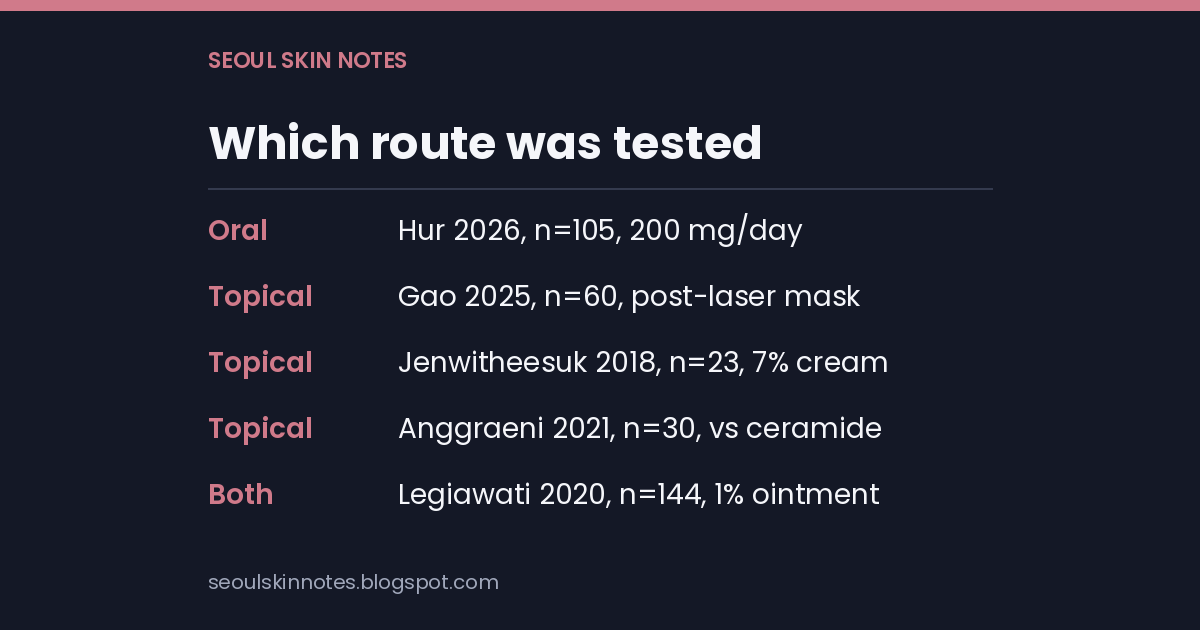
Hur and colleagues published it in Nutrients in 2026. A randomized, double-blind, placebo-controlled, parallel-group trial: 112 participants split 56 and 56, 105 finishing the per-protocol analysis, 200 mg a day of a standardized extract given orally as one tablet. The authors state the research received no external funding. The extract is named in the paper as InnerCica, with asiaticoside at 70 mg/g.
That 11.1% is a fall from 53.02 μm at baseline to 47.15 μm at week 12. Against placebo the change was −5.87 μm versus −1.96 μm (p = 0.018). Total wrinkle volume dropped 13.7%, and the between-group difference was −0.30 mm³ versus −0.10 mm³ (p = 0.004). Cheek transepidermal water loss went from 11.48 to 9.44 g/hm², a between-group change of −2.04 versus −1.05 (p = 0.005). Cheek hydration rose about 2.7%, a between-group gap of +3.26 against +1.35 arbitrary units (p < 0.001).
Three adverse events were recorded across both arms, one in the extract group and two on placebo, all judged unrelated to the product. Elasticity moved least. R2 went from 0.7309 to 0.7363 E/mm at p = 0.024, and the paper itself calls that magnitude small, roughly 0.7% from baseline.

The topical trials are about damaged skin
Gao and colleagues, Journal of Cosmetic Dermatology, 2025 ran 60 subjects, 30 per arm, after non-ablative fractional laser at 1550 nm and 1927 nm. On the three measures I can quote, the mask arm came out ahead. Day 7 TEWL was 20.50 in controls against 12.63 in the mask group in g/(h·m²) (p < 0.001), day 7 erythema index 13.48 against 11.47 (p = 0.020), day 14 hydration 44.76% against 51.55% (p = 0.006).
Before you carry those numbers over to a cica ampoule, look at what was in the mask. It is La Roche-Posay's B5 Pro, and the paper describes it as containing enriched panthenol, centella asiatica extract (madecassoside) and bisabolol. Three actives, no disclosed concentration for any of them. The study was funded by the National Natural Science Foundation of China and by L'Oréal Dermatological Beauty China, La Roche-Posay, which does not invalidate the measurements and is a reason to read them with the funder in mind.
The other topical trial is surgical. Jenwitheesuk and colleagues, 2018 applied a cream containing 7% w/w centella asiatica extract twice daily to split-thickness skin graft donor sites, against placebo, for 12 weeks; 23 of 30 patients completed it. Vancouver Scar Scale pigmentation favored the centella side at p = 0.010 by week 8 and p = 0.001 by week 12, with overall VSS at p = 0.041 across weeks 4 to 12. Scar height was worse on the centella side at week 4 (p = 0.043) before recovering. They did not measure TEWL or melanin, and the cream was mixed at 7% w/w, a figure no cosmetic ingredient list I have read puts in print.
Against ceramide, it drew
This is the result I have not seen a brand quote. Anggraeni and colleagues, 2021 put 30 Indonesian batik workers with dry skin and no contact dermatitis through a four-week double-blind trial, centella cream on one side of the comparison and ceramide cream on the other, applied to hands and arms twice daily.
Both worked.
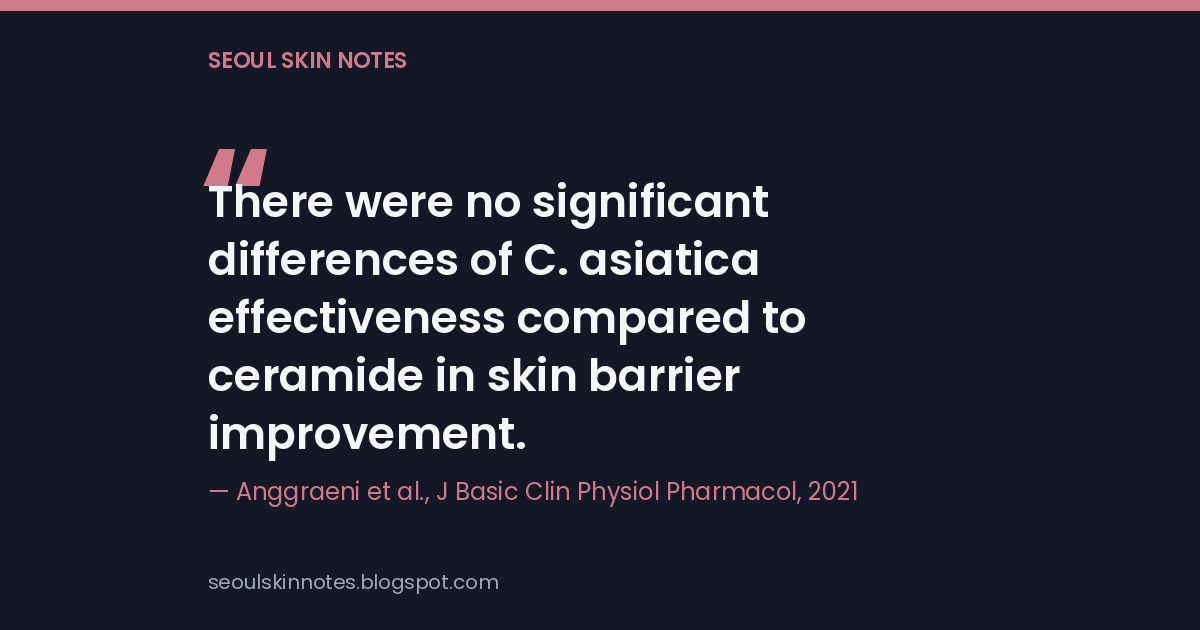
Corneometer readings improved for centella at p = 0.007 on the palm and p = 0.001 on the back of the hand, and for ceramide at p = 0.038 and p = 0.002. Ceramide also moved TEWL on the back of the hand (p = 0.023), where centella did not. The comparison comes down to one sentence in their results: there were no significant differences of C. asiatica effectiveness compared to ceramide in skin barrier improvement. If you are choosing cica over a ceramide cream for barrier repair, this is the only head-to-head trial I found. Four weeks, 30 people, hands and arms.
The 1% arm that went nowhere alone
Legiawati and colleagues, 2020 is the closest thing here to a concentration test. Three arms, 159 enrolled and 144 completing, 28 days, in type 2 diabetes patients with dry skin on the lower legs scored above 3 on the SRRC scale, which covers scaling, roughness, redness and crack fissure. One arm took 2 × 1,100 mg orally plus a 1% topical ointment, one took oral placebo plus the same 1% ointment, one got placebo in both forms.
Only the combined arm separated from double placebo, at p = 0.04 on the clinical score and p = 0.01 on skin capacitance, and the authors limit even that conclusion to patients whose blood glucose was controlled, HbA1c at or under 7 and random blood glucose under 200. The topical-only arm showed no significant advantage by day 29. TEWL was not measured.
| Trial | Completed | Route | What was applied | Result |
|---|---|---|---|---|
| Hur 2026 (Korea) | 105 | Oral | 200 mg/day extract, 12 weeks | Wrinkle depth −11.1%, TEWL −2.04 vs −1.05 g/hm² |
| Gao 2025 (China) | 60 | Topical | 3-active mask after laser, 14 days | Day 7 TEWL 12.63 (mask) vs 20.50 (control) |
| Jenwitheesuk 2018 | 23 | Topical | 7% w/w cream on graft donor site, 12 weeks | VSS pigmentation p = 0.001 at week 12 |
| Anggraeni 2021 | 30 | Topical | Centella cream vs ceramide cream, 4 weeks | No significant difference between the two |
| Legiawati 2020 | 144 | Both | 2 × 1,100 mg oral + 1% ointment, 28 days | Significant only in the combined arm, and only with controlled glucose |
What I could not find
A randomized topical trial at the strengths cosmetics use, somewhere between 0.1% and 1% of an extract, on ordinary skin rather than laser-treated or surgical skin. The nearest candidate is secondhand. Bylka's 2013 review cites a six-month study of 0.1% madecassoside with 5% vitamin C in 20 women aged 45 to 60, reporting significant improvement in firmness, elasticity and skin hydration. That is the review's summary of someone else's paper. PubMed served me a cookie wall on the original and the publisher returned 403, so I have not read it, and I am not going to quote a number out of a page I could not open.
Korean brand data is the other gap. I searched in Korean for the human application test figures behind Skin1004's Madagascar Centella ampoule and got retail listings, review aggregators and shopping pages. Brands here do commission 인체적용시험, the human application test. What comes back out of it is marketing copy. In that search I found no published n, no test period and no p value.
The same review describes the pharmaceutical extract, TECA, as 40% asiaticoside with a 60% mixture of asiatic and madecassic acids. Your ampoule lists "centella asiatica extract" and gives you no split at all.
Does centella do something measurable in people? In five trials, yes, in the same direction, mostly on damaged or aging skin, at effect sizes the papers themselves call small. Is it better than a ceramide cream on a dry, compromised barrier? One trial of 30 people says no.
If you own a Korean cica product whose carton prints a human application test result, with an n and a test period on it, tell me what the panel says. I have not found one.
This is a running series, not a one-off post — a new post goes up every day, at around 1am Korea time.
About · Contact · Privacy Policy
Read next: Ten Snail Mucin Trials, None on a Korean Product · Korean Skincare vs CeraVe: What the Ceramide Lists Show · How Korea Defines a Niacinamide Whitening Serum (2-5%)


Comments
Post a Comment