How to Reapply Sunscreen Over Makeup Without Wrecking It
Every format sold as "reapplies over makeup" solves the smearing problem. Cushion, spray, stick, pressed powder — none of them will drag your foundation across your cheek the way a squeeze of lotion sunscreen would at 2 p.m. Only one of them reliably solves the actual SPF problem, and it's not the one most people reach for first.
That distinction matters because reapplying sunscreen over makeup is the part of your routine you're most likely to skip entirely — then feel virtuous about it, because you put on sunscreen at 8 a.m. and it's already 3 p.m.

The Powder Problem, By the Numbers
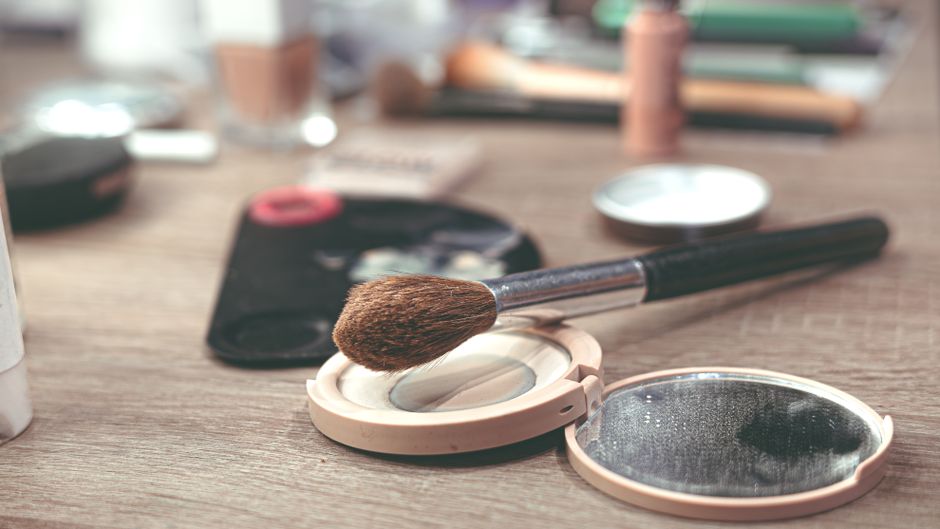
Pressed powder is the format most people assume is basically foolproof — dust it on, done. A study in Anais Brasileiros de Dermatologia had 101 women self-apply their own sunscreens exactly the way they normally would, then measured how much product actually landed per square centimeter of skin. Lotion came in at 1.31 mg/cm². Powder compacts came in at 0.15 mg/cm². The SPF number on any sunscreen label is only accurate at 2.0 mg/cm², the amount used in lab testing.
Do the math and a powder compact tested at SPF 50 is delivering something closer to SPF 5 in real-world use. Cleveland Clinic backs this up from a different angle: you have to apply a genuinely thick layer to get anywhere near labeled protection, and dermatologist Dr. Shari Marchbein's specific rule of thumb, cited by AOL, is 15 seconds per quadrant of your face, brushing back and forth rather than one quick dust-and-go. Almost nobody does that. I don't either, if I'm honest.
None of this means powder sunscreen is useless. It's genuinely good at knocking down shine and adding a small protection top-up on a day when you already put on a real sunscreen that morning. Treating it as your actual line of defense against a Saturday at the beach is the part that doesn't hold up.
Spray and Mist Formats Have the Same Issue, Worse in Wind
Spray sunscreen has a version of the same problem, plus one the powder doesn't have: it's aerosolized, so a meaningful share of what leaves the can never lands on your face at all. Outdoor testing that dermatologists cite regularly finds that even mild wind carries off a large share of a sprayed mist before it settles — worse than people assume, and worse than the can's SPF number accounts for.
There's a second issue that's more about human behavior than physics. Sprayed product dries fast, and because it doesn't feel like a thick layer of sunscreen going on, almost nobody rubs it in afterward. Skipping that step means the spray sits unevenly instead of forming a continuous film, and an even film is what the SPF rating actually assumes you're getting.
Setting-spray-style SPF mists marketed specifically for touch-ups over makeup are honestly the most defensible use of the format — they're not pretending to be your primary sunscreen, just a top-up. Used that way, with a few extra passes rather than one quick spritz, they're a reasonable second-choice option. Used as your only sun protection for the day, they're closer to a gamble.
Does the Cushion Actually Hold Up?
Cushion sunscreen sits somewhere in the middle, and the honest answer is: better than powder, worse than a lotion or stick, and heavily dependent on how many times you actually press the puff. Cosmetic chemist Ginger King, quoted in a NewBeauty piece on cushion sunscreens, made a point I keep coming back to — the sponge itself doesn't transfer all the product it's holding to your face, so even a puff that looks saturated is giving up less than it seems to.
The fix, according to Sulwhasoo derma science director Michelle Shieh in that same piece, is pressing the puff onto the product two or three separate times before applying it, then repeating that whole process for full coverage rather than one dab and done. That's more effort than most people put into a "quick touch-up," which is the entire selling point of the format. The honest framing for a Korean sun cushion (Sulwhasoo's UV Wise On-the-Go and Dermashare's Propolis Tone Up Sun Cushion are both marketed this way) is as a second layer on top of a real morning sunscreen, not a standalone one. A sunscreen you'll actually reapply because it's this convenient still beats a better one sitting unused in your bag — that's the format's real argument for existing, not raw SPF math.
The Stick Format Is the One That Doesn't Ask You to Guess
A solid stick is the one format here where the physical act of using it forces something close to a real dose onto your skin. You're dragging solid product directly across your face under actual pressure, not dusting powder or misting a spray that mostly needs to be rubbed in afterward. It won't disturb makeup underneath the way a cream would, and it doesn't ask you to press a puff four separate times and hope. That's not a clinical claim about its SPF holding up perfectly in every lab condition — nobody's independently re-tested drugstore sticks at 2 mg/cm² for me — it's a mechanical one about how hard the format makes it to under-apply by accident.
Round Lab vs. Beauty of Joseon: Same Filters, Different Price
Two sticks come up constantly in this conversation, and it's worth actually comparing what's in them rather than just picking whichever one has better packaging.

Round Lab's Birch Juice Moisturizing Sun Stick (19g, SPF50+ PA++++) runs $25 on the brand's own US site, $17.50 through StyleKorean's international shipping at the current markdown, and 24,000 KRW at Olive Young in Korea — about $17.70 at the September 3, 2026 exchange rate of ₩1,356.6 to the dollar (all checked this week). Beauty of Joseon's Matte Sun Stick: Mugwort + Camelia (18g, SPF50+ PA++++) lists around $18 and was running $12.60 through StyleVana the same week.
Here's the part that actually surprised me, with one correction that matters if you're buying from the link above. I pulled the INCI lists for both brands' Korea-formula sticks — the versions StyleKorean ships internationally and Olive Young sells in Korea — expecting to find a reason for the price gap. I didn't. Both use the exact same core UV filter system: Diethylamino Hydroxybenzoyl Hexyl Benzoate, Bis-Ethylhexyloxyphenol Methoxyphenyl Triazine, and Ethylhexyl Triazone, with Butyloctyl Salicylate doing photostabilizer duty in both. Same SPF50+ PA++++ rating, same four-filter combination, down to the exact INCI names.
Correction: Round Lab's own U.S. site — roundlab.com, the $25 listing linked above — sells a separately reformulated U.S. version of this stick. Its actual ingredient list swaps in FDA-approved chemical filters instead: Homosalate 9.5%, Octocrylene 5%, Octisalate 4.5%, and Avobenzone 3%. Tinosorb S and Uvinul T150, the filters in the Korea formula, aren't FDA-approved for sale in the US, so the domestic listing can't use them. That means if you buy the $25 U.S.-site stick rather than importing the Korea-formula version, you are not getting the same UV filters as Beauty of Joseon's stick — only buyers of the Korea-formula import (via StyleKorean or Olive Young) get the identical four-filter match described below.
What actually differs between the two Korea-formula sticks is finish and add-ins, not sun protection chemistry. Round Lab leans hydrating — birch sap, niacinamide, a peptide complex — and finishes dewy. Beauty of Joseon's matte version uses silica and boron nitride to cut shine and adds camellia seed oil, and it sits drier on skin. If your skin runs oily under makeup by afternoon, that texture difference is the real reason to pick one over the other between the two Korea-formula sticks — it is not because one protects you better than the other there. But if you're comparing the roundlab.com US stick to Beauty of Joseon's Korea-formula stick, the UV filter chemistry itself is the difference, not just texture.

The brand's own claims about birch sap or camellia oil "brightening" or "calming" skin are the brand's claims — I haven't seen an independent test of either beyond the ingredient list itself, so treat those as marketing until proven otherwise. The UV filter comparison above is the one thing on this page you can verify yourself by pulling up both Korea-formula INCI lists side by side — just make sure you're checking a Korea-formula listing for Round Lab, not the reformulated roundlab.com US version noted above.
Back to the question you actually came here for: reach for a stick first if you want the label's SPF number to mean something. Use cushion or spray for the in-between touch-ups where convenience is the whole point, not the last line of defense. And skip the pressed powder unless you're genuinely willing to spend 15 seconds per quadrant working it in — which, six hours into a long day out, almost nobody is.
This is a running news series, not a one-off post — new stories go up twice a day, roughly 7am and 7pm Korea time.
More Korea coverage from our network: Hallyu Now · Korea Travel Planner · K-Sports Global · Korean Table


Comments
Post a Comment