Is COSRX Cruelty-Free? What the Certifications Say
Is COSRX cruelty-free? Short answer: not by the standard that means something. No Leaping Bunny logo, no PETA "Beauty Without Bunnies" listing, and the company that now owns 93% of COSRX openly tests on animals when a market requires it.
Written for: anyone who's seen "cruelty-free" thrown around in a COSRX haul video and assumed it was a settled fact, the same way "glass skin" gets treated as a settled routine instead of a marketing phrase. It isn't settled. Here's what's checkable, and what isn't.
What COSRX Told People Who Asked
COSRX doesn't dodge the question when customers write in. Per Cruelty-Free Kitty's brand page, which publishes the company's own reply, COSRX states: "We would like to confirm that COSRX does not conduct animal testing on our products or ingredients, nor do we ask our suppliers or any third parties to perform such testing." That's a real statement, not a vague one.

The same reply adds a caveat that matters more than the pledge: COSRX sources raw materials through multiple channels and says it's "difficult for us to verify that no animal testing has been conducted at any stage of the process." That's the honest version of the gap most brands paper over with a badge instead of admitting it.
No Leaping Bunny, No PETA, and That's the Problem
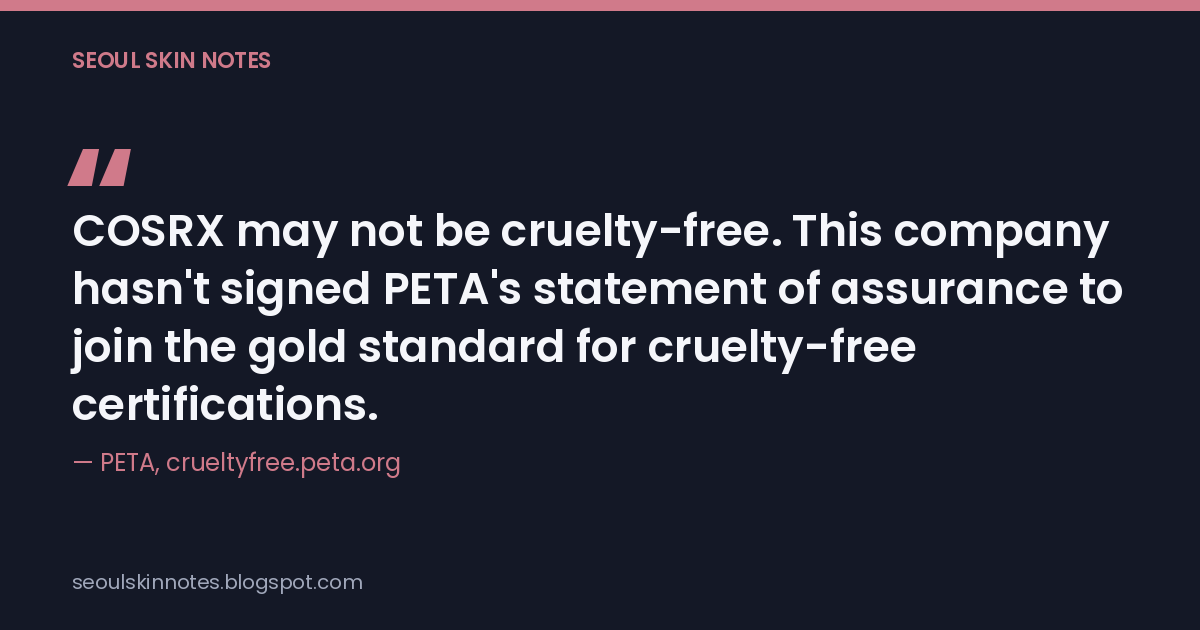
Statements to individual customers aren't audits. Leaping Bunny requires a signed pledge plus supply-chain tracking; COSRX hasn't done it. PETA's own company page is blunter. As of when I checked it on September 9, 2026, it read: "COSRX may not be cruelty-free. This company hasn't signed PETA's statement of assurance to join the gold standard for cruelty-free certifications."
Not signing isn't proof of guilt on its own. Plenty of brands skip certification over the cost and paperwork, not because they're hiding something. But it does mean nobody outside COSRX has independently checked the claim, which is exactly the gap the company's own reply admits to.
Who Owns COSRX Now
This is the part a lot of "is it cruelty-free" roundups skip. AmorePacific took a stake in COSRX back in 2021 and exercised a call option in October 2023 to push its ownership to 93.2%, making COSRX a consolidated subsidiary, according to BeautyMatter's coverage of the deal.
AmorePacific's own animal testing policy, published on its corporate site, says it voluntarily stopped animal testing in 2008 and extended that to partner companies in 2013 "except in cases where it is required by other countries or regulations beyond our control and when there are no alternatives available."
Read that clause twice.
It's a policy with a built-in exit, not a hard line. A parent company that tests on animals doesn't automatically mean the subsidiary does too. But it does mean the "cruelty-free" question about COSRX can't really be separated from what AmorePacific does at group level anymore. Ownership at 93% isn't a passive stake.
Where China's Rules Bite, and Where They Don't
The reflex explanation for "no K-beauty brand is truly cruelty-free" is "China requires animal testing." That used to be flatly true and now it's only half true, which matters if you're trying to be accurate instead of just cynical.
Since May 1, 2021, imported "ordinary" cosmetics, the category most COSRX products fall into, can skip pre-market animal testing in China if the manufacturer files a GMP compliance certificate and a safety assessment instead, per ChemLinked's regulatory summary. That's the real mechanism, not just "sell online and hope." COSRX also sells through cross-border e-commerce channels rather than mainland retail shelves, which sidesteps the stricter registration path entirely.
"Special use" cosmetics are the exception, and this is the one Seoul Skin Notes readers should care about: sunscreens are still in that bucket and still require animal testing for full registration in China as of this year. ChemLinked's own regulatory tracker notes that a July 29, 2026 update carved out exemptions for hair perming, non-oxidative hair dye, and physical whitening products, but sunscreen wasn't on that list. So the toner and serum side of a brand's China exemption doesn't tell you anything about its SPF line.
What Would Count as Verified
This isn't a call to trust nothing. Leaping Bunny's process is specific enough to be worth knowing: a brand and every ingredient supplier sign a renewable pledge, and Leaping Bunny does spot audits rather than taking the paperwork at face value. PETA's list is one notch looser, a signed statement of assurance from a company's leadership, no independent audit attached, which is still more than most brands bother with. Either logo on a product page is checkable in under a minute against the org's own database. A brand's own FAQ page saying "we don't test on animals" with no logo attached is exactly the category COSRX sits in, and it's worth reading that category as "unverified," not as a lesser version of certified.
Is COSRX cruelty-free? No, not in any way you could put on a certification badge. Is it worse than the K-beauty average? Not obviously. Its written statement to customers is more specific than most brands bother to give, and its China workaround is a real regulatory mechanism rather than a marketing line. The honest label is "uncertified, plausible, unverifiable past the second supplier tier," which is a less satisfying sentence than a bunny logo but it's the accurate one.
If you've emailed a K-beauty brand directly and gotten a straighter answer than the ones above, or a worse one, that's worth knowing. Which brand, and what did they actually say?
This is a running news series, not a one-off post — new stories go up twice a day, roughly 7am and 7pm Korea time.
More Korea coverage from our network: Hallyu Now · Korea Travel Planner · K-Sports Global · Korean Table


Comments
Post a Comment