Korean Natural Cosmetics Label: 95% Rule, No Government Seal
"If a Korean cosmetic says natural or organic, the government has certified it." Many overseas shoppers still assume that, and since 2025 it cannot be true of any new product. Even before then, Cosmorning says, a brand could either hold a government certificate or meet the government standard on its own with supporting evidence. If you are deciding whether a Korean "natural" toner earns its premium, the rule that applies today is different, and the primary documents are all in Korean.
Korea's Ministry of Food and Drug Safety (MFDS, 식약처) ended its certification of natural and organic cosmetics on August 1, 2025. Cosmorning reported that the Cosmetics Act amendment was promulgated on January 31, 2025 and took effect on that August date. I did not open the statute text itself, so those dates rest on that report. The same article quotes MFDS saying products already certified stay valid until their certificate expires, and that a certificate can still be cancelled for falsehood or for falling below the criteria.
The number behind a natural label is 95 percent by weight
The replacement is a guide with no seal attached. Cosmorning describes it as a private guide that industry and MFDS worked out together, and the Korea Cosmetic Association (대한화장품협회) published it as a labeling guide for natural and organic cosmetics. It defines a "natural cosmetic" as one where natural-origin ingredients, as ISO 16128-1 defines them, make up 95% or more of the product by weight when calculated under ISO 16128-2.
An "organic cosmetic" needs organic-origin content of at least 10% of the product, with natural content including that organic part still at 95% or more. By my arithmetic, a 100 g jar that qualifies as natural can hold at most 5 g of anything that is not natural-origin.
The guide adds that the brand must be able to substantiate all of this. The Korean wording is "실증할 수 있어야 한다", meaning it has to be provable with documents.
A natural ingredient does not let a product call itself natural
Per the same guide, if the finished product misses the 95% definition, the brand may not describe even one ingredient as natural-origin, although that ingredient really is. The guide's own example of wording that is not allowed is "천연(유래) 원료 OOO 사용", roughly "natural-origin ingredient OOO used".
Take a hypothetical toner that is 60% natural-origin by weight. Under that sentence of the guide it could not advertise its centella extract as a natural ingredient. The guide names no product or brand, so the 60% is my example only.
The MFDS guideline points the same way. In its table of prohibited expressions, "natural" and "organic" wording on a product that does not meet the association's guide is listed as misleading, and using those words requires documents that conform to the guide.
A natural index is allowed, and it must carry a disclaimer
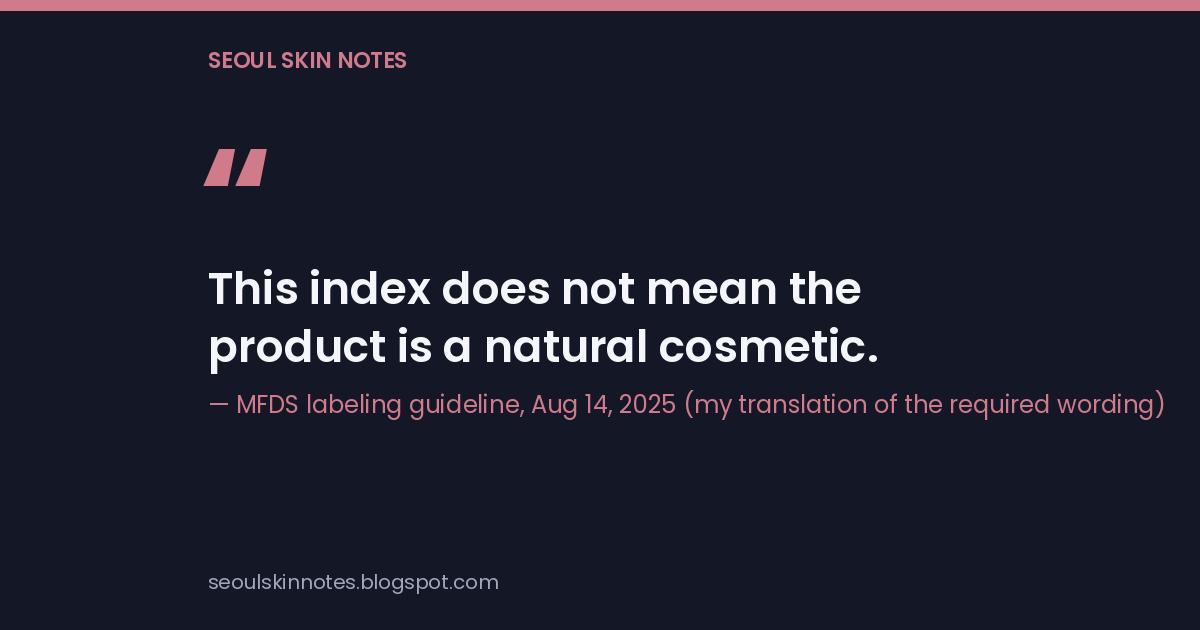
A product below 95% still has one route. The MFDS labeling guideline of August 14, 2025 lets a brand print an index such as "천연지수 00% (ISO 16128 계산 적용)", meaning "natural index 00% (ISO 16128 calculation applied)", provided it holds supporting data for that exact product.
The same guideline then asks for wording so shoppers do not read the number as a category. A pack front that shows the index is advised to say "천연화장품(유기농화장품) 아님", "not a natural (organic) cosmetic". Elsewhere on the pack the sentence is longer and reads, in my translation, that the figure comes from a simple ISO 16128 calculation and does not make the product a natural cosmetic.
Older certificates and COSMOS marks can still sit on a label
Private certification did not disappear. Cosmorning says a product holding a private certificate such as COSMOS can state it, as long as the brand also holds evidence that the product meets the guideline. COSMOS is a private scheme run by an alliance of certifiers from Germany, Italy, France and the UK, and the article names KTR and Control Union Korea as the two Korean bodies designated for it. Cosinkorea carries the same line on cancelling older government certificates.
Shin Jun-soo, head of the MFDS biopharmaceuticals bureau (바이오생약국장), described the change as aligning Korea with global standards and handing companies more responsibility for their own claims. The report adds that the EU, China, Japan and ASEAN run no government certification for natural and organic cosmetics. Shin also said MFDS plans to look into self-regulation with the Korea Cosmetic Association and to step up monitoring of labels and ads.
Check the back of the pack before you pay for "natural"
Turn the product over. If the front says natural or organic, look for an ISO 16128 index and the disclaimer printed beside it. A bare "natural" with no index is a claim the brand has to back with documents it holds, so treat it as the brand's word rather than a state stamp.
This is a running series, not a one-off post — a new post goes up every day, at around 1am Korea time.
About · Contact · Privacy Policy
Read next: Korean Curl Cream Test: 8 Products, a 5.2x Price Gap · Korean Cosmetic Side Effect Reports: 11,882 Filed, 1,285 Counted · Fake Beauty of Joseon Sunscreen on Amazon and Korea's New Council


Comments
Post a Comment