Korean Sheet Mask Ingredients: How to Read the INCI List Order
Peel off a sheet mask and feel your cheeks tingle, and the label is the first place people go looking for someone to blame. Nine times out of ten, they blame the wrong ingredient.
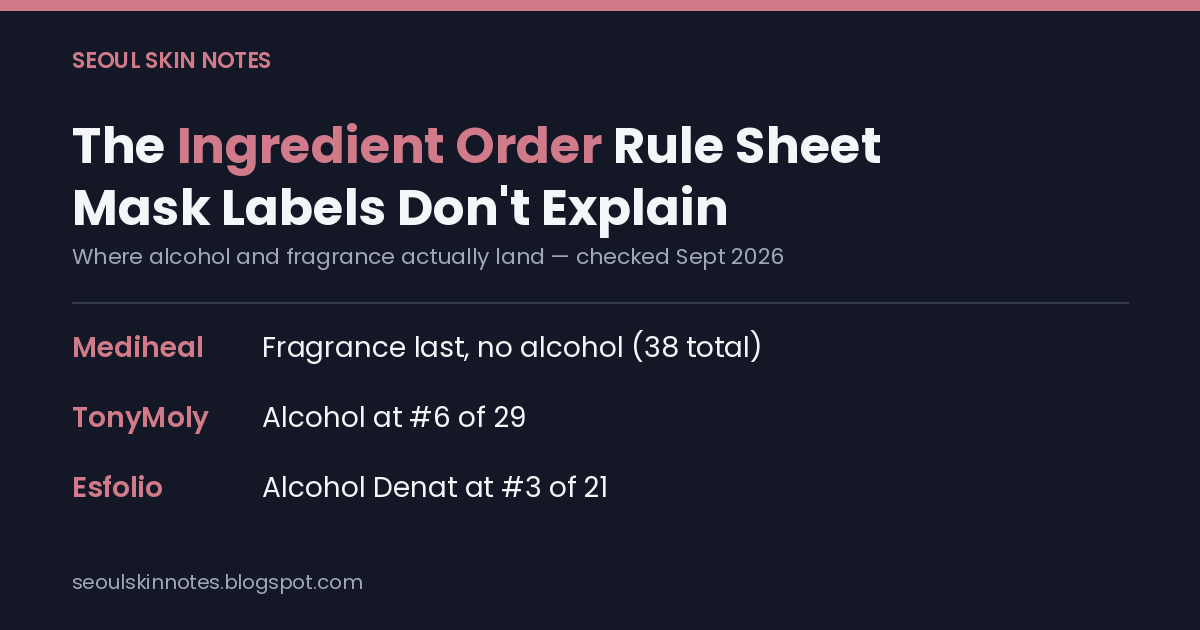
I pulled the full INCI lists for three sheet masks that are easy to find outside Korea (Mediheal's N.M.F Intensive Hydrating Mask, TonyMoly's Master Lab, and Esfolio's Aloe Essence) and checked exactly where alcohol and fragrance land in each one. The pattern that showed up isn't the one most "clean beauty" advice trains you to expect.
The List Doesn't Rank by Danger
An ingredient list reads like a countdown, so it's tempting to treat position as a straight scale of "worst first." It mostly works that way, but not all the way down. Under the FDA's cosmetic labeling rule, everything above roughly 1% concentration has to appear in descending order: highest amount first. Below that 1% line, brands can list ingredients in whatever order they want. The exact wording: ingredients "present at one percent or less... may be declared without regard for predominance."
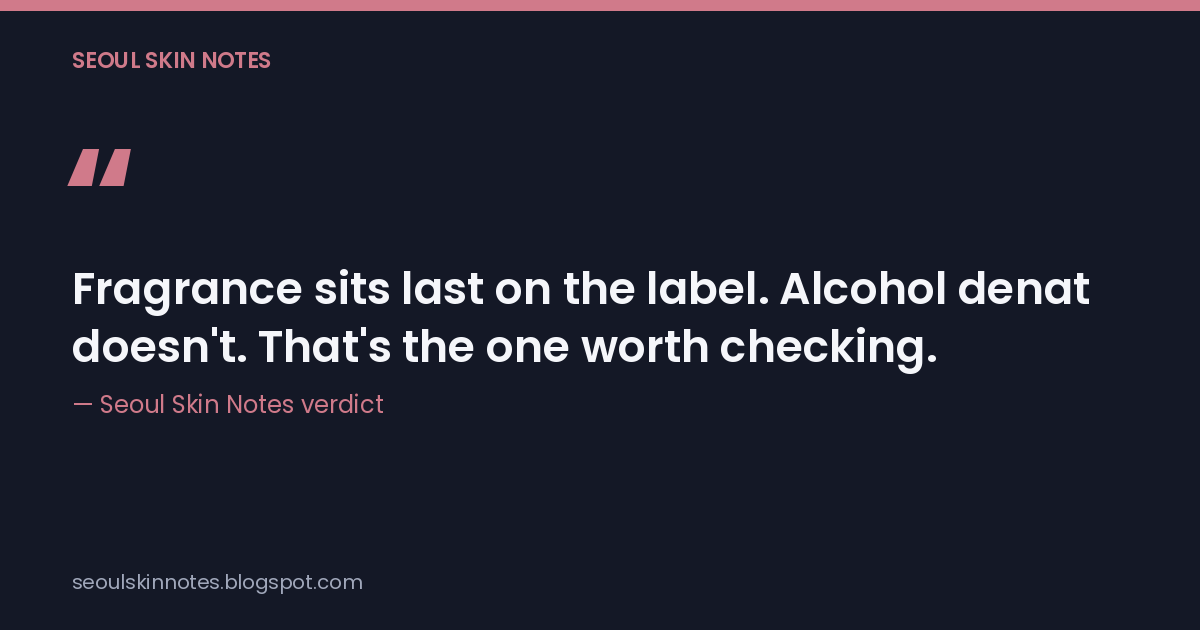
That single rule is why fragrance shows up dead last on almost every mask you'll ever check. It doesn't mean the formula contains barely any fragrance chemicals by ingredient count: a "fragrance" or "parfum" entry can bundle dozens of individual compounds under one line. It means the whole bundle sits under 1% of the total formula by weight, wherever the brand chose to place it in that unordered tail.
Three Masks, Three Very Different Placements
Here's what showed up in each list, in order, this week:
- Mediheal N.M.F Intensive Hydrating Mask: 38 total ingredients. No alcohol at all. Fragrance sits at position 38, the very last entry.
- TonyMoly Master Lab: 29 total ingredients. Alcohol lands at position 6, ahead of collagen extract, panthenol, and most of the plant extracts on the label. Fragrance is last, at 29.
- Esfolio Aloe Essence: 21 total ingredients, the shortest list of the three. Alcohol Denat sits at position 3, right after water and glycerin, meaning it's genuinely one of the more concentrated ingredients in the formula, not a trace additive.
Three fragranced masks, three completely different alcohol stories. Mediheal skips it entirely. TonyMoly puts it mid-list. Esfolio puts it high enough that it's doing real work in the formula, not just evaporating off as an afterthought.
The Real Job Alcohol Denat Is Doing
Alcohol denat isn't in a sheet mask by accident. It evaporates fast, which is exactly the cooling, slightly tightening sensation people describe right after they peel a mask off, and it helps other ingredients (plant extracts especially) dissolve into the essence in the first place. Used once, on skin with an intact barrier, it's rarely a real problem.
The issue is frequency, not the ingredient existing at all. Alcohol denat pulls moisture out of the skin's surface as it evaporates, and a barrier that's already compromised — from actives, from weather, from over-exfoliating — feels that more than skin that's in good shape to begin with. A mask like Esfolio's, with alcohol at position 3 of 21, is a different daily-use calculation than one like Mediheal's, which has none. That's not a knock on Esfolio specifically; that formula is doing what a lot of drugstore-tier Korean sheet masks do to keep costs down and texture light. It's a reason to reach for it a couple of times a week, not seven.
If you're someone who does sheet masks nightly (and plenty of people do, because a mask that costs less than a coffee feels harmless), this is the one thing worth checking before you commit to a brand for the whole week.
Does "Fragrance-Free" Mean Safer?
Not automatically, and this is where the position argument breaks down a little. Concentration order tells you about irritation load: how much of an ingredient is sitting on your face, all at once, for 15-20 minutes. It says nothing about allergy risk. A fragrance blend can still trigger a reaction in someone who's sensitized to one specific compound buried inside it. Citronellol and linalool, for instance, are two of the 26 fragrance allergens EU cosmetics regulation requires brands to break out by name once concentration crosses a set threshold, precisely because the "fragrance" umbrella term hides them otherwise. Position on the list protects you from a general irritation problem. It does nothing for a specific allergy.
So the honest answer is: check alcohol placement if you're worried about dryness and barrier stress from repeated use. Check for a full ingredient breakdown, not just "fragrance-free" marketing language on the box, if you already know you react to specific fragrance compounds. They're different questions with different answers, and treating "no fragrance" as the one clean-beauty box to tick misses the ingredient that's actually sitting higher on two of these three labels.
Checking This Yourself Takes About a Minute
You don't need a chemistry background for this. Pull up the product page on the retailer you're buying from, or search the product name plus "ingredients." INKEEDecoder, formerly INCIDecoder before a trademark dispute forced a rename this year, has most mainstream K-beauty masks logged with the full list in order. Count from the top. If "Alcohol" or "Alcohol Denat" shows up in roughly the top third of the list, treat that mask as an occasional-use item rather than a nightly one. If it's absent, or buried near the very end with fragrance, frequency matters a lot less.
None of this means alcohol denat is a bad ingredient to avoid outright: it's genuinely useful for what it does, and plenty of well-regarded formulas use it deliberately. It means "sheet mask" isn't one category with one safety profile. The bargain-bin mask from the drugstore rack and the fragrance-free one from the same brand's premium line can behave completely differently on your skin, and the only way to know before you feel it is to look at where the ingredient sits — not whether it's there at all.

Next time your face tingles after a mask, skip the fragrance line first. Go straight to counting from the top instead.
This is a running news series, not a one-off post — new stories go up twice a day, roughly 7am and 7pm Korea time.
More Korea coverage from our network: Hallyu Now · Korea Travel Planner · K-Sports Global · Korean Table


Comments
Post a Comment