Is AliExpress Makeup Safe? Korea Tested 1,080 Items
Your AliExpress cart has a nail polish remover in it, and you are typing "is AliExpress makeup safe" into a search box.
Korea's Ministry of Food and Drug Safety (MFDS, 식약처) has tested this. On December 18, 2025 (KST), it reported that it had bought 1,080 cosmetics from online marketplaces and that 230 of them, 21.3%, failed Korean safety standards. Read quickly, that sounds like a failure rate for online makeup, and the second figure in the reports sounds like one for AliExpress, since 218 of the 230 failures were sold there.
The test
CNC News writes that the buyers picked product groups that had failed in the previous year's tests, top-ordered products and products high in the popularity rankings (부적합 품목군과 주문량 상위 제품, 인기 순위 제품 등을 구매하여 검사했다). The items came from eight platforms: AliExpress, Amazon, Naver Store, Shein, Coupang, Cosmic (코스믹), Alibaba and 11st (11번가), and the lab was KATRI (KATRI시험연구원).
A basket built that way is a targeted sample, and the 21.3% describes this basket. The CNC News headline, 해외직구 화장품 시험 결과 21%가 안전 부적합 확인 ("overseas direct-purchase cosmetics test results, 21% confirmed as failing safety standards"), is phrased as a statement about overseas direct-purchase cosmetics in general.
The ministry posted its own press release on December 18, 2025 (’25년 해외직구 화장품 시험검사 결과 공개, issued jointly with customs and the Korea Consumer Agency). I checked the figures here against it and against three Korean reports, CNC News, Cosinkorea and Nocut News, which agree with it wherever they overlap. The three reports leave out the number of items bought per platform. The release gives it.
CNC News also includes a warning (해외직구 화장품은 정식 수입 제품과 달리 한글 표시나 안전 확인 절차가 없어 국내에서 사용금지 또는 제한 원료가 포함되어 있을 수 있으며). Put in English, overseas direct-purchase cosmetics, unlike officially imported ones, have no Korean-language label or safety check, so they may contain ingredients that Korea bans or restricts.
Categories
The release, CNC News and Cosinkorea give the failures by product group.
| Product group | Failed | Failure rate |
|---|---|---|
| Hair (두발용) | 69 | 38.3% |
| Nail (손발톱용) | 61 | 33.9% |
| Eye makeup (눈화장용) | 62 | 17.2% |
| Color makeup (색조화장용) | 38 | 10.6% |
The four rows add up to 230, so every failure sits in one of these groups. The ministry singles out two sub-groups. Of 42 nail removers (네일 리무버), 31 failed. Of 21 hair-thickening powders (흑채), 12 failed, 57.1%. Those are small samples, and the release's sub-type table shows other hair products failing at about the same rate: 11 of 21 hair tonics and essences and 16 of 32 hair creams and lotions.

The release gives how many items were tested in each group: 360 color makeup, 360 eye makeup, 180 nail and 180 hair (Nocut News also gives the 180 for hair and says 69 of them failed). Those total 1,080, so skin care is not one of the groups, and the release's sub-type table lists no face creams, serums or sunscreens.
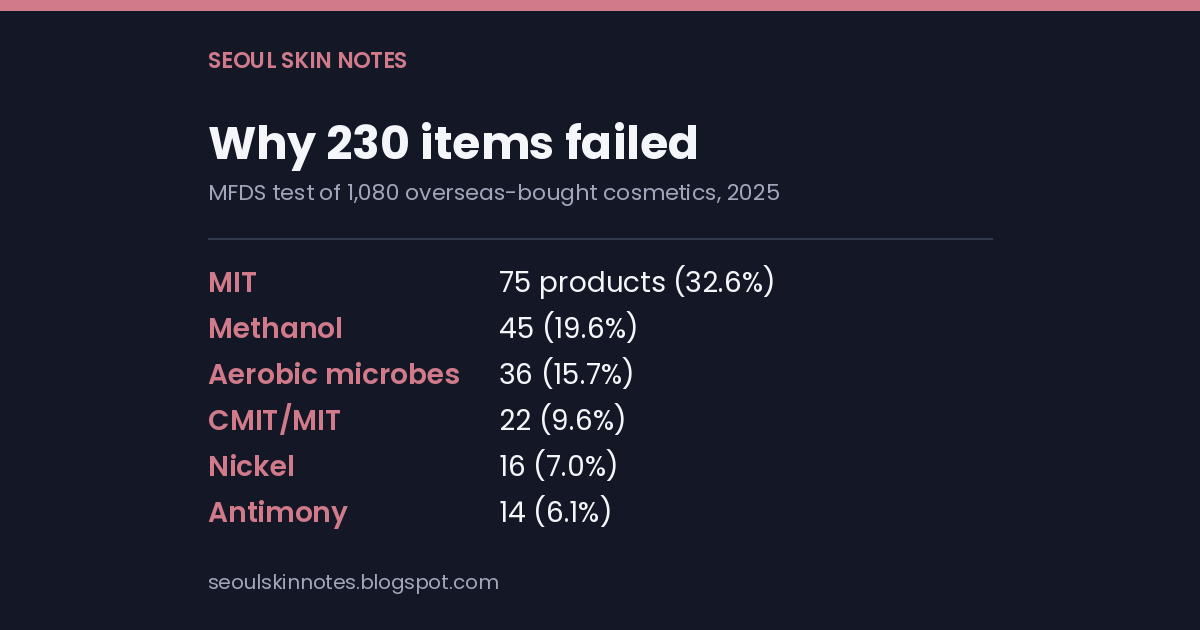
The tests that failed most often, as CNC News counts them, were MIT (75 products, 32.6% of the failures), methanol (45, 19.6%), total aerobic microbial count (36, 15.7%), CMIT/MIT (22, 9.6%), nickel (16, 7.0%) and antimony (14, 6.1%).
Two readings were far over the limit. Formaldehyde in a hair product reached about 50 times Korea's limit of 2,000 μg/g, and lead in a color makeup product about 22 times the 20 μg/g limit. Korea allows MIT (methylisothiazolinone) and the CMIT/MIT mixture only in rinse-off products, at 0.0015% or less, and bans them in all other cosmetics.
Color makeup failed least, at 10.6%, or about one product in ten. After reading these rows I would not order a nail remover or a hair powder from a marketplace listing. A lipstick has better odds, but a lead reading is something no label shows you.
Platforms
By platform, the failures were AliExpress 218 (95%), Amazon 8 (4%), Shein 3 (1%) and Alibaba 1 (0.4%). By country of manufacture, 223 (97%) were made in China and 7 (3%) in the United States.
Those are shares of the failures; a failure rate divides by the items bought on each platform. The release gives those purchase counts: AliExpress 844 of the 1,080 items (78.1%), Amazon 134, Naver Store 39, Shein 32, Coupang 16, Cosmic 12, Alibaba 2 and 11st 1. A platform that supplied most of the basket would supply most of the failures even if its items failed no more often than anyone else's, and AliExpress did supply most of the basket. Dividing (my arithmetic), AliExpress items failed at 25.8% (218 of 844), Amazon's at 6.0% (8 of 134) and Shein's at 9.4% (3 of 32). Alibaba's 1 failure came from 2 items, too few to read, and the other four platforms had none. So the 95% shows where the failures came from, not how often AliExpress items failed, which was about one in four, and more than four times Amazon's rate in this basket. By country of manufacture the release counts 888 China-made items (223 failed, 25.1%), 113 made in the United States (7 failed, 6.2%), 64 in Japan and 15 in Europe (none failed).
After the results, the ministry asked customs (관세청) to hold the products and the broadcasting regulator (방송미디어통신심의위원회) to block the sales pages. CNC News and Cosinkorea both write 233 products at that point, three more than the 230 in their first paragraph, and neither explains the gap. The release also reports a separate joint test with customs and the Korea Consumer Agency, 91 color-makeup and eye-makeup items of which 3 failed heavy-metal limits, and 230 + 3 = 233 (my arithmetic; the release does not write the sum). The 1,080-item test this post is about had 230.
Left out
Temu is not among the eight platforms. CNC News mentions it once, in background: tests last year (지난해) of color and eye makeup bought from AliExpress, Temu and others had found many heavy-metal failures, meaning lead, nickel and antimony. CNC News gives no year, and for a December 2025 article I read last year as 2024. No Temu purchases were in the 2025 basket, so the test cannot show how Temu compares.
The release counts the 1,080 items by country of manufacture (China 888, United States 113, Japan 64, Europe 15, with no Korea category), and neither it nor the three outlets gives a K-beauty share, so 21.3% is not a K-beauty figure. Fakes of Korean brands are a separate problem, covered in my post on fake Beauty of Joseon sunscreen. The 2026 testing plan brings the two together.
Since then
CIRS Group reports that the rule permits analytical inspection of directly purchased overseas cosmetics, meaning physical, chemical and microbiological testing, alongside label checks. MFDS amended the Enforcement Rule of the Cosmetics Act on March 31, 2026, and the changes have been in force since April 2.
On May 12, Cosinkorea reported that MFDS will test 1,200 items in 2026, up from 1,080 in 2025 and 110 in 2024. The steps are information gathering, purchase, testing and judgment, and action, and this year's round includes suspected counterfeits (위조 의심 화장품). The same article cites block counts for counterfeit K-brand cosmetics on overseas online sites from the Intellectual Property Office (지식재산처): 16,774 in 2023, 23,494 in 2024 and 36,116 in 2025.
On October 1 the National Assembly passed an amendment to the Cosmetics Act (화장품법), and as of Cosinkorea's October 7 report it had been sent to the government and still needed cabinet review and presidential promulgation. Cosinkorea wrote that the MFDS commissioner may ask sellers of cosmetics with damaged, forged or altered packaging or labelling to stop selling them and delete the online listing, and that 20,370 counterfeit cosmetics listings were blocked through June this year.
Cosinkorea and CNC News both say MFDS posted the names, photos and failed items of the failing products on its main website (식약처 대표 누리집).
Before you pay for that nail remover, open the listing, press Ctrl+F and search for "isothiazolinone" (it matches both methylisothiazolinone and methylchloroisothiazolinone). MIT caused the most failures in this test, 75 of 230, and Korea allows it only in rinse-off products at 0.0015% or less; your own country's limit may differ. The search cannot catch methanol, bacteria counts, nickel or antimony, so it covers only two of the six failure types, and only as far as the listing's ingredient list is accurate. If the listing shows no ingredient list at all, pick another listing.
This is a running series, not a one-off post — a new post goes up every day, at around 1am Korea time.
About · Contact · Privacy Policy
Read next: Korean Cosmetic Side Effect Reports: 11,882 Filed, 1,285 Counted · How Korea Defines a Niacinamide Whitening Serum (2-5%) · Why Korean Sunscreen Isn't FDA-Approved in 2026
You might also like: How to Read the Date on Korean Food Packages After the 2023 Law Change (Korean Table)


Comments
Post a Comment