Korea's Cosmetic Animal-Testing Rule and the 29.9% Rise in 2025
Did South Korea stop animal testing for cosmetics in 2017? Not in the sense most English-language posts imply. Korea's rule since February 2017 stops cosmetics from being sold when they were animal-tested, with exceptions, and the official count of animals used for cosmetics in 2025 went up 29.9% on the year, according to audit data reported on October 4 and 5, 2026.
The belief. The version that circulates says Korea banned it in 2017, so no animals are used for K-beauty. It is easy to see why. Korean cosmetics law did change in 2017, and the Korean press itself calls it a ban (동물실험 금지 제도).
The 2026 figures. Per 식약일보 (KFDN) on World Animal Day, October 4, under the headline "동물실험 5년간 1491만 마리…화장품에 29.9% 증가", the figures come from audit data presented by Democratic Party lawmaker Nam In-soon. Per 푸드투데이, 14,913,427 animals were used over five years, of which mice were 13,374,183 (89.7%). For 2025 alone, experiments tied to medicines and similar products used 2,746,118 animals, 91.6% of the year.
Dividing 2,746,118 by 0.916 puts the 2025 total near 3.0 million (my arithmetic, not a published figure), and every purpose other than medicines shares under 9% of it. Among those categories, cosmetics grew fastest from 2024 to 2025, at 29.9%. Herald Business and Women's News carry the same figures. Per Herald, Nam pointed to the increase as happening despite the 2017 ban.
What the 29.9% does not tell you. I read all four articles and none of them prints how many animals were used for cosmetics in 2025 or in 2024. A 29.9% rise could mean a thousand more animals or a hundred thousand more, and none of the four says which. None says which kind of experiment the extra animals went into, or whether any of it falls under a legal exception. Nam's own response, per the reporters, was a call to pass a law promoting alternative test methods.
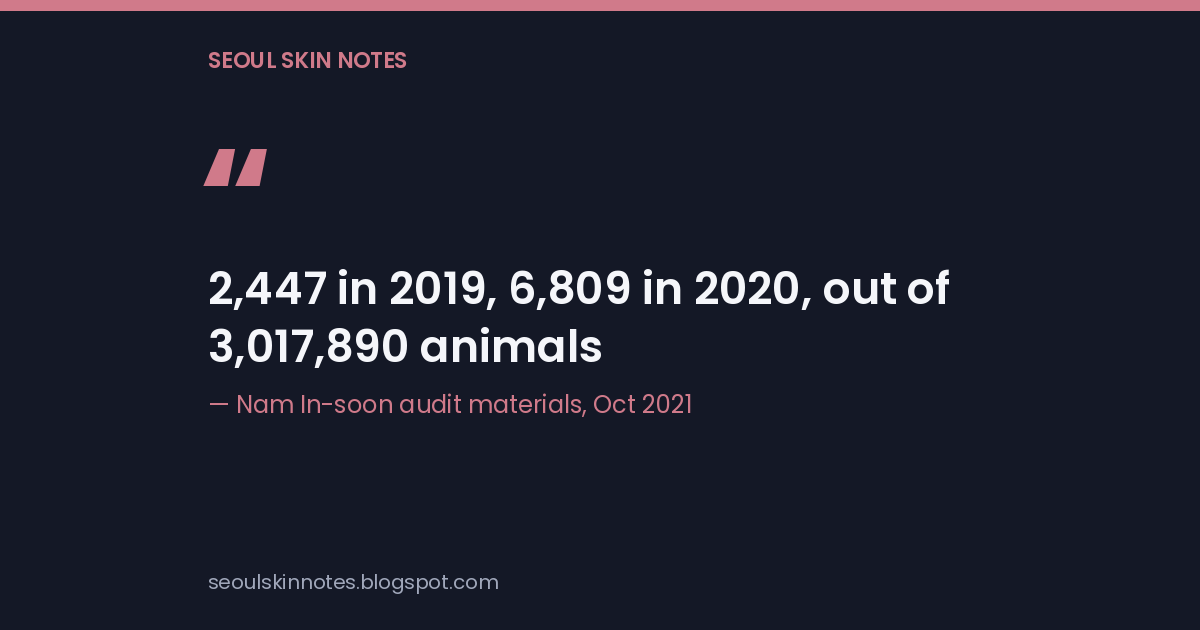
An older audit gives a sense of scale. Per 민족의학신문 on October 8, 2021, using Ministry of Food and Drug Safety (MFDS) data that Nam presented, cosmetics experiments rose from 2,447 animals in 2019 to 6,809 in 2020, "무려 4362마리가 늘어 178.3%". The same article puts total animal use in 2020 at 3,017,890, so cosmetics came to about 0.23% of all animals that year (my arithmetic). That is one year, five years ago, and I found no 2025 base to compare it with.
What the law actually forbids. The rule is Article 15-2 of the Cosmetics Act. Per a Segye Ilbo report dated November 28, 2016, the MFDS announced a draft enforcement-decree amendment with an effective date of February 4, 2017, under which distributing or selling cosmetics made through animal testing draws a fine (과태료) of 1 million won. Per Korea's easy-law portal, cosmetics responsible sellers and customized-cosmetics sellers may not distribute or sell a cosmetic that was animal-tested, or one made with animal-tested ingredients, whether made under contract or imported. The rule applies to distribution and sale.
The same page lists six exceptions. Animal testing remains allowed where it is needed to set usage standards for restricted ingredients such as preservatives, colorants and UV filters or to run a risk assessment, where no alternative method exists, where the export country's law requires it, where the importing country's law requires it for product development, and where an ingredient was developed through animal testing under another law. The sixth is a catch-all for other cases the MFDS commissioner decides on. The same page puts the fine at up to 1 million won.
The 2017 rule is a sales restriction with exceptions built in, and a lab count for "cosmetics" is not a count of violations. I have no evidence that the 2025 increase came through any of those exceptions, and I am not claiming it did. The official number is not zero, and the 2026 articles do not break out the reason.
Where the alternatives stand. The MFDS has been publishing guides for replacing animal tests. Its own channel has a video titled "화장품 등 안전성평가를 위한 동물대체시험법 [kDPRA]" (alternative test methods for cosmetics safety assessment). Per Ajunews on October 18, 2023, three new or revised guidelines cover eye damage and irritation using a human-cornea-equivalent model, skin sensitization with an in chemico amino-acid binding method, and in vitro skin absorption.

What a shopper can check. One exception above covers exports. When the destination country's law requires animal testing, the Korean rule allows it. If you buy Korean skincare abroad, that exception is the one that bears directly on products sold abroad, though I found no source saying how often it is used. A label claim such as "cruelty-free" is a brand statement, and none of the sources I opened says the Cosmetics Act certifies it.
Today, search 화장품법 제15조의2 on law.go.kr and read the exceptions in the version currently in force. Then email the brand and ask which exception it uses, if any.
This is a running series, not a one-off post — a new post goes up every day, at around 1am Korea time.
About · Contact · Privacy Policy
Read next: Korean Cosmetic Side Effect Reports: 11,882 Filed, 1,285 Counted · How Korea Defines a Niacinamide Whitening Serum (2-5%) · Why Korean Sunscreen Isn't FDA-Approved in 2026
You might also like: How to Read the Date on Korean Food Packages After the 2023 Law Change (Korean Table)


Comments
Post a Comment