Is Beauty of Joseon Sunscreen Mineral or Chemical?
Is Beauty of Joseon sunscreen mineral or chemical? The honest answer is "it depends which bottle you're holding," and the brand's own site states it clearly once you know which page to read.
This one's for anyone who picked Relief Sun: Rice + Probiotics off a "gentle, natural K-beauty" recommendation list and assumed the rice-and-probiotics branding meant a physical, mineral formula. It doesn't. The two most popular Beauty of Joseon sunscreens sit on opposite sides of the mineral/chemical divide, and the front label doesn't distinguish between them.
Relief Sun: Rice + Probiotics is a chemical sunscreen
This is the one that went viral for its thin, no-white-cast finish, and that finish is exactly why it can't be mineral. Every one of its active ingredients is an organic, carbon-based filter, the textbook definition of a chemical sunscreen. Its INCI list, pulled from the brand's own product page and cross-checked against INCIDecoder's ingredient breakdown, names four active UV filters: Diethylamino Hydroxybenzoyl Hexyl Benzoate (Uvinul A Plus), Ethylhexyl Triazone (Uvinul T150), Methylene Bis-Benzotriazolyl Tetramethylbutylphenol (Tinosorb M), and Diethylhexyl Butamido Triazone (Uvasorb HEB).
No zinc oxide anywhere in the list. No titanium dioxide either.
It's not a bad formula. It's just not what "rice and probiotics" makes it sound like. According to the ingredient-testing site What's in My Jar, which lists concentration ranges pulled from the formula, Uvinul A Plus sits around 3.5–4.3%, Uvinul T150 around 2.6–3.2%, Tinosorb M around 2.0–2.5%, and Uvasorb HEB around 1.2–1.4%, a fairly standard modern chemical-filter stack, the same Uvinul/Tinosorb family that shows up across most European and Korean sunscreens that don't leave a cast.
Rice extract, the fermented soybean and pumpkin extracts, and the niacinamide all sit below the four UV filters on the ingredient list, meaning they're present in smaller amounts. They're not doing the sun protection. They're the skin-conditioning layer built around filters that are, chemically, no different from what's in a French or German drugstore sunscreen.
The Daily Tinted Fluid Sunscreen is the opposite
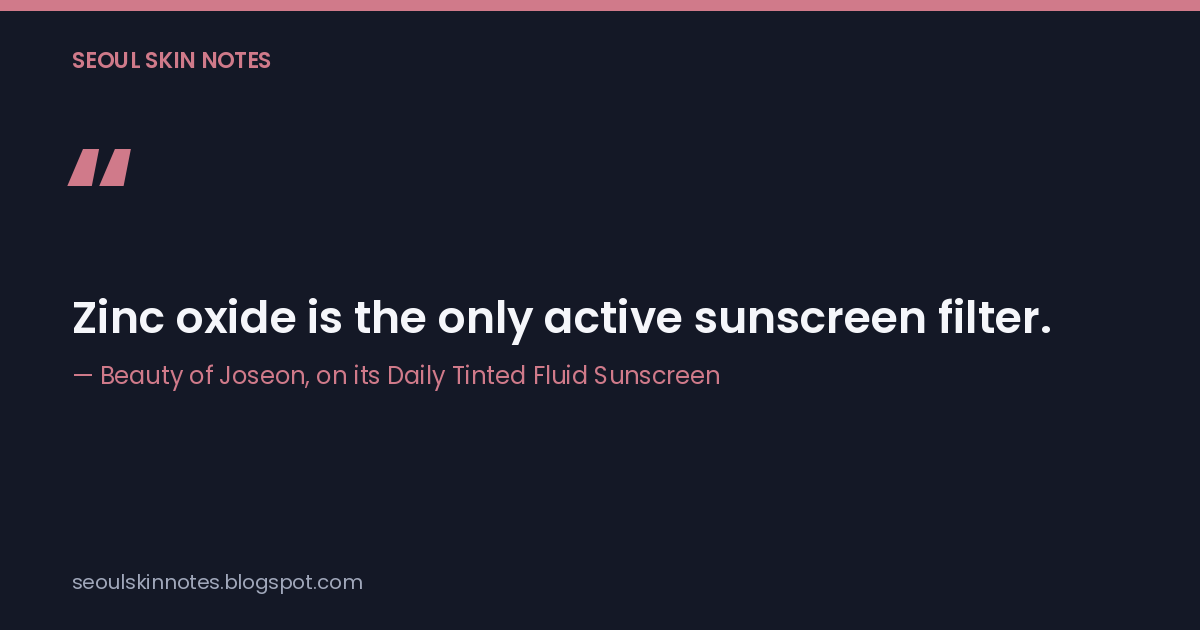
Beauty of Joseon's other big sunscreen, the Daily Tinted Fluid, is genuinely mineral, and the brand states this plainly on its own blog. "Daily Tinted Fluid Sunscreen contains zinc oxide sunscreen filters," the Beauty of Joseon blog post announcing the product states, adding that "zinc oxide is the only active sunscreen filter" and that everything else in the formula supports rather than replaces it. Zinc oxide is listed first in the ingredient deck, a decent tell on its own, since INCI order roughly tracks concentration for anything above 1%.
Two flagship sunscreens carry the same "Beauty of Joseon" label and the same rice-adjacent marketing language, yet completely different filter chemistry. If you bought one expecting the other, the texture difference you're noticing isn't in your head.
Why the distinction actually matters
Mineral filters (zinc oxide, titanium dioxide) sit on top of skin and physically deflect UV; chemical filters absorb it and convert it to heat. Neither is objectively safer at the concentrations used in either product. That's not the debate here. The practical differences are texture, reapplication behavior over makeup, and reef-safety labeling, and they run in opposite directions for these two products:
- Finish: Relief Sun's chemical stack is why it sinks in with essentially no cast on most skin tones. The tinted fluid's zinc oxide needs the added tint to avoid one.
- Photostability: Tinosorb M (in Relief Sun) is one of the more UV-stable organic filters on the market, so you're not losing much protection to sun exposure over the day the way you would with older chemical filters like plain avobenzone.
- Sensitivity: if your skin reacts to chemical filters specifically (stinging, flushing), Relief Sun is the wrong pick regardless of how gentle "rice and probiotics" sounds. The tinted fluid is the one to reach for instead.
None of the fermented-ingredient marketing changes any of that. So how do you actually know which sunscreen you're buying, instead of trusting the front-of-bottle copy?

A gap in what's publicly confirmed
The SPF rating on the tinted fluid isn't consistent across every listing I checked as of this week (September 2026). Some retailer pages still show an earlier SPF30 PA+++ version, while Beauty of Joseon's current blog post for the reformulated product states SPF40. I can't confirm from public sources whether that's a formula update, a regional variant, or just stale retailer copy that hasn't caught up. If the exact SPF number matters for your routine, check the number printed on the box in hand.
The actual takeaway
Skip the "is this brand mineral or chemical" question. Beauty of Joseon isn't one or the other, it's both, split across two different bottles. If a no-cast, sink-in finish matters more to you than filter type, Relief Sun's Uvinul/Tinosorb combination is genuinely well-engineered for that. For anyone who specifically wants a physical filter (pregnancy, reactive skin, or personal preference), the Daily Tinted Fluid is the one with zinc oxide as the active filter, tint included so it doesn't ghost the wearer.
Either way, reading the ingredient list on the box for ten seconds beats trusting the marketing copy in the whole product description. It's a habit worth building before the next "gentle" Korean sunscreen recommendation.
What's your read? Do you reach for the chemical or mineral version, and has the finish difference actually changed your routine? Drop it in the comments. I'm curious how split this actually runs among readers who've used both.
This is a running news series, not a one-off post — new stories go up twice a day, roughly 7am and 7pm Korea time.
More Korea coverage from our network: Hallyu Now · Korea Travel Planner · K-Sports Global · Korean Table


Comments
Post a Comment