Why Some Korean Vitamin C Serums Sting (It's Not the Percentage)
COSRX's best-known vitamin C serum runs at 23% pure ascorbic acid. Klairs' version runs at 5%. Some By Mi's sits at 3%. All three are sold as "the" vitamin C serum to fix dullness and dark spots, and if you've ever bought the wrong one and felt your face burn for a full minute, you already know the percentage on the front of the bottle doesn't tell you what you actually need to know.
What's in the Bottle
I pulled the full ingredient lists straight from each brand's own site, as of today (Sept 7, 2026), instead of trusting the marketing copy.
COSRX's The Vitamin C 23 Serum lists Ascorbic Acid as the second ingredient after water, with 23% printed right on the INCI. It also quietly carries 3-O-Ethyl Ascorbic Acid further down the list, a second, more stable vitamin C form doing backup work you'd never guess from the product name alone. It's $25 for 20mL.
Klairs' Freshly Juiced Vitamin Drop uses plain Ascorbic Acid too, but at 5%, and the brand states the formula sits at pH 3.8. Sodium Ascorbyl Phosphate, a gentler, near-neutral-pH derivative, shows up near the bottom of the ingredient list, well past the point where it's doing much on its own. Regular price is $23 for 35mL; it's currently discounted to $16.10.
Some By Mi's Galactomyces Pure Vitamin C Glow Serum, confirmed on Soko Glam's product page, runs 3% ascorbic acid (the brand markets this as "30,000ppm," which is the same number dressed up differently) plus Sodium Ascorbyl Phosphate again, this time sitting a bit higher in the list than in the Klairs formula. It's $28.05 for 30mL, and Galactomyces Ferment Filtrate, not vitamin C, is the first listed ingredient.
None of these are pretending to be something they're not. But "vitamin C serum" is doing a lot of work to describe three genuinely different products.
You can check this yourself in under a minute for anything already on your shelf. Open the brand's own product page, not a reseller's copy-pasted description, find the ingredient list, and see where "Ascorbic Acid" or "Sodium Ascorbyl Phosphate" sits. First five ingredients means it's doing real work. Last ten means it's mostly there for the label.
Why the Percentage Isn't the Whole Story
Here's the part the label doesn't explain: plain Ascorbic Acid (the "L-ascorbic acid" form all three of these use as their headline ingredient) only stays stable and able to penetrate skin at a low pH. A 2017 review in The Journal of Clinical and Aesthetic Dermatology states it directly: "Reducing the acidity of L-ascorbic acid to a pH below 3.5 is an effective method of improving its stability and permeability." Skin itself sits around pH 4.5–5.5. That gap is why a fresh dab of ascorbic acid can sting for the first thirty to sixty seconds. You're putting something two-plus points more acidic than your skin directly onto it, and the low pH is what makes the ingredient work in the first place, not a flaw in the formula.
That's also why concentration alone is a bad predictor of how a serum will feel. COSRX's 23% is the highest number here and, on paper, the most likely to bite on first use. But Klairs' 5% still carries the same low-pH requirement to stay active. It's milder, not painless. Some By Mi's 3% is gentler mostly because it's diluted, with Galactomyces Ferment Filtrate carrying more of the actual formula. If your skin has reacted badly to one "vitamin C serum," the fix might not be dropping to a lower number on a different bottle. It might be a different form entirely, one where sodium ascorbyl phosphate or a similarly stabilized derivative sits near the top of the list instead of the bottom.

The Price Doesn't Track the Concentration Either
This is the part that surprised me once I ran the numbers per milliliter instead of per bottle.
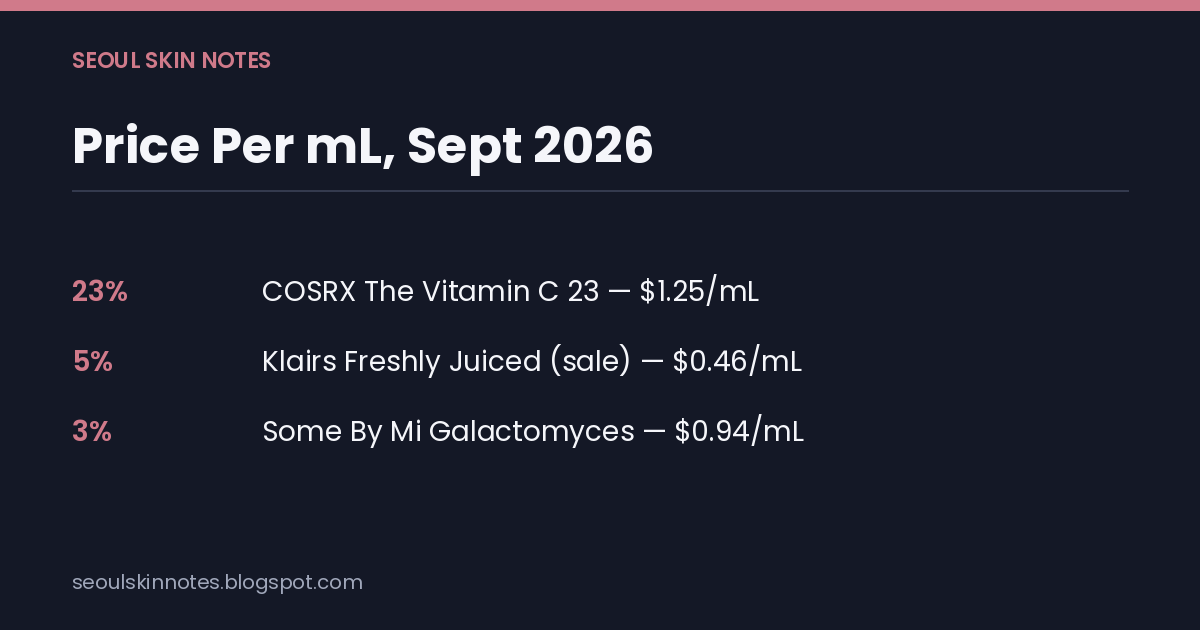
| Serum | Ascorbic acid % | Price (as of Sept 7, 2026) | Price per mL |
|---|---|---|---|
| COSRX The Vitamin C 23 | 23% | $25.00 / 20mL | $1.25 |
| Some By Mi Galactomyces Vitamin C | 3% | $28.05 / 30mL | $0.94 |
| Klairs Freshly Juiced Vitamin Drop | 5% | $16.10 / 35mL (sale) | $0.46 |
The serum with the highest concentration is also the most expensive per milliliter, and the one with the lowest concentration is currently the cheapest. That's a coincidence of this exact snapshot, not a law of skincare pricing (none of these brands set prices by percentage), but it does mean COSRX buyers are paying a premium for both the strength and the sting risk, while Klairs' formula is priced like an easy, low-stakes way to test whether vitamin C even agrees with your skin before spending more on something stronger.
Which One to Reach For
If you've never used a vitamin C serum and don't know how your skin handles low pH, start with the Klairs bottle. It's the cheapest entry point right now, the concentration is low enough that a bad reaction is unlikely, and if it does nothing for you after a few weeks, you've lost $16, not $25.
If you've already been using a gentler vitamin C for a while and stopped seeing results, the COSRX jump to 23% is a real step up, not a marketing number. Patch-test it on your jaw first, because that concentration will tell you fast whether your skin can take it. Some By Mi is the odd one out here: it's marketed on vitamin C but its own first ingredient is Galactomyces Ferment Filtrate, so treat it as a fermented-brightening serum with a vitamin C assist, not a vitamin C serum with extras, and price it against that category instead.
One more thing worth knowing if you're layering: none of this changes how you should handle vitamin C next to retinol or a chemical exfoliant. A low, near-neutral-pH form like the sodium ascorbyl phosphate buried in the Klairs and Some By Mi formulas is far more forgiving to pair with an AM/PM routine that also includes actives, while a 23% pure ascorbic acid at low pH is the one you keep separate from your retinol night and save for mornings under sunscreen.

If you're deciding between the three tonight, the Klairs bottle is the one I'd point a first-timer to, not because it's the best formula on paper, but because it's the cheapest way to find out whether vitamin C even agrees with your skin before you risk a $25 bottle on the 23%. Whichever one you pick, open the brand's own ingredient list before you check out. The number on the front is a start, not the whole answer.
This is a running news series, not a one-off post — new stories go up twice a day, roughly 7am and 7pm Korea time.
More Korea coverage from our network: Hallyu Now · Korea Travel Planner · K-Sports Global · Korean Table


Comments
Post a Comment